Shape
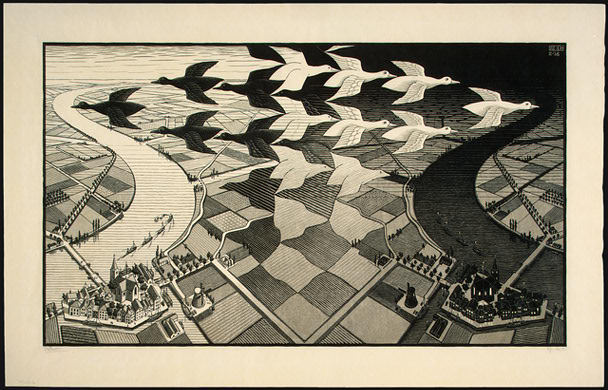
"Day and Night" M. C. Escher (1938)
Shape is about many things. Our visual cortex evolved to
recognize and identify shapes as they relate to us. We are adept (define)
at separating an image of an object from its surroundings, the figure from
the ground. Artists often refer to image areas that belong to the object
as "positive", areas that reveal the surroundings are called "negative."
The students must realize that these terms, positive and negative, are
not value judgements. "Negative" areas are just as important and "good"
as "positive" ones. Compositionally, both are important. The human visual
system may be "hard wired" to distinguish figure from ground. At least
this is a hypothesis (define)
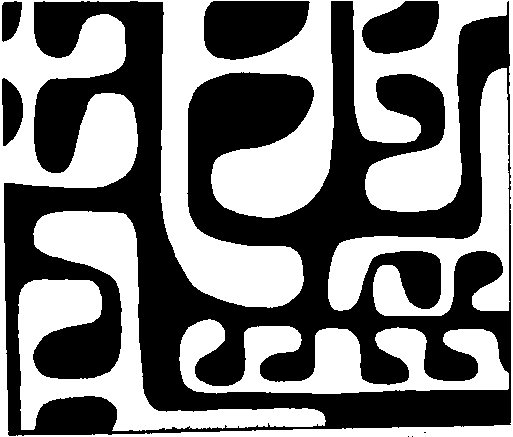
for the constantly reversing of perception of figure/ground relationship
in images (see below) whose positive and negative areas are perfectly balanced.
 This
is a Rubin
figure, named after the twentieth century psychologist who made a face/vase
illusion famous.
This
is a Rubin
figure, named after the twentieth century psychologist who made a face/vase
illusion famous.
Make a pattern in which the positive and negative areas are perfectly
balanced.
For a good introduction to perception and lots of illusions go to IllusionWorks.