|
Influenceby Kayci Pineda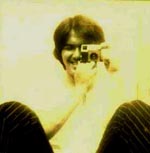 Photographs are the easiest way to keep our most treasured memories. They are the easiest to keep, retrieve and the bestest instrument to to help reminisce over the past. Why? Simply because photographs are not as precise as the memories kept in our minds. Though humans are addressed as the most complex being on earth because of our capability to remember how to do things in a correct manner, we tend to forget things whenever we decide to "discard" a certain memory that we ought not to remember for the longest time. And it is often a task when we try to remember something from the (distant) past, that oftentimes certain details of that memory is not complete. So I might as well say that photographs are the bestest aid to help a person remember of the time he/she was in, whether tha memory is good or bad.
Since I was a child I grew fond of pictures--photographs of our annual family reunion, someone's birthday and even someone's death. Those memories are well-kept in an album, and as my mom puts it, those albums serve as a mark of our existence in this world, and that those events are enough evidence that we are humans capable of experiencing such joys, sorrow, achievements and defeat. Photographs document how we came into this world, how we experience life's hardships as well as how we coped with it; and how some people influenced our lives. That is why for me, a camera is a must-have for every family, to help leave a mark in this world aside from the wisdom shared with other people.
Pictures are an art form. It is up to the photographer how he/she would use a box with several mirrors, windows and buttons called camera. I grew up seeing my father's camera bought after he came home from Saudi, and as we Filipinos put it as "katas ng Saudi". At first I find it weird for someone to carry that huge of a camera. It is a single-lens reflex camera, and for a child like me, it is so embarrasing for me to lug around such object.
My dad loves taking pictures. Back in college he was a member of UST's Camera Club. But because he was from a poor family who was able to study college in UST through athletic scholarship, he cannot afford to buy an SLR camera. Instead he borrows camera from orgmates and take pictures of every nook and cranny of the university. Until he became a full-fledged architect, his love for photography never ceased, as he swore that he will buy his own camera as soon as he comes home from Saudi. Photographs are the easiest way to keep our most treasured memories. They are the easiest to keep, retrieve and the bestest instrument to to help reminisce over the past. Why? Simply because photographs are not as precise as the memories kept in our minds. Though humans are addressed as the most complex being on earth because of our capability to remember how to do things in a correct manner, we tend to forget things whenever we decide to "discard" a certain memory that we ought not to remember for the longest time. And it is often a task when we try to remember something from the (distant) past, that oftentimes certain details of that memory is not complete. So I might as well say that photographs are the bestest aid to help a person remember of the time he/she was in, whether tha memory is good or bad.
Since I was a child I grew fond of pictures--photographs of our annual family reunion, someone's birthday and even someone's death. Those memories are well-kept in an album, and as my mom puts it, those albums serve as a mark of our existence in this world, and that those events are enough evidence that we are humans capable of experiencing such joys, sorrow, achievements and defeat. Photographs document how we came into this world, how we experience life's hardships as well as how we coped with it; and how some people influenced our lives. That is why for me, a camera is a must-have for every family, to help leave a mark in this world aside from the wisdom shared with other people.
Pictures are an art form. It is up to the photographer how he/she would use a box with several mirrors, windows and buttons called camera. I grew up seeing my father's camera bought after he came home from Saudi, and as we Filipinos put it as "katas ng Saudi". At first I find it weird for someone to carry that huge of a camera. It is a single-lens reflex camera, and for a child like me, it is so embarrasing for me to lug around such object.
My dad loves taking pictures. Back in college he was a member of UST's Camera Club. But because he was from a poor family who was able to study college in UST through athletic scholarship, he cannot afford to buy an SLR camera. Instead he borrows camera from orgmates and take pictures of every nook and cranny of the university. Until he became a full-fledged architect, his love for photography never ceased, as he swore that he will buy his own camera as soon as he comes home from Saudi.
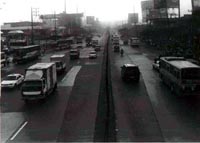
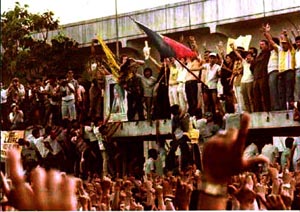 When he bought the camera two years before I was born, he took pictures of my older siblings, relatives, even the EDSA Revolution in 1986 and the infamous coup d'etat that killed Sgt. E. Esguerra in Quezon City was captured on camera. He was no photojournalist, but he took those pictures to keep as memories, and as an evidence that he was there and lived during that era.
I was born 1987 and as my mom and sister puts it, I have the most pictures among us three children. My older siblings do have their baby pictures, but not as many--and sharp as the baby pitures I have. From birth to my baptism, up to my graduation in pre-school, grade school and high school, those highest point of my life were well-documented by my doting father.
Well, it wasn't only I whom dad took pictures on. An an architect he took pictures of the site he was working on. He collates it to create his portfolio to show prospective clients. During the peak of his career, pictures of scattered planks of wood, excavated land and scaffoldings were all over the house, even under the beddings. Whenever he traveled he took pictures of astonishing structures where he would get inspiration for his future projects. When he bought the camera two years before I was born, he took pictures of my older siblings, relatives, even the EDSA Revolution in 1986 and the infamous coup d'etat that killed Sgt. E. Esguerra in Quezon City was captured on camera. He was no photojournalist, but he took those pictures to keep as memories, and as an evidence that he was there and lived during that era.
I was born 1987 and as my mom and sister puts it, I have the most pictures among us three children. My older siblings do have their baby pictures, but not as many--and sharp as the baby pitures I have. From birth to my baptism, up to my graduation in pre-school, grade school and high school, those highest point of my life were well-documented by my doting father.
Well, it wasn't only I whom dad took pictures on. An an architect he took pictures of the site he was working on. He collates it to create his portfolio to show prospective clients. During the peak of his career, pictures of scattered planks of wood, excavated land and scaffoldings were all over the house, even under the beddings. Whenever he traveled he took pictures of astonishing structures where he would get inspiration for his future projects.
 It was only before I entered college when I tried experimenting on my dad's then 20-year-old camera. He had taught me several techniques to shoot pictures, as well as the correct handling of the loose parts. But as my dad's trusted camera started to die on me, the new technology of digital cameras became famous, as cameras that are supposed to be half-pound heavy could be as small and lightweight as a piece of bath soap. It also lessens the hassle of over, under or accidentally exposing the film, as well as the added cost to send a roll of film to a commercial processor. Digital cameras were easier to use, and gives a lot of unlimited shots that a regular film with maximum exposure of 36 can give. Plus, images taken with digital cameras are easily kept and saved that gives you enough freedom to take more pictures.Having been able to take FOTOCAM in college, there are a lot of things I have learned. Those that I have learned were the Sunny Rule of Thumb that, in case a camera malfunctions, the exposure of the roll of film will work as well under sunlight with distinct shadow given several techniques to adjust the camera's aperture size and shutter speed. I also learned how to reel, process and print my images myself, without the help of any commercial person. I share everything that I have learned in photography to my dad, because it is my way of gratitude to him for teaching me how photographs create a big impact onto everybody's life. It was only before I entered college when I tried experimenting on my dad's then 20-year-old camera. He had taught me several techniques to shoot pictures, as well as the correct handling of the loose parts. But as my dad's trusted camera started to die on me, the new technology of digital cameras became famous, as cameras that are supposed to be half-pound heavy could be as small and lightweight as a piece of bath soap. It also lessens the hassle of over, under or accidentally exposing the film, as well as the added cost to send a roll of film to a commercial processor. Digital cameras were easier to use, and gives a lot of unlimited shots that a regular film with maximum exposure of 36 can give. Plus, images taken with digital cameras are easily kept and saved that gives you enough freedom to take more pictures.Having been able to take FOTOCAM in college, there are a lot of things I have learned. Those that I have learned were the Sunny Rule of Thumb that, in case a camera malfunctions, the exposure of the roll of film will work as well under sunlight with distinct shadow given several techniques to adjust the camera's aperture size and shutter speed. I also learned how to reel, process and print my images myself, without the help of any commercial person. I share everything that I have learned in photography to my dad, because it is my way of gratitude to him for teaching me how photographs create a big impact onto everybody's life.
 I now realize that photography is not only a way of documenting one's life, but it is an art that when you do not put passion into it, you would not know the deeper meaning of every moment taken. Photography also made me aware that memories are sweet whenever remembered by heart, but it is much more sweeter when a moment is captured in a piece of paper--that when you see it, you can't avoid different feelings coming back, and you will be able to remember more memories other than that.
Thanks to dad, if he did not buy that piece of black box I would not be here. I now realize that photography is not only a way of documenting one's life, but it is an art that when you do not put passion into it, you would not know the deeper meaning of every moment taken. Photography also made me aware that memories are sweet whenever remembered by heart, but it is much more sweeter when a moment is captured in a piece of paper--that when you see it, you can't avoid different feelings coming back, and you will be able to remember more memories other than that.
Thanks to dad, if he did not buy that piece of black box I would not be here.
|
|