 I have always been fascinated by distortions in our everyday surroundings --- distortions that not only violate the proper order of things but also add an exciting element to the norms and folkways of the Filipino culture. It is undeniable that the modern-day Filipino has acquired a zest for living on the edge: people walking along a street with a �no jaywalking� sign, pedestrians urinating on walls even if it is strictly prohibited, civilians� continuous disregard for warnings, etc. Though we are all aware that these actions connote a bad reputation, even if such are unintentional, one can't help but wonder why people do it again and again.
For this photo essay, my goal was to present these distortions in their rawest form (and what better way to showcase these than on the streets). The idea was to shoot striking images that feature this interesting concept --- capture these events in their most spontaneous, on-the-spot moment to make people conscious of their actions, especially in public settings. Awareness that these ironies continue to exist would be a stepping-stone for people to realize what needs to be straightened out. With the photos I have taken, it is not my intention to expose and criticize the flaws of our culture. It is more of pointing out these scenarios so that we can take the necessary corrective action.
 Armed with an ISO 100 film, an SLR camera and a tripod, I trooped to the streets of Malate and Las Pi�as expecting for such distorted events to rarely take place. And though I soon found out otherwise, it is sad to know that these events are still rampant wherever you go in the metro. I was soon overwhelmed by the bulk of pictures I could take with this theme. One minute there would be a parked car in front of an establishment's driveway, the next there would be jeepneys unloading passengers in the middle of an intersection. With each snapshot, I was amazed, not by the violations per se, but by how we, as Filipinos, continually push our limits and boundaries, going against the standards and norms imposed by the society, even if what we are doing isn�t necessarily proper or acceptable. So much for 'living on the edge'.
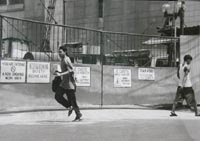
I'd like to believe that some of the images I captured speak volumes on these paradoxical events --- from the most minute distortion to the most evident ironies. One of my favorites would be the picture I took near Robinson's Place - Malate. I was at the right place at the right time. It was a little after noon and I was getting ready to wrap up my photo shoot and return to DLSU. It just so happened that as I was making my way to Taft Avenue, I came across a construction site with a gate boasting several warning signs. Though exhausted and with no more than 15 shots left from my roll of film, I set up my camera and tripod amidst all the pedestrians passing by and waited for the perfect picture. Out of nowhere, there were two guys, one walking, the other rushing to the opposite direction. It was a sudden reflex when I pressed the shutter. I had no idea if I had made a good composition until much later when I had it developed and printed. I love that particular picture among all those included in my portfolio. The irony in the image is uncanny.
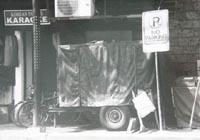
Another picture I like is the very first one I took. I had just arrived in Malate and was looking for a perfect spot to rest for a bit. There was a cafe in the area with an interesting ambience. Little did I know, right across the street was a distorted yet humorous photo composition waiting to be taken. After awhile, I took notice of it and began clicking away. I must have taken 5 shots of it, but I find the one in my portfolio as the most appealing. Having a cart-like structure with vehicular wheels and mountain bikes positioned beside a 'no parking' sign makes for an interestingly comical photograph.
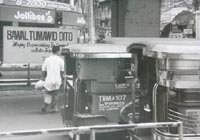 I also took pictures along Taft Avenue, particularly near Vito Cruz. Even before I started shooting, I had kept my eye on the Bawal Tumawid Dito sign in front of the Torre Lorenzo Condominiums. Somehow, I had already predicted that the said composition would take most of my time. I was right. I found myself crouching in front of my tripod and camera for almost an hour, waiting for the perfect picture. I had taken several snapshots of people explicitly violating the street sign but I wasn't satisfied. Until one man unboarded a jeepney and crossed the street right in front of the sign's bold red letters. I had clicked on impulse and I remember hoping that I did not overexpose the film. When I had the photo printed, my brother, a former photojournalist, said that there was much clutter within the frame (meaning there are a lot of elements that need not be included in the composition). But personally, I think it adds to its appeal. It enhances to the sharpness of the photo's message.
Overall, I had decided to include twelve photos in my portfolio. Personally, I feel like those twelve images will get my point across to those who would look at them. In relation to the negative dimension of my theme, I had intentionally over-developed and blurred some of my pictures, to add some noise and establish a 'dark aura'. I do not wish to shock people with the technique I used on my photos. What I am trying to do is make them familiar with each scene --- make them realize that these ironic events take place on the streets every single day.
With each click of the shutter, each subject I shoot and each setting I find myself in, I feel like I have grown mutually in thought and perception. I have definitely learned a lot of things after seeing the world through the lens of my camera. As for my insights on the output of my theme, it is one thing to consistently push the envelope and go against the norm, but it is another to uphold one's ethics and moral standards. Though I know that my portfolio cannot bring about change overnight, at least I have exposed these scenarios and have initiated awareness to those who would look at them.
