 My first real camera was a Creative Card Camera, which was digital and point-and-shoot. Being new to taking photography seriously, I had great trust in digital photography and secretly laughed at huge signs posted on photo shops screaming �FREE ONE ROLL OF FILM FOR EVERY 10 PRINTS!� I knew that traditional photography would soon die down. However, my fickle-minded self was immediately tugged back from fanaticism over digital photography and pushed to at least having an open mind to choose between a roll of film and a memory card after my college Photography class.
Initially, it seemed to me that Black and White photography is already �ancient�. Not only do we go back to the days when the words �color� and �photography� were not used in the same sentence, but we are also required to use an analog camera. The words �mega pixels�, �USB�, �saturation� do not exactly apply to the topic. I did not really enjoy non-color photography basically because I was (and still am) a huge fan of Lomography. I used to love only greatly saturated photographs.
However, the amazing thing about monochrome photography is that every shoot remains to be a challenge. The world is full of color and it seems every time one composes a photograph with Black & White film, there is a need to disregard that fact. Due to this limitation, one is able to focus more on the subject and on the other aspects of composing a photograph besides, of course, color scheme. And because there is the lack of color, one must also consider during framing that hues between black and white will appear relatively similar, therefore one must find ways on how to make objects of these colors stand out. But still, the lack and the presence of color in a photograph may immediately modify the �feel� an image exudes. Black and White photographs, specifically portraits, give off the natural feel of classiness most of the time. On the other hand, the sight of blood red in a picture may present gore.
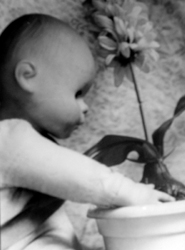 In this day and age, through digital manipulation, a color photograph can immediately be turned into a �grayscale� (a term for Black and White images usually used in imaging software and printing) image and at times, even vice versa. Note that this is when the digital format is used. For film, manipulations are done manually and most of the time during the printing process done inside the darkroom. My portfolio of silver gelatin prints focuses on surrealism and my main concept centers on playing, whether through the shot composition, which may be seen on how I chose my subjects, or through manipulations in printing. The idea of �playing� with the whole process of photographing came when a friend suggested the topic f surrealism. Unfortunately, Surrealism was too broad for me to cover so I ended up thinking of the core of the art movement and my thoughts led me to how artists of the DADA movement played with almost anything and not meaning anything (however research shows that Luis Bu�uel�s Un Chien Andalou was a protest against the film industry of their time and a boost towards the movement�s desire to uplift Avant-Garde art despite its lack of sense). At first, it was quite difficult to search for the �unusual�, considering that the view of the word actually differs from person to person. Initially, I decided that the portfolio would contain a lot of random shapes and gibberish language to emphasize the feel that one is playing and not really making sense. I also had to research on the Surrealist art movement. I discovered Salvador Dali�s art and his series of self-portraits (the one that had him posing with his facial hair all raised up, as if puttied). Dali basically inspired me to do one photograph that had my friend with a moustache mask as the subject. Some modern Surrealist photographs also had dolls and distorted faces as subjects. However due to limited time, I stuck with the dolls and did not attempt to shoot anything distorted since I had no idea on where to find them, anyway. Instead of faces, I attempted to take on nude photography by taking a picture of a woman�s breasts. Ironically, I did not have difficulty in looking for a subject willing to pose half-naked. To make the photographs look more interesting, I made manipulations during the printing process (most of which were done right under the photo
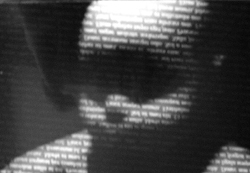 enlarger). I had a series of photographs of a friend who posed in a different position and angle in each shot and had the camera steady all throughout the shoot. I had each negative of the series cut and pieced together with duct tape and a small piece of clear acetate to give the illusion that the subject has multiplied, as if she was more than one. In one case, a �fortunate accident� occurred when I unintentionally placed a photograph of a building on top of the piece photo paper I was printing on (during the process of exposing the photo paper to light). The result was a superimposition � the building appeared on the face of my other photo�s subject. In another manip, I had a few words from the Lorem Ipsum generator (www.lipsum.com) printed on clear acetate and placed over some shots during exposure to do another trick of superimposing words onto the image. The reason as to why most of us feel that making decisions is difficult is that almost all choices have their share of pros and cons. This applies to our choices of Color and Black and White photography, and Traditional and Digital photography. Photography has been long loved by people all over the world and with technology; color has been an added feature to it. This basically makes Black and White photography not aa �lesser� art form but something we as artists can work around with with less -- not exactly to the extent that we feel �limited� in expressing what we feel or think. On the other aspect, manipulations can be done in photos through the traditional and the digital way. Digital manipulations may be easily done, but the traditional way of doing tricks under the enlarger is still more exciting despite the need for more effort (and materials). In this day and age, there may be trends and things may be more often done the �digital way�. However, the thing I am most thankful for is whether the process is of high technology or of the old days, we still have these selections to choose from.