HOME
ABOUT
COMPARISON:
...Deaths
...Addictiveness
...Health
...Crime
...Number of users
BACKGROUND:
...UN
...Misuse
Drugs Act:
......'drugs' definition
......'misuse' definition
......medicinal use, stress
...ACMD
...Risky activities
...Police discretion
...CPS discretion
...Jury rights & duty
...Human rights
...Health policy
...Education policy
...Trade policy
...Modernisation
...Prohibition
......Convictions
...Civil disobedience
...Concerns
.......Gateway
.......Driving
.......Increased usage
...Prejudice
...Political parties
NORTH
WALES
ACTION:
...Leaflets
...Letters published
...Letters guide
...Letters templates
...Letters to MPs etc
|
For
advert-free site
go to www.palad.org.uk
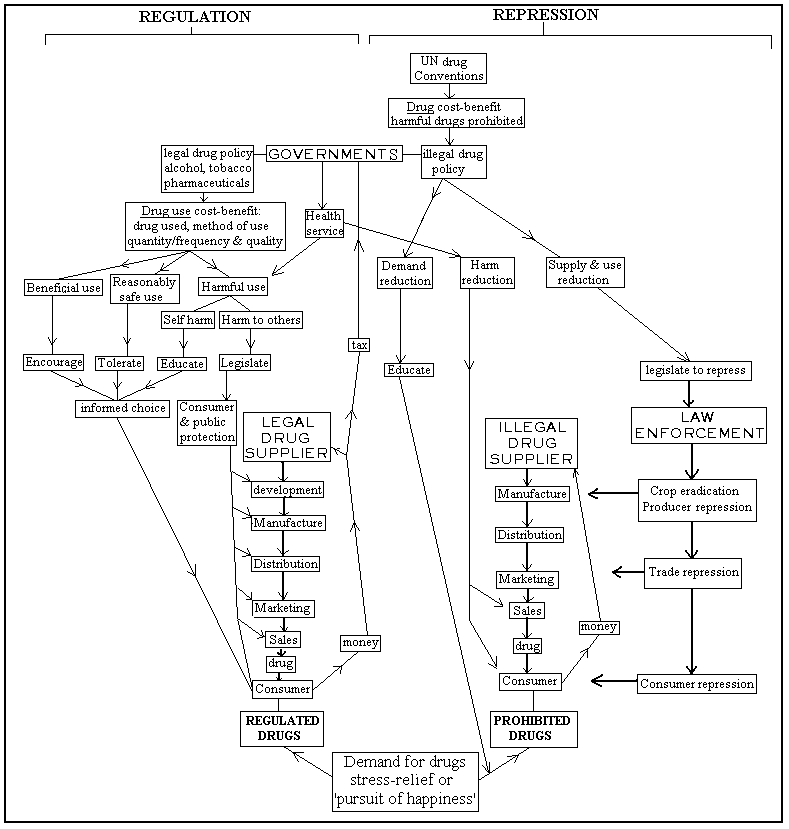
1. A system model of drug
policy/control is needed:
- to show the simplest overview
of all essential processes within the drug
control system, connecting all policy areas
together into an integrated system, allowing
a 'whole system' view. This model would
outline the relationships between health,
law, education and economics and link them
with human rights and the responsibilities of
authorities.
- to show that UN drug
Conventions divide drug control policy into 2
very different systems, one based on
regulation, the other on repression.
- to compare the costs and
benefits of regulation with those of
repression.
- to provide prohibitionists and
reformers with common ground upon which
debate can be based.
- to show how organisations
could cooperate to form networks by defining
their roles within the system.
- to show prohibitionists that
legalisation should not be feared as an
unknown because it is a tried and tested
system that has proven to be more effective
than prohibition.
2. A model of current drug
control comparing legal drug regulation with illegal
drug repression
- UN drug Conventions prohibit
the production, supply and use of
non-medicinal drugs that are harmful. The
Conventions are intended to result in harm
reduction.
- The Conventions impose a
global illegal drug policy on national
governments to ensure the prohibition of
international illegal drug supply.
- Regulation of legal drugs:
National governments implement their own
legal drug policies. A cost-benefit analysis
determines the type of government
intervention. Education is used to encourage
beneficial use (e.g. moderate alcohol
consumption), tolerate reasonably safe use
and discourage use harmful to the consumer.
Education policy encourages informed choice.
The cost-benefit analysis also identifies
use, supply and production harmful to others.
Legislation and law enforcement are used to
limit this. Legislation designed to prevent drug
production harmful to others can
include laws requiring a cost-benefit
analysis (e.g. clinical trials for
pharmaceutical drugs), quantity and quality
control, safe use instructions, side-effects
warnings, ingredients list and sell-by date.
Legislation designed to prevent drug
supply harmful to others can include
laws requiring marketing restrictions (e.g.
advertising) and sales restrictions (e.g.
sales outlets, sales to young people).
Legislation designed to prevent drug
use harmful to others includes laws
against drink-driving, passive smoking and
drug-related violence. Drug sales are taxed
providing sufficient income to cover all the
costs of drug education, regulation and law
enforcement as well as covering the costs of
health treatment for the harm caused by drug
use.
- Repression of illegal drugs:
Illegal drug policy aims to reduce harm by
repressing all production, supply and use
through legislation and law enforcement.
Education is used to discourage demand for
illegal drugs. Authorities cannot regulate
black market production, supply and use to
limit the harm they cause so there is no
possibility of quantity/quality control, of
marketing or sales control, or of taxing the
trade to pay for social costs. Considerable
amounts of money are spent attempting to
repress illegal drugs but the black market
has continued to expand. Harm reduction
policies are slowly being introduced by some
authorities, usually through health and
education services, to limit the harm caused
by illegal drug production, supply and use
(e.g. quantity/quality control, safe use
instructions, needle exchanges). Other
authorities are reluctant to implement such
harm reduction policies for fear they will
encourage illegal drug use.
3. Criticisms of the current
divided drug control system:
- UN drug Conventions fail to
define 'drug', 'harm' and 'non-medicinal
use'. 'DRUG': They fail to provide any
evidence that illegal drug use is more
harmful than legal drug use (alcohol and
tobacco). The Conventions fail to undertake a
cost-benefit analysis of all non-medicinal
drug use. They prohibit the illegal drugs
before any scientific judgement. This
pre-judgement, or prejudice, results in the
prohibition of those drugs not traditionally
used in the West while permitting traditional
drugs equally, or more, harmful. As with all
unjust discrimination 'different from
traditional' is equated with 'bad' and 'same
as traditional' is equated with 'good'.
Recent scientific evidence suggests that
safer alternatives to legal drugs have been
prohibited suggesting that the legal
regulation of illegal drugs may be a harm
reduction policy. For example evidence
indicates that cannabis is a safer
relaxant/intoxicant than alcohol in terms of
risk of addiction, overdose, accident and
violence. The Conventions encourage the use
of more harmful drugs by prohibiting safer
alternatives. This inconsistency leads
people, especially the young, to disrespect
the law and the authorities. 'HARM': The
Conventions also fail to distinguish harm to
the consumer from harm to others. They fail
to recognise that citizens have greater
rights to risk harming themselves than to
risk harming others. 'NON-MEDICINAL USE': The
Conventions fail to consider evidence
suggesting that all non-medicinal drugs are
mostly misused by those suffering from stress
- work-related stress or stress from poverty
and social exclusion. Untreated stress may
cause more harm than the use of so-called
non-medicinal drugs for self-medication. The
Conventions fail to recognise the human right
to self-medicate for stress. They also deny
another unalienable human right, the 'pursuit
of happiness' - so long as that pursuit does
not harm others.
- UN Conventions cannot develop
and adapt as better evidence of drug harm
emerges because a single nation may veto any
change. As a result national governments are
prevented from exploring alternative modern
evidence-based policies designed to optimise
harm reduction, cost effectiveness and
informed choice.
- Legal drug policies target
actual harm both to consumer and to others
rather than trying to prevent beneficial use
and reasonably safe use - they focus
resources where they are needed and do not
waste them where they are not needed.
Self-harm is not criminalised, only harm to
others. Citizens may risk self-harm not only
from legal drugs but also from food misuse
(obesity) and recreational activities (e.g.
sports accidents). Production and supply
regulations ensure that drugs are as safe as
possible. Legal drug policy recognises the
right of consumers to informed choice and the
right of producers and suppliers to meet
consumer demand. Regulation also allows the
drug trade to be taxed to pay for the social
costs, making no demands on non-drug using
tax-payers.
- Illegal drug policies: HUMAN
RIGHTS: There is repression of the rights of
consumers to use the illegal drugs
beneficially or reasonably safely. There is
no recognition that citizens have greater
rights to risk harming themselves than to
risk harming others. The prejudice and use of
law against illegal drugs leads to producers,
suppliers and consumers facing
discrimination, social exclusion,
persecution, prosecution, punishment,
imprisonment, even death. DEMOCRATIC RIGHTS:
tax-payers' money is not used
cost-effectively. There has been little
involvement of citizens in policy making.
Democratic mechanisms within the justice
system have been disabled primarily by
failure to inform juries of their right -
indeed legal duty - to judge whether or not
the law is just. TRADE RIGHTS: Producer
nations are denied the right to sustainably
exploit their natural resources and provide
their subsistence farmers with a livelihood.
Suppliers are denied fair trade rights and
consumers are denied consumer rights
(informed choice and consumer protection).
ENVIRONMENTAL RIGHTS: Crop eradication
programs cause environmental damage. HARM
INCREASING: There are no regulatory
safeguards for production and supply making
illegal drug use more harmful than if legally
regulated (see 2.3 above). Health and
education authorities wishing to implement
harm reduction policies to compensate for the
lack of regulatory safeguards are severely
hampered by the prohibition policy of
governments. ECONOMIC WASTE and FUNDING
CRIME: The reliance of illegal drug policy on
law enforcement is expensive but ineffective.
No income is possible from taxing the trade
to cover social costs so all profits go to
organised crime while the additional law
enforcement costs of prohibition are wasted
through lack of focus on actual harm.
4. Conclusions and
recommendations:
- Prohibition is not a cost
effective form of regulation. It ignores a
major source of income (tax) and requires
large additional expenditure (law enforcement
costs).
- Prohibition causes more harm
than it prevents. It makes drug production,
supply and use more harmful (no regulatory
safeguards), harms the environment and the
rights of producers, suppliers and consumers.
- Regulations for controlling
drugs, whether medicinal or non-medicinal,
should target the specific risks of harm at
each stage of production, supply and use.
Repression of a natural instinct and human
right is unjust and unsustainable. Harm
reduction strategies aim to fill the void
left by lack of regulation: testing
quality/quantity of illegal drugs, supplying
consumers with safe use instructions and the
means of following those instructions (e.g.
needle exchange programs).
- Regulatory frameworks for
potentially harmful activities should be
reviewed to extract the 'best practise' from
each framework. This integrated framework
should then be adapted to each potentially
harmful activity.
Using
the drug control system model to guide integration of
organisations into networks
First
principles - Rights of Individuals and
Responsibilities of Authorities
|