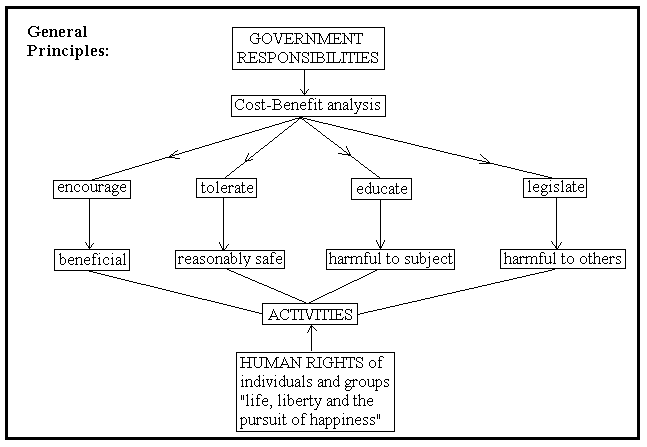
When is it justifiable for Governments (national
and global) to intervene in the affairs of
individuals and groups (e.g. consumers and businesses)?
Summary:
- Natural instincts for "life, liberty and
the pursuit of happiness" lead to "unalienable"
human rights;
- Government intervention in the exercise of
human rights by both individuals (e.g. drug
users) and groups (e.g. drug suppliers)
should be restricted to preventing harm to
others through regulation and law, preventing
self-harm through education and encouraging
beneficial behaviour. Reasonably safe
behaviour, neither beneficial nor
particularly harmful, requires no
intervention.
- A cost-benefit analysis guides the
definitions of beneficial behaviour,
reasonably safe behaviour, behaviour harmful
to the subject and behaviour harmful to
others.
Background:
1. "We hold these truths to be self-evident:
that all men [or people] are created equal;
that they are endowed by their Creator [or Nature]
with certain unalienable rights;
that amongst these are life, liberty and the
pursuit of happiness".
Declaration of Independence, USA.
BUT what if the exercise of our "unalienable"
rights leads us to infringe the rights of others, to
harm them even? Authorities have the responsibility
to exercise power on behalf of citizens to regulate
society, to prevent harm to others.
2. "the only purpose for which power can be
rightfully exercised over any member of a civilized
community, against his will, is to prevent harm to
others. His own good, either physical or moral, is
not a sufficient warrant. He cannot rightfully be
compelled to do or forbear because it will be better
for him to do so, because it will make him happier,
because, in the opinions of others, to do so would be
wise, or even right. These are good reasons for
remonstrating with him, or reasoning with him, or
persuading him, or entreating him, but not for
compelling him, or visiting him with any evil, in
case he do otherwise. To justify that, the conduct
from which it is desired to deter him must be
calculated to produce evil to some one else. The only
part of the conduct of any one, for which he is
amenable to society, is that which concerns others.
In the part which merely concerns himself, his
independence is, of right, absolute. Over himself,
over his own body and mind, the individual is
sovereign". On Liberty, John Stuart Mill
(1859)