Opening of the film 'Reefer Madness' (1936)
Directed by Louis Gasnier:
"The Motion Picture you are about to witness may
startle you. It would not have been possible,
otherwise, to sufficiently emphasise the frightful
toll of the new drug menace which is destroying the
youth of America in alarmingly increasing numbers.
Marihuana is that drug. A violent narcotic -- an
unspeakable scourge -- The Real Public Enemy Number
One!
Its first effect is sudden, violent, uncontrollable
laughter; then come dangerous hallucinations -- space
expands -- time slows down, almost stands still…
fixed ideas come next, conjuring up monstrous
extravagances, the total inability to direct
thoughts, the loss of all power to resist physical
emotions… leading finally to acts of shocking
violence… ending in often incurable insanity.
In picturing its soul-destroying effects, no attempt
was made to equivocate. The scenes and incidents,
which are fictionalised, are based upon actual
research into the results of Marihuana addiction.
If their stark reality will make you think, will make
you aware that something must be done to wipe out
this ghastly menace, then this picture will not have
failed in its purpose. Because the dread Marihuana
may be reaching forth for your son or daughter…
or yours…OR YOURS!"
www.dead-projectionist.com/reviewDetail.asp?ID=199
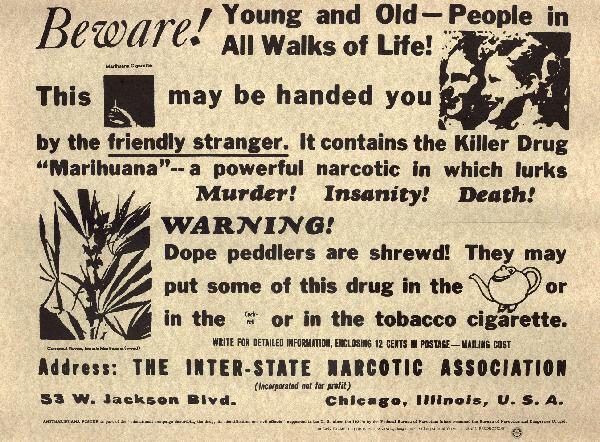
A poster from that era's propaganda is here
"Reefer makes darkies think they're as good as
white men."
Federal Bureau of Narcotics Chief Harry J. Anslinger,
1929
“Users of marijuana become
stimulated as they inhale the drug and are likely to
do anything. Most crimes of violence in this section,
especially in country districts, are laid to users of
the drug.”
New York Times - Sep.16, 1934
“Marihuana is “a more
dangerous drug than heroin or cocaine.”
Authority for this statement is United States
Commissioner of Narcotics H. J. Anslinger. . . . the
drug is adhering to its Old World traditions of
murder, assault, rape, physical demoralization, and
mental breakdown.”
Scientific American - May 1938
"Marihuana influences Negroes
to look at white people in the eye, step on white
men's shadows and look at a white woman twice."
Hearst newspapers nationwide, 1935
"Permanent brain damage is one
of the inevitable results of the use of marijuana."
Ronald Reagan 1974
"Marijuana leads to
homosexuality ... and therefore to AIDS."
White House Drug Czar Carlton Turner 1986
Current prejudice:
A UK registered charity, The
National Drug Prevention Alliance says on their
website:
"It [cannabis] causes permanent brain damage,
even from 1 joint every other day".
"What about the use of cannabis as a medicine ?
This is a 'scam' by the legalisers 'to give pot a
good name' (their words, not ours!). Every relevant
American health authority has rejected it, for
example in relation to MS, cancer, glaucoma, AIDS etc".
www.drugprevent.demon.co.uk/mainpage.html
Susan Greenfield, a leading neuroscientist,
2002:
"Another notion is that cannabis
is less harmful than cigarettes. I'm not sure how
this idea came about, certainly not as the results of
any scientific papers."
"Moreover, there appears to be a severe
impairment in attention span and cognitive
performance in regular cannabis users, even after the
habit has been relinquished. All these observations
testify to a strong, long-lasting action on the brain.
Some attempts have been made in laboratories to work
out what cannabis could actually be doing to brain
cells. So far, some data have suggested that there
can be damage to neurons, and at doses comparable to
those taken on the street.
Comment: The World Health Organisation's report
'Cannabis: a health perspective and research agenda'
states: "The weight of the available evidence
suggests that even the long term heavy use of
cannabis does not produce any severe or grossly
debilitating impairment of cognitive function. If it
did research to date should have detected it".
www.observer.co.uk/comment/story/0,6903,776394,00.html
The World Health Organisation's
report 'Cannabis: a health perspective and research
agenda':
"A suspicion that chronic heavy cannabis
use may cause gross structural brain damage was
provoked by a single poorly controlled study using an
outmoded method of investigation which reported that
cannabis users had enlarged cerebral ventricles (Campbell
et al, 1971). This finding was widely and
uncritically publicised. Since then a number of
better controlled studies using more sophisticated
methods of investigation have consistently failed to
demonstrate evidence of structural change in the
brains of heavy, long term cannabis users (e.g. Co et
al, 1977; Kuehnle et al, 1977)."
www.druglibrary.org/schaffer/hemp/general/who-probable.htm
Action on Smoking and Health (ASH):
"A study often quoted as evidence of the
harmfulness of cannabis (Wu et al - http://content.nejm.org/cgi/content/abstract/318/6/347)
compared toxin exposure from cigarettes and cannabis
– however, the subjects had on average a history
of smoking 29.9 tobacco cigarettes per day and 16.5
cannabis cigarettes per week (13 times difference)."
www.ash.org.uk/html/regulation/html/cannabis.html
Government reply to Police
Foundation's 'Runciman Report' on The Misuse of Drugs
Act:
"11. The Government agrees with the Police
Foundation's conclusion that the main classification
criteria [within The Misuse of Drugs Act] should
continue to be that of dangerousness..."
www.parliament.the-stationery-office.co.uk/pa/cm200001/cmselect/cmhaff/226/22604.htm