
PAANI MORCHA
Previous | Home | Contents | Next

The Looming Water Crisis
Bucket-Chain Irrigation and Power Plants
Topics
Introduction
Virgin Flows
The Meaning
Macaulayan Mindset
Recharge Ground Water
Alternative Schemes
Irrigation *
De-forestation and Revival of Rivers
Population and Water Pollution
Reliving Our Mistakes
Inter-Basin Transfers
Conclusion
Top
Table of Contents
|
In earlier days, when the water table was high, wide wells had 'ashta-chakras', or bucket chain arrangements with wooden gears driven by bullocks circumambulating them, which gave farmers ample water for irrigation cheaply, as part of a beautiful system of cattle husbandry. Today this art is lost. Where the water table was deeper, small check-percolation dams diverted rain waters to irrigation tanks. 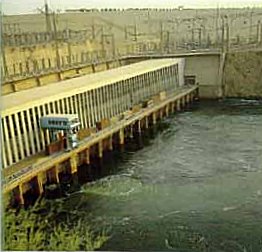 What Dams can do! |
 Forests were preserved and rivers flowed fulsomely, keeping ground water amply recharged by its rich resource. People in close touch with nature rejoiced in its bountifulness and lived contentedly with its plentiful produce that came from fields irrigated without artificial power. In times when wars or terrorism target power plants of a country, is it not safer to have a system such as this that provides immunity to food production from such inimical acts of possible adversaries?
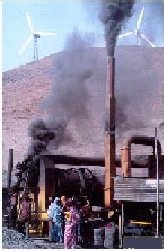
In ay case power plants consume valuable resources, and their effluents pollute the environment. Thus systems of irrigation that do not require artificial power sources, release such power for other requirements and are much safer, cleaner and being locally managed, are more cost-effective. If effected through animal husbandry, as mentioned above, they are more pleasurable and are integrated with the Indian culture.
Forests were preserved and rivers flowed fulsomely, keeping ground water amply recharged by its rich resource. People in close touch with nature rejoiced in its bountifulness and lived contentedly with its plentiful produce that came from fields irrigated without artificial power. In times when wars or terrorism target power plants of a country, is it not safer to have a system such as this that provides immunity to food production from such inimical acts of possible adversaries?
In ay case power plants consume valuable resources, and their effluents pollute the environment. Thus systems of irrigation that do not require artificial power sources, release such power for other requirements and are much safer, cleaner and being locally managed, are more cost-effective. If effected through animal husbandry, as mentioned above, they are more pleasurable and are integrated with the Indian culture.