
PAANI MORCHA
Previous | Home | Contents | Next

The Looming Water Crisis
"Virgin Flows" and "Multipurpose" Development Plans
Topics
Introduction
Virgin Flows *
The Meaning
Macaulayan Mindset
Recharge Ground Water
Alternative Schemes
Irrigation
De-forestation and Revival of Rivers
Population and Water Pollution
Reliving Our Mistakes
Inter-Basin Transfers
Conclusion
Top
Table of Contents
|
Today, global warming is beginning to cause the glaciers to shrink, and is reducing the virgin flow of these rivers. Growing prosperity due to the techno-scientific-industrial revolution had led to the growth of population and a high consumption culture, resulting also in the growth of cities and congested slums. The growing water needs of these settlements has had to be met. The West went on to build dams and canals in the last century to harness rivers' resources, and the East, Russia, India and China, were soon to follow suit. Since independence India went on a dam, barrage and canal building spree that is unequaled in the world. Today nearly two thousand such schemes are in place or are being constructed. The diversion of waters through these schemes has greatly depleted the lean season flows of the affected rivers, and indeed turned some totally dry, which in turn has resulted in virtually no re-charge of the affected basins' ground water for some eight months of the lean seasons. This, in turn, has greatly depleted the important fresh water storages, namely the ground water resource. Growth of population has led to cutting down of forests, thereby also depleting the lean season flows of rivers, which has more adversely affected the peninsular rivers of India that have no glaciers to support them. 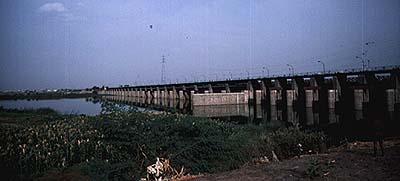
Yamuna River BarrageThe reduction in the discharge from glaciers and from the forested catchment areas of rivers has altered the calculated premises pertaining to the flow in rivers, on which the major and medium scale river valley projects were based. But despite this we continue to invest heavily in such schemes. And, whereas the West and Russia have understood the adverse effects of mega river valley projects, and have stopped constructing dams and barrages, India and China have continued relentlessly, without pausing to consider the extent to which the 'virgin flows' of rivers and streams have been reduced, and could have been safely milked for such projects. Specialists in India justify these so-called 'multi-purpose' development plans by stating that in the developed world, they have exploited their rivers to the fullest extent, and so there is no need for any more dams and barrages there, but since we have yet to do so, the necessity for our 'major' and 'medium' irrigation and power schemes still exists.. The crucial question is, "What is the bench-mark for deciding on what is this 'fullest extent' to which such exploitation of a stream's resources, could be permitted?" The answer lies, obviously, in the extent to which 'virgin flows' may be allowed to be depleted, without adversely affecting the basic water resources of rivers and their many uses for mankind. Nowhere in the United States or Europe are such flows reduced to zero, as is happening to many rivers in India.
The errors of the earlier colonial period, when canals were built to generate revenue for the imperial power, were to be compounded many times over during the last fifty years since our independence.
|
 The apparent success of the first major river valley scheme at