PAANI MORCHA
Previous | Home | Contents | Next

The Looming Water Crisis
Self-Inflicted Injury Through Destruction of Rivers
Sureshwar D. Sinha
Topics
Introduction *
Virgin Flows
The Meaning
Macaulayan Mindset
Recharge Ground Water
Alternative Schemes
Irrigation
De-forestation and Revival of Rivers
Population and Water Pollution
Reliving Our Mistakes
Inter-Basin Transfers
Conclusion
Top
Table of Contents
|
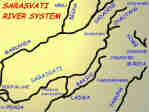
It is now becoming amply clear that the Sindhu-Saraswati basin was, if not the first, certainly amongst the earliest cradles of civilization evolved by human beings. An analysis of the archaeological finds of the lowest level excavations at Mehergarh in Pakistan, where the ruins are fortunately above the flood plains of the Indus [Sindhu], and are therefore well preserved, are also witness to the above pattern of civilizational development. Due to the tectonic movement of the South Asian plate, the Saraswati first shifted westwards, and later disappeared below the plate. This was the first reduction in the availability of water in this region, and archaeological evidence speaks of the mass migrations from the banks of the Saraswati to those of other rivers, as the basin of the former became a desert. The Ganga and the Yamuna were pushed eastwards due to the same tectonic phenomenon [even before the disappearance of the Saraswati], and continue their slow shift in that direction even in the current geological period. However, together the remaining glacier-fed rivers and the monsoons have continued to ensure that the Indo-Gangetic plains are amongst richest basins in the world from the point of view of water resources. Visitors to India since ancient times, amongst them the Greek Megasthenes, the Chinese Fa-Hien and the Arab scholar Al-Beruni, have testified that even when the monsoons failed, the wells of this basin did not dry up, and hence, the land was free from the scourge of famine. But the scene is changing due to other causes, amongst which is also mindless human interventions. 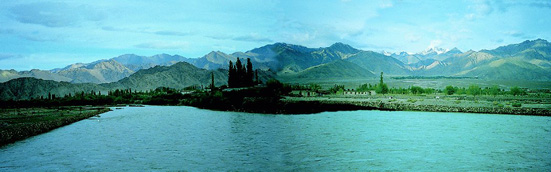
Origins of River YamunaThe above testimony of visitors, was indicative of the rich ground water resources, which were regularly re-charged by a dense system of aquifers and aquitards that safely stored the monsoon waters as well as the glacial flows and waters released from forests' roots for these rivers during the lean seasons. Though flood canals have been in vogue in India since the second millennium B.C., the first perennial canal, constructed on the Yamuna, was attempted by Feroze Tughlak, to be later completed by the Emperor Shah Jehan, who extended it to Delhi. It was only after this venture, that this basin was visited by its first recorded famine. The British were later to build canals on the Ganga and the Yamuna in the nineteenth century, which was followed by two of the worst famines of our recorded history. Whereas modern man was quick to harness this planet's surface water resources by diverting the waters of its rivers through perennial canals to areas of need, he failed to recognize the close relationship that exists between these waters and the huge ground water resources of these rich plains. |