|
|
|
|
|
|
|
|
||||||||||||||||||||||||||||||||||
|
|
||||||||||||||||||||||||||||||||||||||||
 |
 |
|
|||||||||||||||||||||||||||||||||||||||
 |
|
||||||||||||||||||||||||||||||||||||||||









Purpose
The Lay of Sir Launfal is a striking example of the Otherworld female’s role as temptress who takes men away from their own land and into the Otherworld. Their function in this tale centres around beauty and romance, whilst also taking on a more significant, symbolic role in Celtic mythology as bearers of the cup of kingship and the pathway to enlightenment.
Background
This particular lay was written by Marie de France, a French Abbess who probably wrote this French text between 1160 and 1175. As a particularly early example of Arthurian Romance, The Lay of Lanval has a structure more similar to that of Celtic texts than later texts.
Structure/story
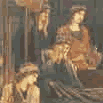
The eponymous hero in this particular lay is disliked at King Arthur’s court, so he goes on his travels and comes to a magical stream he cannot cross because his steed is too afraid. So instead, Sir Launfal goes to sleep at the side of the stream. He soon meets two beautiful Otherworld maidens, serene and beautifully attired, carrying a golden cup and a towel, who bring a message from their ‘lady’ who wishes to convene with Sir Launfal.
He goes back with them into the distant Otherworld and enters into their lady’s beautiful pavilion, to find a woman therein whose beauty is greater than none. She tells him, ‘I bring you my love’ and that she will supply him with bounteous gifts: abundant gold and rich clothing as well as her own company whenever he desires it, on condition he tells no-one of their allegiance. He agrees and, after making love and enjoying a sumptuous Otherworld meal, retires to the mortal world.
Sir Launfal holds a great feast for all the nobles and redeems
himself in the court’s eyes with his great wealth. One day the Queen
sends all her most beautiful maids out to the knights as they are convened
at the castle, and notices that Launfal is ignoring the ladies. He confesses
that he has a lady who is more beautiful even than Guinevere, even though
in so doing he loses his love. The Queen takes offence and goes crying
to the King. The King tells Launfal he must prove that he is telling the
truth or renounce his statement. Suddenly the two beautiful maidens from
before appear, and two more, and finally Launfal’s lady. Everyone
agrees that she is more beautiful than the Queen and she then takes Launfal
away across the sea into the sunset of the Otherworld. Note that there
is an explicit reference to this Otherworld as being called Avalon –
Avalon is a corruption of the Old Irish ‘Avlann’ which means
‘river’.
Points
As often seen in Celtic texts, we have the classic theme of water in connection to the Otherworld women, as the stream Launfal cannot cross is the transition to the Otherworld. Even at the close of the tale, Launfal is explicitly taken across water to reach Avalon.
Similarly, another idea from Celtic texts is that of Otherworld events occurring after the hero has fallen asleep, therefore causing some ambiguity as to whether or not the ensuing sequence of events are in fact a dream or reality, in this case the first meeting of Launfal with the messenger women after he has fallen asleep at the side of the stream.
Something you may notice is that I have not mentioned any particular
names of the women in this lay. There is a good reason for this: they
remain un-named by the author, but this does not mean they are insignificant,
far from it. In fact to me it merely indicates the crucially symbolic
nature of the women themselves. In novels and soap operas today, we experience
daily characters designed to let us into their psyche; in this tale, the
women’s significance lies in the roles they play rather than their
personal motivations and an intimate reader/character relationship.
Version Two
There is, however, also another version of this lay, which supposedly relates more closely to the original Celtic version of this particular tale. In this slightly more eroticised tale, Sir Launfal is a more Lancelot-type figure who is exiled from the court for warning Arthur not to marry Guinevere because she has a reputation as a whore. He is plotted against and eventually, his faery queen love arrives to chastise Arthur, blind Guinvere and carry Launfal away into the Otherworld islanbd (this time, the Isle of Olyroun), since he proved himself too noble to remain in mortal company.
Points
In this second version, the faery queen is a much more powerful figure than in the first, although it does seem that the closer we get to the Celts, with earlier and earlier stories, the more powerful the women seem to be. In this case, although the maiden is technically summoned by Arthur, she is the one to judge Guinevere, she delivers their sentences and her authority is unquestionable whilst present. The fact that she clearly has power over the kind, and not just any king but the most famous king in our history, speaks volumes concerning female power at the time. The Lady is described as ‘Triamour’, the Triple Goddess of the Celts, also known as Faery Queen and Goddess of Witches, a role also linked with other important Otherworld women including Guinevere and Morgan Le Faye. The maiden in this tale appears in a completely positive role, satirizing the justice of the king and his court and wielding unimaginable power over a male hierarchy.
|
|
|||||||||||||||||||||||
|
|
|||||||||||||||||||||||
|