|
|
|
|
|
|
|
|
||||||||||||||||||||||||||||||||||
|
|
||||||||||||||||||||||||||||||||||||||||
 |
 |
|
|||||||||||||||||||||||||||||||||||||||
 |
|
||||||||||||||||||||||||||||||||||||||||





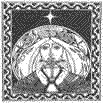




The Lady of the Lake
It would be something of a crime to research Otherworld women and not give the famous Lady of the Lake her own section, so we have created a small area for her here. However, our findings reveal that although an important character in the Arthurian legend, the Lady of the Lake is not quite as she seems.
The relationship of Otherworld women with water is one we have explored more than once. It is a well-established theme and quite possibly the most important, exemplified by the Lady of the Lake’s crucial role as Excalibur’s keeper; Excalibur is a powerful symbol of power and true kingship.
The more modern stereotypical view of the Lady of the Lake is that she is one woman who lives in the lake and occasionally offers either Excalibur or her hand, to catch Excalibur. In fact, she is much more than this. She is a mediator between ‘real’ world and Otherworld, almost a symbolic gateway between worlds. Interestingly and quite importantly, what the majority of most modern people fail to realise is that the Lady of the Lake is not actually one person. The Lady of the Lake is in fact a role: any Otherworld woman at all could be the Lady of the Lake at any one time, since she is not a particular person but in fact a position held by anyone. With this in mind, the Lady of the Lake has been linked to several different Arthurian characters. Amongst those said to have possibly been the Lady of the Lake is Morgan Le Faye, who we know was able to take on many roles, as discussed in our Morgan Le Faye section. In our 'Functions' section, other possibilities surrounding the Lady of the Lake are discussed.
(See Functions section for more info)
Avalon
That famous Otherworld land wherein Arthur is reputedly resting and being tended to by Otherworld maidens, with the possibility that he may one day return. Avalon has been suggested as many different sites, even Glastonbury Abbey claims itself as the true Avalon, where Arthur is laid ‘to rest’, although in the Arthurian Legend there is a great deal of ambiguity surrounding whether or not Arthur actually died.
One of the most important elements concerning Avalon is the theme of water. We experience the theme of water throughout Arthurian mythology concerning the Otherworld. Water was important to the Celts, as a symbol of transcendence and continuation. Death was not feared by the Celtic people, rather accepted as a stage of transcendence into the Otherworld, where they would continue the rest of their lives. The Celts did not understand Geography as we do today; they believed simply that to travel further than the eye could see into the ocean would mean reaching this divine place, the Otherworld, perhaps equivalent to Heaven in Christianity. This Otherworld place across the water was Avalon.
The Lay of Sir Launfal also makes explicit mention of the Isle of Avalon.
|
|
|||||||||||||||||||||||
|
|
|||||||||||||||||||||||
|