|
|
|
|
|
|
|
|
||||||||||||||||||||||||||||||||||
|
|
||||||||||||||||||||||||||||||||||||||||
 |
 |
|
|||||||||||||||||||||||||||||||||||||||
 |
|
||||||||||||||||||||||||||||||||||||||||










 Ascertaining
what is fact and fiction is virtually impossible in Arthurian Legend,
and this is certainly the case when we come to look at Guinevere. Subject
to the impositions of the ideologies and traditions of each era of literature,
the perception of Guinevere projected varies throughout history.
Ascertaining
what is fact and fiction is virtually impossible in Arthurian Legend,
and this is certainly the case when we come to look at Guinevere. Subject
to the impositions of the ideologies and traditions of each era of literature,
the perception of Guinevere projected varies throughout history.
There are various spellings of her name. The Welsh version is ‘Gwenhwyfar’, where ‘gwei’ means white and ‘hwyfar’ means spirit or shadow. The latter part of the name is also linked to the Irish word ‘Siabhfadh’ meaning fairy, introducing an association with the Otherworld. This is strengthened in that some accounts Guinevere is referred to as the ‘May Queen’; fairyfolk traditionally urged knights and nobles to dress in green on May Day and the colour green is almost always linked to the ‘fairy’ in ancient mystical writings. She is sometimes regarded as a female Gwyn Ap Nuad, an Otherworld king.
Her parentage varies with different sources, though all accounts do agree that she was of noble birth. According to Malory, she was the daughter of King Lameliard; Geoffrey of Monmouth claims she was the daughter of a Roman noble; and Welsh tradition states that King Ogrfan Gawr of Knucklas Castle was her father. On her marriage to Arthur, as part of her dowry, Guinevere brought the Round Table to Arthur’s Court from her father. It was this, and the land, with which Guinevere was to be intrinsically associated.
What is agreed about her is that she was considered one of the most beautiful women in the world. It was her beauty that captured both Arthur and Lancelot, two knights known to be as strong in spirit as in battle, and drove them apart; consequently Arthur’s reign and prosperity came crashing down. Her beauty was said to be representative of the beauty of the land of Britain so that she was much more than Queen of the land, but an actual personification of it. This concept introduces the suggestion that Guinevere was in fact a powerful fertility goddess, whom Arthur needed to wed in order to ensure the prosperity of his land. This notion relates to the pagan origins of the Grail and its power to restore the health of a sickly king, only secured through relations with a goddess who personifies the land. In this sense, Arthur and Guinevere’s relationship was about more than love: if she did not remain with him, as sovereign goddess, her absence would precipitate the crumbling of Arthur’s kingdom.
Her beauty did indeed prove troublesome: Guinevere is often abducted in various tales, and of course requires rescuing by a knight. Guinevere’s betrayal of Arthur in committing adultery with his favourite knight, Lancelot, led to Lancelot’s failure in his quest for the Grail, and to the demise of both men in battle. Guinevere’s arrest for adultery and treason signalled the symbolic collapse of the strength and unity of the Round Table as well as the land itself. As penance for her sins, Guinevere then retreated into a nunnery.
Curiously, it is only after the imposition of Judo-Christian values onto the Arthurian Legend that Guinevere is regarded as a tainted woman. The Celtic tradition championed the human, who had equal power to the men, including the right to take as many lovers as they chose. Therefore, her reputation as a disloyal adulteress is a misinterpretation as the Medieval and Renaissance morality sanctioned the imposition of guilt upon Guinevere.
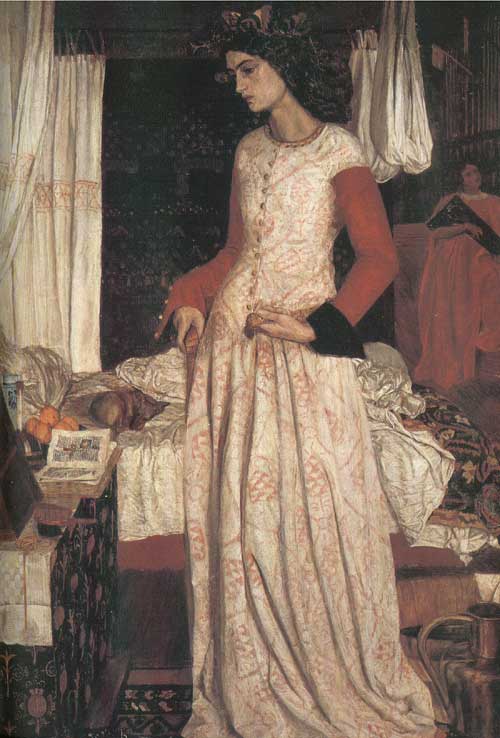
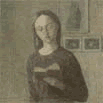
This image represents the sexual guilt of Guinevere after her
adultery with Lancelot - click on the image to enlarge.
|
|
|||||||||||||||||||||||
|
|
|||||||||||||||||||||||
|