|
|
|
|
|
|
|
|
||||||||||||||||||||||||||||||||||
|
|
||||||||||||||||||||||||||||||||||||||||
 |
 |
|
|||||||||||||||||||||||||||||||||||||||
 |
|
||||||||||||||||||||||||||||||||||||||||







It is the case that the function of Celtic otherworld women is fairly
specific, differing from each individual rather than as a straight forward
and concise purpose for the women as a group. In order to make the functions
as clear as possible, we will briefly look at certain Celtic women as
somewhat of an introduction to the more in-depth studies of the prominent
goddesses which will follow.
Lady of the Lake
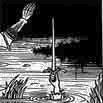
As we know the Lady of the Lake has many guises and it is most difficult to determine where on person begins and another ends. Throughout the Legend the Lady appears as Vivian, Morganna, Nimue and Argante to name but a few. Therefore the Lady provides many different functions. As the Queen of the Lake she provides inspiration and imagination for the Celtic people and indeed is the one who gives Arthur his sword Excalibur in her first appearance in “Suite de Merlin”. Her association with water reflects the interest Celtic people had in water deities, as they demonstrate the great power of the goddesses. This Lady is later beheaded and after a second appearance as the foster mother of Lancelot, she appears as the enchantress of Merlin. A recurring function of Celtic Otherworld women, that of the seductive temptress is displayed in “Vulgate Merlin”. Merlin is sealed in his tomb while still alive and The Lady becomes the Magical Protector. She attempts to aid King Arthur against his sister Morgan Le Fay. Obviously The Lady of the Lake is one character but is assumed by many different women.
The Fair Lady of Astolat
Although, as with most of the women featured in the Arthurian Legend, The Fair Maid of Astolat is portrayed in varying ways, all accounts of her describe her love for Lancelot to be so passionate, that she cannot live without him and thus she commits suicide and floats down the river to Camelot in a barge, as illustrated in the famous painting by John William Waterhouse (1888). This Lady goes by many different names and associations for example The Lady of Shallot and Elaine. It has been suggested that Elaine was one of Arthur’s half-sisters and that she had two other sisters Morganna and Anna. As Morganna is one of the names used for the Lady of the Lake it seems a potent argument that Elaine may have been part of the line of goddesses who became the Lady of the Lake. Certainly it helps explain why the latterly mentioned three main personifications; a goddess, a faery queen and an elf. She was indeed at least three people and Elaine was possibly one of them.
Morgan Le Fay
Morgan Le Fay on her first introduction is simply the leader of nine sorceresses who helps Arthur on Avalon. It is not until the writing of de Troyes that it is suggested she is Arthur’s sister. And still she is not yet associated with the evil sister who steals Excalibur in a plot to kill her brother. Her character is most inconsistent but the three deities make up a very important element in Celtic life. The Celtic Triple Goddess; Morrigan, Macha and Bodbh, is an essential function in female/male association; the mother who bears him, the wife who weds him and the hag who lays him out for burial. Morgan Le Fay exemplifies the intrinsical function of Celtic Otherworld women in their society.
Guinevere
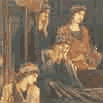
Arthur’s wife is also functioning as a temptress and seducer from the otherworld. We know her to be a Bansidhe, as an Irish woman (‘Ban’ Irish for woman) and a woman of the otherworld (‘Sidhe’ Irish for Otherworld). Interestingly the function of the Bansidhe in Irish folklore has been to frighten and control young children and thus an evil spirit, something which we do not immediately associate with Guinevere. Does this mean however, that this was not her intended purpose and that she may infact have evoked uncertainty in the reader of the Arthurian Legend? The Arthurian Queen is not only a temptress for Arthur, but also for the famous Lancelot.
Painting of Guinevere by William Morris
Arianrhod
The goddess who is associated with the crescent moon, stars, moonbeams and sacred kingship. She is described as the Welsh goddess of the moon, fertility and fate and her name , Arianrhod, means ‘Silver Wheel’ of ‘Keeper of the Wheel’, the wheel being all the stars in the Milky way. The story goes that after her brother rapes a royal virgin he suggests her as a replacement to appease the king. After she fails the test of maidenhood her two sons are taken from her. Her brother takes one of the boys and when he shows him his mother, Arianrhod places a curse on the child, denying him the right to have a name unless sanctioned by herself, and thus denying him “real life”. However her brother successfully tricks her into over-ruling the curse and so places and second , preventing him from ever bearing arms, and a third, preventing him from ever having a wife of this race. It seems that her brother cleverly fashions the boy a wife of flowers but the bride betrays them and thus Arianrhod retreats triumphantly. She has become known as the goddess who would not be forced into the position of a man’s footholder, paving the way for the view that Celtic women were admired for their minds just as they were for their beauty. So what is her purpose? Some say she is integral in the Otherworld initiations, living in the tower called Caer Sidi where the dead go before re-birth. As a so-called Spider Goddess she is associated with webs and the ability to weave. This is an extremely important role in Celtic Society as the weavers controlled the fate of the mortals and of creation itself. It is believed that Arianrhod is an incarnation of Argante, the Queen of Avalon in the Arthurian Legend. Argante is also another name for the Lady of the Lake, adding fuel to the debate of the number of women who became the Lady of the Legend.
The Function of Celtic Otherworld Women in Summary
- Temptress
The Lady of the Lake seduces Merlin
Guinevere seduces Arthur and Lancelot
Morgan Le Fay seduces Merlin
- Protector
The Lady of the Lake protects Arthur by giving him Excalibur.
She also protects the magic of the imprisoned Merlin.
- Inspiration, Imagination and
Wisdom
The Lady of the Lake is synonymous with the Celtic belief that water was
a
demonstration of the Goddesses power and her ability to be gentle as soon
as she
could be fierce.
- Moon
Arianrhod is in control of one of the most important aspects of Celtic
life, the moon,
as the Celtic people spoke of time in terms of nights rather than days.
The people
were always at the disposal of the goddesses in order to retain their
social order.
- Fertility
Arianrhod controls fate and destiny and her decisions dictate life, death
and re-birth.
- Fate and Destiny
All goddesses had power over fate and destiny. As supernatural beings
they had the
power to influence individuals and events. Thus people treated Otherworld
women
with trepidation.
- Healer
Morgan Le Fay first appears as the woman who promises to heal Arthur.
Without
the healing women, the fate of Celtic society would be in jeopardy.
- The Triple Goddess
Mens’ dependency on the women for mothers, wives and hags who will
lay them
to rest.
Conclusion
The function of Celtic Otherworld women is very difficult to
define, not least because all of the women appear to be incarnations of
the same people at different points in the Legend. The artistic licence
of the writers uses the female characters of Arthurian Legend for their
desired effect and therefore tracing the functions of these women who
appear to merge into one another, results in a somewhat compounded conclusion.
However, the essence of this information exemplifies the importance of
the women in Celtic Society. The Otherworld Women functioned as living
forces in the both the imagination and the worship of the Celtic people.
The absolute essence of the universe and all it’s creativity was
female and was clearly a culture in which women were the spiritual and
moral pivot. The emphasis was on co-existence of mortals and Otherworld
women with an awareness of the tenuous relationship between the two. The
Goddesses were the openers and closers of life and could just as easily
be the takers as they could be the givers.
|
|
|||||||||||||||||||||||
|
|
|||||||||||||||||||||||
|