|
|
|
|
|
|
|
|
||||||||||||||||||||||||||||||||||
|
|
||||||||||||||||||||||||||||||||||||||||
 |
 |
|
|||||||||||||||||||||||||||||||||||||||
 |
|
||||||||||||||||||||||||||||||||||||||||







The Appearance of Otherworld Women
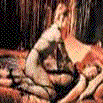
In Celtic mythology, there is often a marked difference between the author’s description of an Otherworld woman and the intended presentation of her. In the main, these fictional accounts of their beauty and dress are kept deliberately vague and short, most notably in ‘The Voyage of Coula’, in which the female protagonist is irresistible to all but her chosen Coula. In this case, like others, we are merely given a general description:
“…he is talking to a young and beautiful woman of noble descent who will suffer neither old age nor death.”
This lack of detail could be for a number of reasons.
Firstly, to some extent the myths represent moral teachings, therefore it is not as important to visualise the women as to understand their role and purpose. Detailed description could potentially confuse the issue.
Conversely, it could be argued that the descriptions are vague to increase entertainment value, in form of male sexual fantasy. Otherworld women are often associated with being fragile, for example Rigru Roislethan, we are told, lives in a crystal house. Also, the intricate nature of their ornate dress increases the distinction between these ornamental beauties of the Otherworld and the practical, hard working Celtic wife. Therefore, although this superficially seems to disagree with Moyra Caldecott, who argues “the dumb blonde would not stand a chance in Celtic society”, we must not forget the incredible power held by the Otherworld women we have studied, which merely complements their beauty. However, by keeping descriptions vague, it is possible to increase the potency of the male sexual fantasy, allowing each individual to picture his own ideal of beauty. This is a habit encouraged in the description of ‘Niamh of the Golden Hair’:
“To some men, her hair was the colour of yellow flag iris which grows by the summer waters; others thought it like ruddy polished gold.”
We also see some evidence of this in ‘The Lay of Launfal’, where on Launfal’s first meeting of his Lady, there is an ornate description of her pavilion but her own description remains brief:
“By reason of the heat her raiment was unfastened for a little, and her throat and the rondure of her bosom showed whiter and more untouched than hawthorn in May.”
This image is particularly striking in terms of the male sexual fantasy ideal: she simultaneously manages to both represent innocence through her white skin and connection with nature, as well as appear highly sexually inviting, with her slightly “unfastened” clothing.
The final possibility as to why authors did not give greater descriptions of Otherworld women is the strong tradition of formulae in Celtic mythology. It often occurs that aspects of Celtic literature are repeated almost verbatim from one tale to another; the appearance of women may be no exception. They are invariably presented as young, beautiful, with tradition Celtic features and with ornate dress. Therefore, an author only needs to hint at these norms, either by a general description or by making clear the aphrodisiacal effect of the Otherworld woman on worldly men.
To some extent, the appearance of Celtic Otherworld women is dictated by their place and role in mythology. Their permanently youthful looks can be attributed to their habitation of Etain, otherwise known as Tir-nan-og meaning ‘the land of the ever young’.
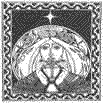
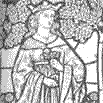
It is also possible that their ornate dress originated due to an association between Otherworld women and the golden cup of kingship. In ‘The Vision of the Scall’, we find one such description:
“A young woman with a golden diadem on her head and a vessel of silver with golden ornaments by her, and in the vessel was golden ale.”
The tradition of presenting kings with the cup of kingship as a signal of approval is reminiscent of a coronation, and the incredibly ornate attire, the ceremonial garb to match.
This decoration also helps to signify the rank and important of these Otherworld beings, all of whom seem to hold high social status and command great respect. However, such decoration was not solely reserved for Otherworld women or indeed to women exclusively. The Celts took great pride in their appearance; men could be punished if their girdle began to exceed desirable volume. They also were known to have worn gold and silver trinkets such as are described in the texts. In this aspect, the appearance of Otherworld women has an important role in these stories, as it helps distinguish them as Celts or having a benevolent coexistence with the Celts by mimicking Celtic identity. However, in their superiority of dress they are established as mystical characters of great status. Identity was of great importance to the Celts; they made conscious efforts to try and distinguish themselves, as described by Diodorus Siclus. He tells us they are:
“white of skin, and their hair is blond, not only naturally so, but they also make it their practice by artificial means to increase the distinguishing colour.”
For this reason, it is of no surprise that the Otherworld women often
conform to the stereotypical features of the Celt. In ‘Voyage of
Art, Son of Conn’, there is a suitable description of Becuma Gresgel,
the bansid:
“She had a cloak about her with an embroidered border of red gold, and a scarlet satin tunic against her white skin and soft yellow hair. Grey were the eyes in her head, thin her red lips, black the eyebrows, her body straight and pale as snow.”
Moyra Caldecott’s view, which I mentioned briefly above, has some particularly interesting inferences when we consider that she speaks of today’s ‘dumb blonde’ as society’s modern view of beauty. Interesting here is the comparison of today’s ideal of beauty with that of the Celtic ideal in the above quote: often, women were specifically said to have white skin, dark eyebrows and long dresses; today, the marketable beauty is tanned, blonde and wearing next to nothing. An interesting transition for us to consider.
In any case, Becuma’s outfit in the above quote helps us to identify her further than being a Celtic Otherworld woman. The author has employed physiognomy to hint at her character. The scarlet satin tunic worn next to her skin illustrates sexual potency and reveals her as a wanton woman. Likewise, her ‘green cloak’ can be equated to the vices of greed and envy. These aspects of Becuma’s appearance help to portray her as unfit to marry Conn:
“Fair was that woman, but a woman banished for her own transgression, was not worthy for the high king of Ireland.”
Gradually, as the legend of Arthur becomes greater and increasingly European elements start to infiltrate the myths, these Celtic Otherworld women begin to lose their identities. Their subtle portrayal is replaced by more detailed descriptions that reveal less tradition and understanding. However, these new heroines fulfil the requirements of a romantic protagonist in the fashion of the period; the Celtic elements that remain are of limited significance to the much-changed audience.
|
|
|||||||||||||||||||||||
|
|
|||||||||||||||||||||||
|