|
|
์
 |
The imposing Doi Inthanon, located in Chiang Mai
province, is the highest point in the country, and is often dubbed
'The Roof of Thailand'. In Doi Inthanon National Park there are also
several lesser summits to explore. Geologically speaking, the
mountain range is largely composed of granite batholiths that extend
in a southerly direction towards the Shan Hills range in Myanmar
(Burma), and form the division between the Ping River to the
east and the Mae Chaem River to the west.
The
park covers an area of 301,500 rai (482 sq km), taking in parts of
the Son Pa Tong, Jom Tong, and Mae Jam districts. This
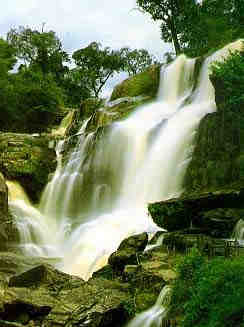
mountainous park is also home to one of the most impressive
waterfalls in Thailand, the Mae Ya Waterfall. |
In the past Doi Inthanon was known as Doi Loing, or 'Doi Ang
Ka' (Doi meaning mountain). Doi Loing therefore means a big
mountain. The name Doi Ang Ka was sometimes used, as about 300 m
away from the mountain's base there was a pond shaped like a washing
tub (Ang). Flocks of crows (Ka) also used to gather at the pond, and
that is how the name came to be adopted.
But what about the
name 'Doi Inthanon'? Chiang Mai’s last sovereign, King
Inthawichayanon, with great foresight, expressed concern for the
forests of the hilly countryside in the north. He was aware that it
served as the watershed for the whole of central Thailand. Before
his death, he commanded that his remains were to be placed on the
summit of Doi Loing. After his demise his wishes were carried out,
and the mountain was renamed 'Doi Inthanon' in honour of his name.
The stupa at the summit that houses his remains is visited by
thousands of people every year.
In 1959, the Doi Inthanon
Forest was one of fourteen throughout the country that had been
established as National Parks by the government. And in 1965 it
was named as a National Conservation Area. Later on, in 1972,
the park's boundaries were extended by the Forestry Department of
Thailand to include the Ban Loing, Sob Tai, Song Kael, Yang Karm,
Jom Tong, Mae Vin, and Son Pa Tong districts and sub-districts.
On 16th January 1974, during a visit by His Majesty the King
and Her Majesty Queen Sirikit to Doi Kun Klang, he suggested that
the boundaries of the park be further extended. In February the Mae
Suank, Chang Keng, and Ta Pha subdistricts became part of the park.
Due to the park extension projects, in 1975 the Doi Inthanon
National Conservation Forest, the Jom Tong National Conservation
Forest, and the Mae Jam National Conservation Forest all became the
Doi Inthanon National Park that we know today.
Topography
The park is rugged and mountainous
with Doi Inthanon reaching 2,565 m above sea level -- the highest
point in Thailand. Doi Hua Mod Loing is the second highest peak, and
stands at 2,330 m. The park is the source of the Mae
Klang, Mae Pa Kor, Mae Pon, Mae Hoi, Mae Ya, Mae Jam, and Mae Karn streams. The
water from the streams also generates electricity at the Bhumibhol
Dam.
Climate
The lowlands, below 800 m in
elevation, are warm and dry outside the rainy season, but the summit
of Doi Inthanon has a climate more like Canada than Thailand! The
temperature sometimes drops down to –8 degrees Celsius, and frost is
not unusual during the cool and dry season. January is the coldest
month with an average nighttime temperature of 5.5 degrees Celsius.
In any season, though, Doi Inthanon is a great place to visit if you
want to be free from the heat of the lowlands.
Forests and Wild Animals
The forested national parks of Thailand
are immensely valuable towards preserving the country's heritage. In
the Doi Inthanon National Park the forests comprise hilly evergreen
forests, pine forests, tropical rain forests, and more. The park is
also a source of many economically valuable woods like teak and
pine, but logging has been discouraged for a number of years now.
Moreover, there is a large variety of beautiful and colourful
flowers, such as the forest rose, and a host of other flora that
cannot be seen anywhere else in Thailand. Sadly, many animal species
are becoming extinct due to destructive deforestation, and non-stop
hunting by the hill tribe people. But you can still sometimes catch
a glimpse of tigers; and gibbons, deer, wild pigs, Siamese hares,
fowls and other animal life still abound, thanks to the vigilance
and protection of the park rangers.
Outstanding
Attractions
As many road access points have now been
constructed, private transportation is a convenient way to visit Doi
Inthanon. In fact, the main attractions are spread over a 40 km
range, and only a private vehicle will give you the ability to make
the most of your trip. A motorcycle is perhaps the best way to get
through the rough and narrow dirt roads that lead to the hill tribe
villages.
Nevertheless, if you want to really get in touch
with the park -- and thoroughly absorb its natural beauty, then
walking or hiking is highly recommended. There are many footpaths
and trails to follow on Doi Inthanon as a result of the long
occupation by the hill tribes. The starting point is usually at the
Mae Klang Waterfall, which is located 66 km south west of Chiang
Mai. You could then choose to stay over at the Mae Aeb Karen Village
for the first night, at Pa Mon Karen Village for the second night,
at Pang Somdet Village for the third night, followed by a walk up to
the summit the next morning.
The Summit of Doi
Inthanon
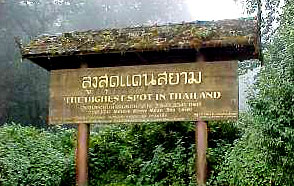
Doi Inthanon is the highest point in Thailand.
The trip to the summit offers some fine views along the way,
especially during November and December. And when you have reached
the top the atmosphere is unique. There is nowhere else quite like
it in Thailand, and you feel a sense of achievement and wonder as
you look out all around you. The forests you can see from above that
you have recently walked through have roses growing that are
similar to the ones you can see in Phu Kra Dung, but much bigger.
These high-stemmed plants are called 'Thousand-Year Roses'.
Doi Khun Klang
Doi Khun Klang is found at at
Km 31. It mostly features grassland, because the forests were
depleted about 50 years ago. In the rainy season, the mountain is
brilliantly green, and is very pleasant for sightseeing.
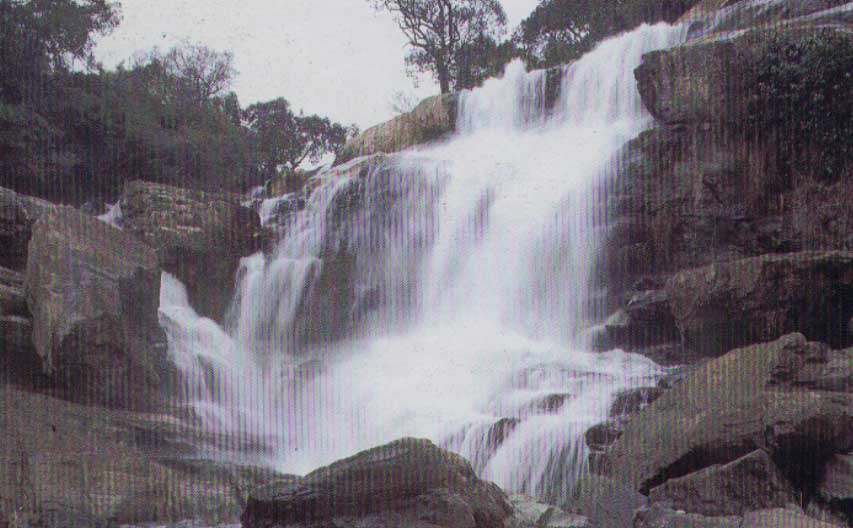
The Mae Klang Waterfall
The Mae Klang
Waterfall is in the east of the park. When you reach Km 8 on the Jom
Tong-Inthanon route, turn left and go straight ahead for 1 km, and
you can’t miss it. This beautiful waterfall has been visited by
Thais for many years and they continue to come in large numbers on
any sunny day to swim, picnic, and relax in its quiet setting.
|
 |
The Mae Ya Waterfall
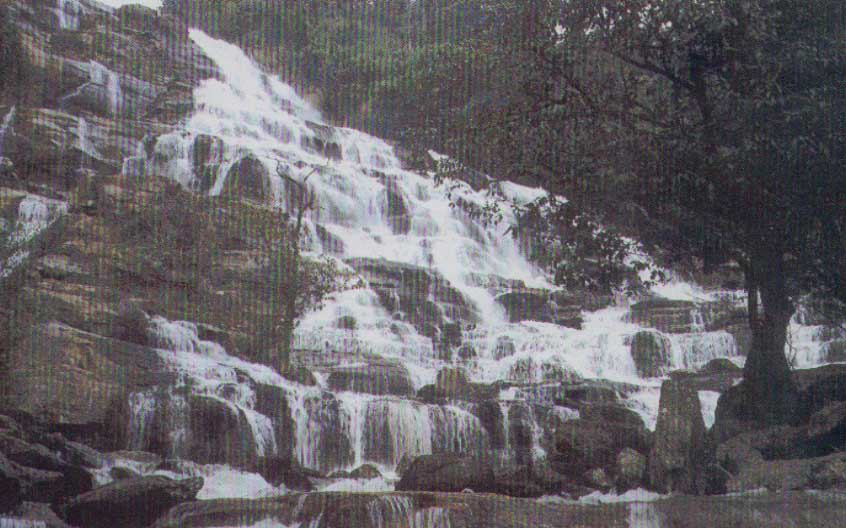 |
The Mae Ya Waterfall is
located in the south of the park. Thought to be the highest in
Thailand, it is well worth the extra effort to get there. It is
estimated that the Mae Ya River plunges down more than 250 m at this
point. This fantastic body of water, cascading down over an
ever-widening series of steps is undoubtedly a photographic
favourite.
|
Siripum Waterfall
The Siripum
Watrfall is located near to Km 31, on the Jom Tong-Inthanon route.
The name of the waterfall used to be 'Lao Lee', after the name
of the leader of the Meo hill tribe, who live in the north of
Thailand. Later on, Jarktong Tongyai, who was a cabinet
minister in the Agriculture and Cooperative Society
Department, proposed 'Siripum' as the new name in honour of Her
Majesty the Queen.
|
Watchiratan Waterfall
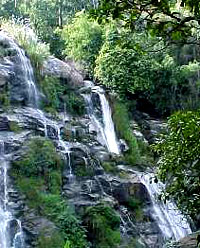
This waterfall has as its origin the Mae Klang stream, and
is located at Km 22 on the Jom Tong-Inthanon route (reached by a
short, easy trail from the parking area). The water from the Mae
Klang Stream has a drop ofaround 70 m at this point, creating a
misty veil of great beauty.
|
 |
Caves
Many caves
in the park are well-known and definitely worth a visit. The most
interesting cave, with beautiful stalagmites and stalactites, is
Prijinda. This large cave is located inside a mountain in the
eastern section of the park.
From the Muang district of Chiang
Mai, drive on the Chiangmai-Hid route, go towards Km 58. Before
reaching Amphur Jom Tong Market, turn right, enter Jom Tong- Doi
Inthanon route, and drive for about 48 km, heading for the summit of
Doi Inthanon. In fact, at the junction (turn right into Jom Tong-
Doi Inthanon route) go straight ahead, drive to Km 8 and then turn
left. If you drive on for 1 km, you can’t miss the Mae Klang
Waterfall and the park offices.

By
train The
State Railways of Thailand operate daily services from Bangkok's
Huala-mpong Railway Station, including a popu-lar overnight sleeper.
Telephone Bangkok 223-7010 or 233-7020 for further information.
By
bus
The
10-hour journey from Bangkok can be made on airconditioned coaches
and non-airconditioned buses originating from the Northern Bus
Terminal on Bangkok's Kamphaeng Phet 2 Road (Tel: 936-3660 or
937-8055 for further details).
By air
Thai Airways (Tel: Bangkok 280-0060,
628-2000) operates daily flights from Bangkok and other northern Thaicities.
|
