Next: Cr:ZnSe laser (positive GDD)
Up: Multiple pulse operation
Previous: Variation of the self-amplitude
Bounded multiple pulses
As it was found (see, for example
[4,7,8,9]), the multipulse
generation can be caused by the formation of the bounded
soliton-like complexes with strong correlation between components.
The stability of the spectrum modulation in the experiment
suggests the nearly constant inter-pulse distance and phase
difference.
The presence of the different mechanisms of the ultrashort pulse
destabilization somewhat complicates the picture. The number of
the pulses in the bounded soliton-like complex does not depend on
the initial field only in the regions, where there is no
multistability. Outside these regions the number of pulses, their
intensity and durations depend on the initial conditions.
The inter-pulse distance is more sensitive to the initial
conditions. The multiple pulses formed by the continuum
amplification have, as a rule, random distances because the pulse
can rise at the arbitrary moment within the cavity period.
However, the inter-pulse distance approaches the constant for the
regular initial signal due to an interaction of the pulses arising
from the common seed.
In the case of the multiple pulse generation caused by the bounded
perturbation growth, the pulses evolve through the dissociation of
the initial single pulse. Because the pulses stay close-coupled
all the time, interaction between the pulses plays a major role
and the inter-pulse distance becomes less dependent on the initial
conditions.
In practice the presence of the mode locking start-up assistance
(for example, due to acousto-optical modulator [26])
will regularize the initial field and produce the repeatability of
the inter-pulse distances. However, the dissociation of the
bounded multiple pulse complex always has the nonzero probability
if only a fast saturable absorber is involved.
The interaction between the pulses in the bounded soliton-like
complex can result from the soliton interaction mechanism and from
the binding potential formed by dissipative factors. The mechanism
of the Schrödinger solitons interaction was analyzed in the
framework of the inverse-scattering formalism [46]. It
was found that the motion of the soliton pair can be described as
to be influenced by the effective force, which depend on their
relative phase
 , amplitude and distance
 . In the
specific case of
=0 and the equal amplitude of the
interacting solitons, such interaction causes the periodic
collapse of the bounded multiple pulse complex with the period
. In the
specific case of
=0 and the equal amplitude of the
interacting solitons, such interaction causes the periodic
collapse of the bounded multiple pulse complex with the period
 [47], where
 is the initial inter-soliton distance normalized to the soliton
duration and
is the initial inter-soliton distance normalized to the soliton
duration and
 is normalized to the dispersion length. If we
take the parameters of Fig.
is normalized to the dispersion length. If we
take the parameters of Fig.
![[*]](crossref.gif) , this formula gives time
of 2
, this formula gives time
of 2 10
10 cavity round-trips as the double pulses
collapse period. It is obvious, that it is too small to explain
the observed steady-state behavior of the multiple pulse
complexes, which are interferometrically stable over seconds in
the experiment. Hence, the soliton mechanism can not be considered
as the single and main source of the pulse interaction. First,
this mechanism does not describe the situation of the positive GDD
and second, the contribution of the spectral dissipation reduces
the interaction of the Schrödinger solitons
[48,49,9].
As it was found in [7], the perturbation of the
nonlinear Schrödinger equation by the linear and nonlinear loss
terms and by the spectral filtering produces the oscillating
soliton wings. The overlapping of these wings forms the soliton
interaction potential, which has a minimum. In fact, the
interaction through the oscillating pulse wings is suppressed in
our case due to the damping of the side-band generation (see Fig.
and [50]). Nevertheless we suppose, that the
spectral loss [4] and the fast absorber saturation
may contribute to the interaction of the pulses.
Let us consider Eq. () from this point of view. There is
the method to analyze the pulse interaction, which is based on the
study of the conserved momenta of Eq. ()
[8]:
cavity round-trips as the double pulses
collapse period. It is obvious, that it is too small to explain
the observed steady-state behavior of the multiple pulse
complexes, which are interferometrically stable over seconds in
the experiment. Hence, the soliton mechanism can not be considered
as the single and main source of the pulse interaction. First,
this mechanism does not describe the situation of the positive GDD
and second, the contribution of the spectral dissipation reduces
the interaction of the Schrödinger solitons
[48,49,9].
As it was found in [7], the perturbation of the
nonlinear Schrödinger equation by the linear and nonlinear loss
terms and by the spectral filtering produces the oscillating
soliton wings. The overlapping of these wings forms the soliton
interaction potential, which has a minimum. In fact, the
interaction through the oscillating pulse wings is suppressed in
our case due to the damping of the side-band generation (see Fig.
and [50]). Nevertheless we suppose, that the
spectral loss [4] and the fast absorber saturation
may contribute to the interaction of the pulses.
Let us consider Eq. () from this point of view. There is
the method to analyze the pulse interaction, which is based on the
study of the conserved momenta of Eq. ()
[8]:
 and
and
 .
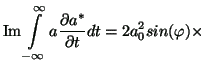
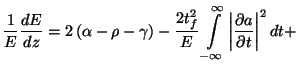
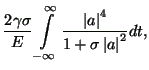
Multiplying Eq. () by
.
Multiplying Eq. () by
 , adding the
complex-conjugate, and integrating over
, adding the
complex-conjugate, and integrating over
 results in:
 |
|
 |
(10) |
which is the energy balance equation for the laser
field.
Let us consider as the simplest example a superposition of two
pulses:
( is the half-distance,
and
are normalized to the pulse duration).
It is obvious, that the interference between the pulses alters the
energy "transmission" increment (right-hand side of Eq.
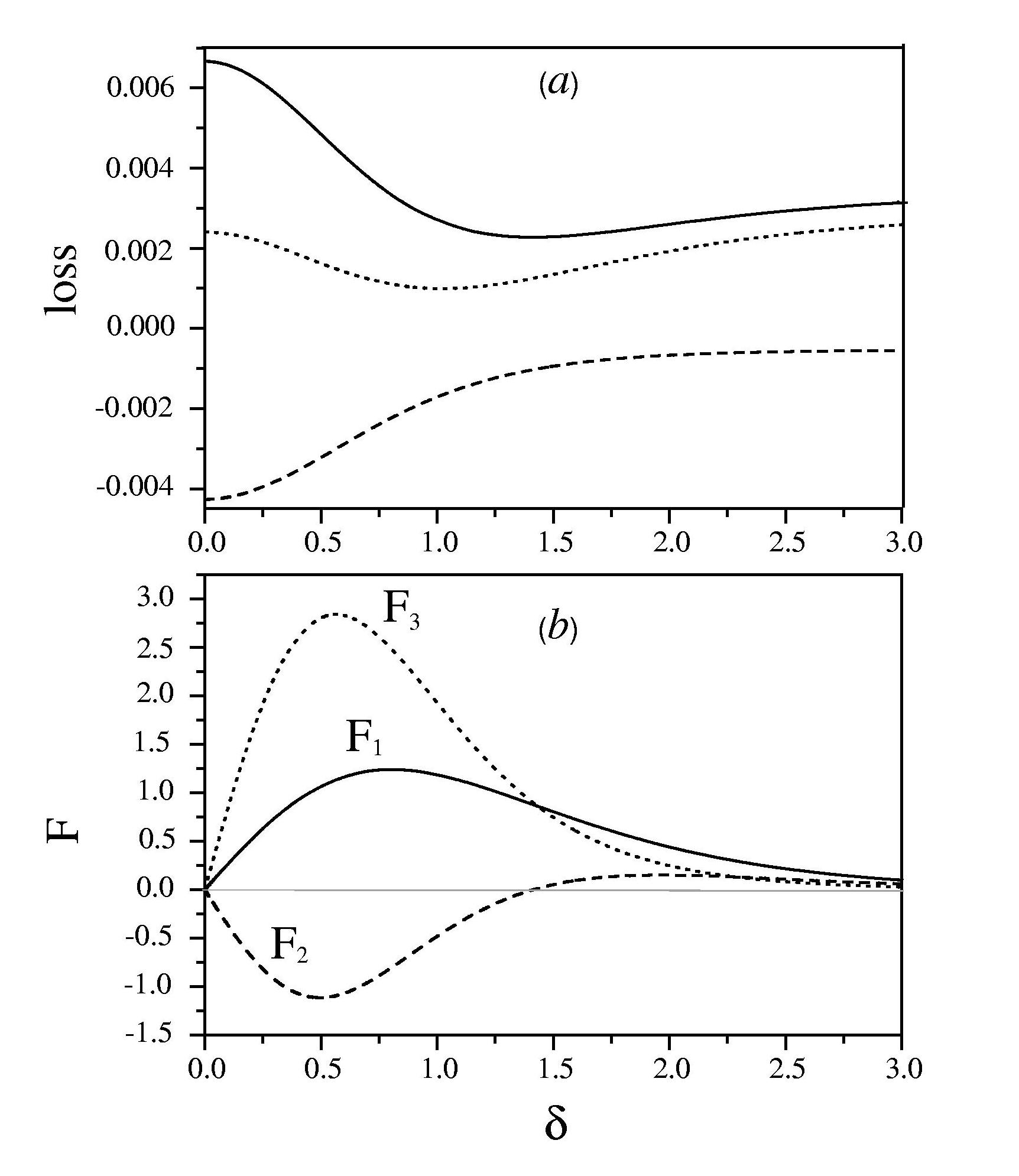
()). Fig.
, a shows the energy
loss due to the spectral filtering (solid curve), the absorber
saturation (dashed curve) and their common action (dotted curve)
in the dependence on
(=0). One can see, that
there exists the minimum of spectral loss for
=0 and
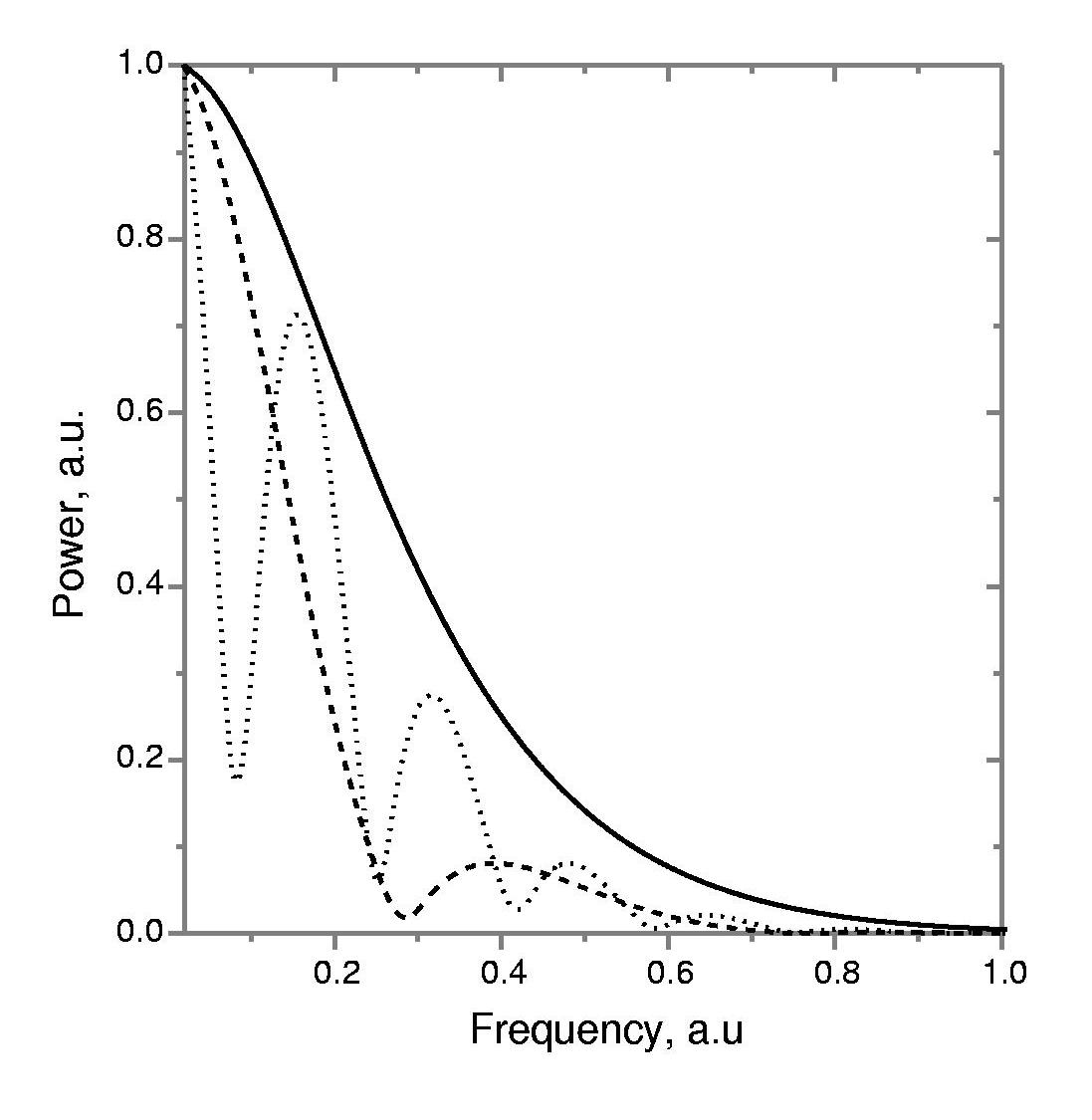
 . The appearance of this minimum is demonstrated
in Fig.
. The merged pulses suffer the larger spectral
loss as a result of the widest spectrum (solid curve). The
increase splits the spectrum and concentrates the energy
in its central part (dashed curve). The spectral loss is minimal
in this case. The further distance increase forms the more uniform
modulation with the rise of the high-frequency part (dotted
curve). As a result, the spectral loss approaches that of the
single pulse. The spectral loss decrease produced by this
mechanism is larger for the shortest pulses. Hence, region of its
action extends for the distances
. The appearance of this minimum is demonstrated
in Fig.
. The merged pulses suffer the larger spectral
loss as a result of the widest spectrum (solid curve). The
increase splits the spectrum and concentrates the energy
in its central part (dashed curve). The spectral loss is minimal
in this case. The further distance increase forms the more uniform
modulation with the rise of the high-frequency part (dotted
curve). As a result, the spectral loss approaches that of the
single pulse. The spectral loss decrease produced by this
mechanism is larger for the shortest pulses. Hence, region of its
action extends for the distances
 5
5
 8
8
 . The
chirped pulses interact even stronger.
. The
chirped pulses interact even stronger.
Figure:
Energy loss for the spectral filter
(solid), the saturable absorber (dashed) and their common action
(dotted). (b): Functions
 (solid),
 (dashed)
and
(dashed)
and
 (dotted).
 =0.1,
=0.1,
 =1,
=0,
=12
=1,
=0,
=12
 ,
,
 =0.02. Inter-soliton half-distance
is
normalized to the pulse duration
.
=0.02. Inter-soliton half-distance
is
normalized to the pulse duration
.
|
|
Figure:
Spectrum of the double-pulse complex with
=/1.76,
=0 (solid line), 0.6 (dashed line), 1.8
(dotted line).
is normalized to
.
|
|
The next obvious mechanism is the fast absorber saturation, which
favors the pulses merging due to the stronger loss saturation for
the overlapping pulses. In the calculation we took into account
only the first term in the expansion on
 in the last
term of Eq. () (dashed curve in Fig.
,
a; this treatment is similar to that for the explanation
of the colliding-pulses regime in [13], where the
double-pulse generation resulted from the stronger Kerr-lensing
for the colliding pulses). The combination with the spectral
filtering can lead to the "absorbtion" of the pulses into the
"potential well" for the comparatively small
and
(dotted curve in Fig.
, a). But the
increase of the field amplitude and the saturation parameter lead
to the pulse merging in the simplified model of Eq. ()
because the last term approaches the maximal value of 2 as
a result of the pulse amplitude or
growth. At this
moment, it is not quite clear what mechanism prevents the pulses
from collapse. It is obvious, however, that the distance between
the pulses is a result of the balance between the pulling force
(the fast absorber saturation) and the yet unclear repulsion
mechanism. The pulse intensity growth causes stronger saturation
of the absorber and therefore increases the pulling force. This is
illustrated by Fig.
in the last
term of Eq. () (dashed curve in Fig.
,
a; this treatment is similar to that for the explanation
of the colliding-pulses regime in [13], where the
double-pulse generation resulted from the stronger Kerr-lensing
for the colliding pulses). The combination with the spectral
filtering can lead to the "absorbtion" of the pulses into the
"potential well" for the comparatively small
and
(dotted curve in Fig.
, a). But the
increase of the field amplitude and the saturation parameter lead
to the pulse merging in the simplified model of Eq. ()
because the last term approaches the maximal value of 2 as
a result of the pulse amplitude or
growth. At this
moment, it is not quite clear what mechanism prevents the pulses
from collapse. It is obvious, however, that the distance between
the pulses is a result of the balance between the pulling force
(the fast absorber saturation) and the yet unclear repulsion
mechanism. The pulse intensity growth causes stronger saturation
of the absorber and therefore increases the pulling force. This is
illustrated by Fig.
 and
, where
inter-pulse distance decreases with intensity growth caused by
increase and
and
, where
inter-pulse distance decreases with intensity growth caused by
increase and
 0, respectively.
Some additional aspects of the pulse interaction can be revealed
by the consideration of the second momentum of Eq. (),
which describes the force acting on the pulse along the
axis:
0, respectively.
Some additional aspects of the pulse interaction can be revealed
by the consideration of the second momentum of Eq. (),
which describes the force acting on the pulse along the
axis:
where
 and
and
 are the functions of
and describe the linear loss and gain action and the
spectral filtering, respectively, and
are the functions of
and describe the linear loss and gain action and the
spectral filtering, respectively, and
 is the function of
,
, peak intensity
is the function of
,
, peak intensity
 and
and describe the fast absorber action.
,
and
have analytical form, but the expressions are
overcomplicated and not instructive. A typical case is illustrated
by Fig.
, b. Besides the trivial
stationary points
=0,
and
and describe the fast absorber action.
,
and
have analytical form, but the expressions are
overcomplicated and not instructive. A typical case is illustrated
by Fig.
, b. Besides the trivial
stationary points
=0,
 , there exists some
inter-pulse distance causing zero interaction due to spectral
filtering (intersection of
with zero line). As
depends also on
and
, there exists some
inter-pulse distance causing zero interaction due to spectral
filtering (intersection of
with zero line). As
depends also on
and
 , the right-hand side
of Eq. () can vanish at values of
which
differ from 0,
. Thus, the stable pulses can have various
phase differences.
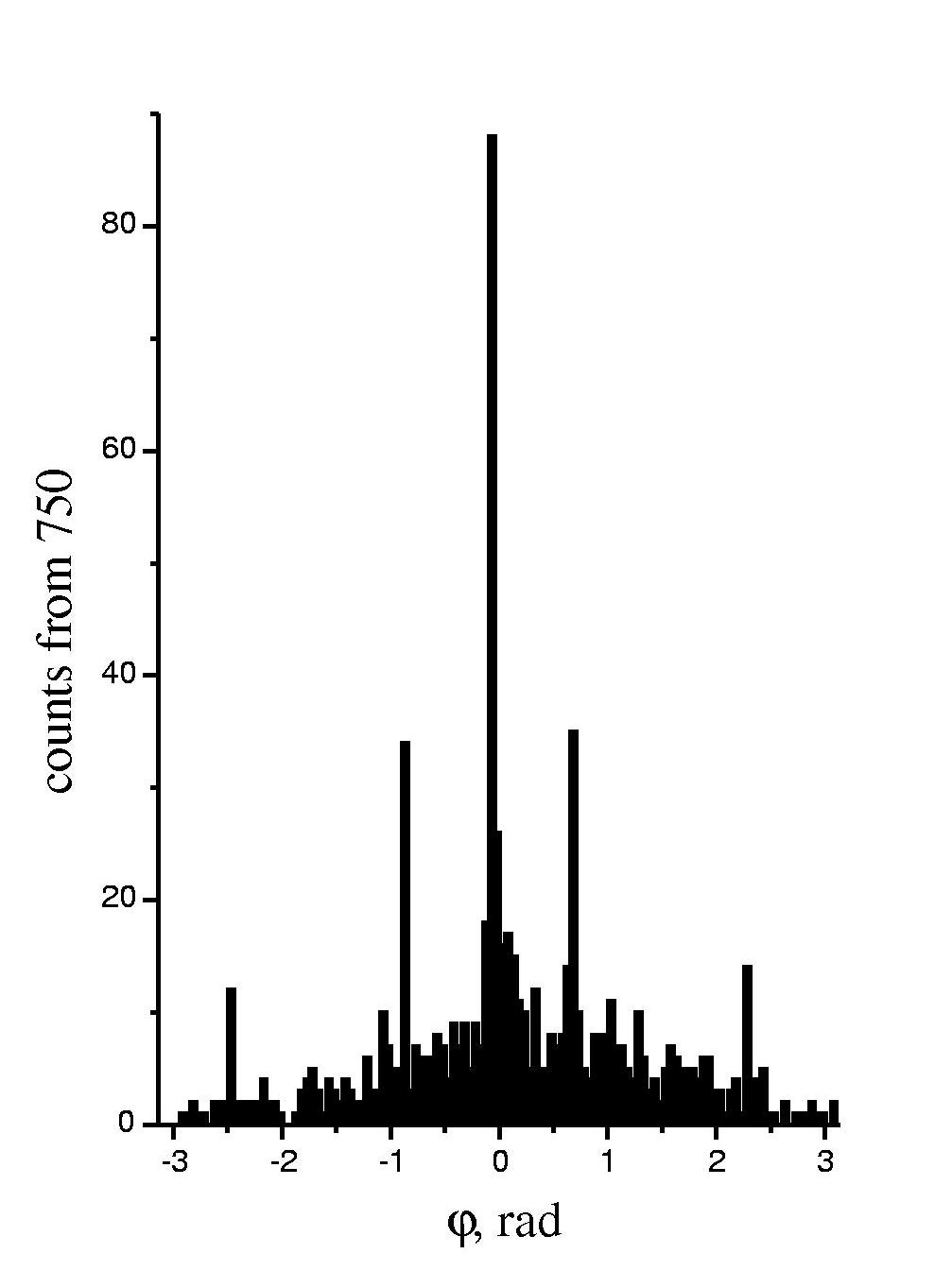
Our calculations demonstrate, that the phase difference changes in
the process of the pulse evolution, in agreement with
[4,9]. The simulation also reveals the
existence of the "attracting" set of
values. The
vicinity of these points is the most probable place for the pulse
to stay, as demonstrated by the histogram in Fig.
.
This histogram was accumulated from 750 multiple pulse regimes
corresponding to the various system parameters as well as the
various initial conditions. We suppose, that the existence of this
attracting set explains the spectrum regularity, which is observed
experimentally.
, the right-hand side
of Eq. () can vanish at values of
which
differ from 0,
. Thus, the stable pulses can have various
phase differences.
Our calculations demonstrate, that the phase difference changes in
the process of the pulse evolution, in agreement with
[4,9]. The simulation also reveals the
existence of the "attracting" set of
values. The
vicinity of these points is the most probable place for the pulse
to stay, as demonstrated by the histogram in Fig.
.
This histogram was accumulated from 750 multiple pulse regimes
corresponding to the various system parameters as well as the
various initial conditions. We suppose, that the existence of this
attracting set explains the spectrum regularity, which is observed
experimentally.
Figure:
Histogram of the phase differences
accumulated for the different double and triple pulses regimes.
|
|
It should be noted, that the unbounded multiple pulse complexes
can be stable over the whole simulation time. As the difference
between the pulse intensities in the soliton-like complex, as a
rule, is small enough, this causes the constant phase difference
during the large time period. The last results in the
experimentally observed regular spectrum for the pulses with large
and nonuniform
.
Next: Cr:ZnSe laser (positive GDD)
Up: Multiple pulse operation
Previous: Variation of the self-amplitude
V.L. Kalashnikov
2002-12-28