Next: Bounded multiple pulses
Up: Multiple pulse operation
Previous: Positive GDD
Variation of the self-amplitude modulation
The variation of the
 parameter, which corresponds to
the change of the loss saturation intensity, is the common way to
adjust the mode-locking efficiency in a typical Kerr-lens mode
locking setup. For example, the growth of
,
corresponding to the saturation intensity decrease, can be
achieved by setting the laser operating point closer to the edge
of the cavity stability range [40]. As it was shown in
[2,40], the typical normalized to the self-phase
modulation coefficient values of
lie in the range of
1
parameter, which corresponds to
the change of the loss saturation intensity, is the common way to
adjust the mode-locking efficiency in a typical Kerr-lens mode
locking setup. For example, the growth of
,
corresponding to the saturation intensity decrease, can be
achieved by setting the laser operating point closer to the edge
of the cavity stability range [40]. As it was shown in
[2,40], the typical normalized to the self-phase
modulation coefficient values of
lie in the range of
1 100 for the four-mirror Ti:sapphire laser.
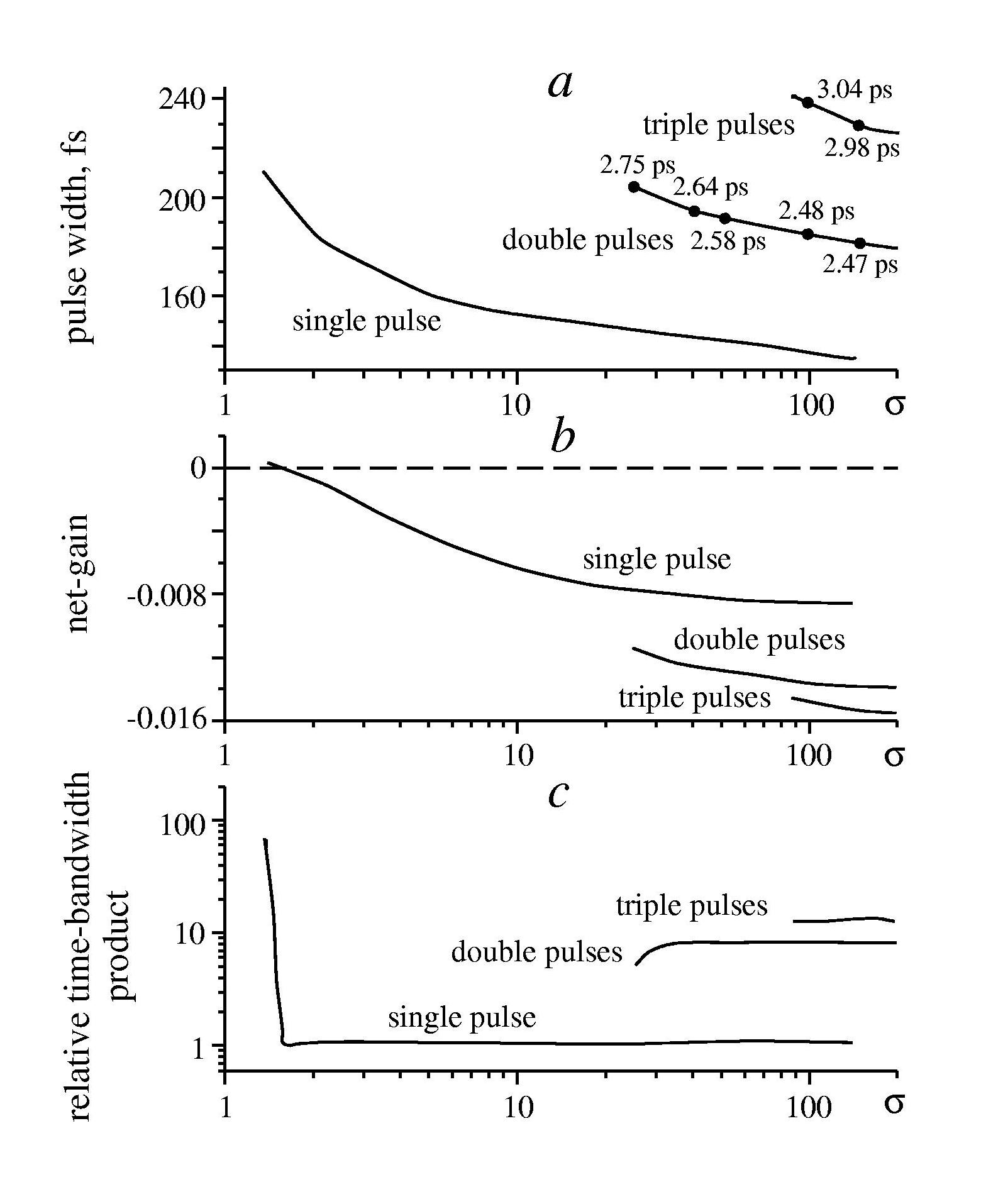
As Fig.
100 for the four-mirror Ti:sapphire laser.
As Fig.
![[*]](crossref.gif) ,
,
 shows, the increase of
shortens the ultrashort pulse. Such shortening is accompanied by
the growth of the phase retardation, the pulse energy and the
intensity due to the saturation of the fast absorber. The energy
rise decreases the net-gain outside the pulse due to the gain
saturation (Fig.
,
shows, the increase of
shortens the ultrashort pulse. Such shortening is accompanied by
the growth of the phase retardation, the pulse energy and the
intensity due to the saturation of the fast absorber. The energy
rise decreases the net-gain outside the pulse due to the gain
saturation (Fig.
,
 ). It should be noted that
for the given parameters the single pulse is almost chirp-free for
the increasing
(Fig.
, c).
). It should be noted that
for the given parameters the single pulse is almost chirp-free for
the increasing
(Fig.
, c).
Figure:
The pulse width (a), the net-gain
coefficient outside the pulse (b) and the time-bandwidth
product related to the one for the Schrödinger soliton
c for the single, double and triple pulses versus
. Captions at points denote the inter-pulse distances.
P=
 ,
,
 =-5000
 .
.
|
|
The most interesting phenomenon caused by the
change
is the existence of the mechanism of ultrashort pulse
destabilization, which differs from the one considered above. We
can see from Fig.
that there exists the minimum and
the maximum of
protected from the pulse
destabilization. The small
does not allow to saturate the fast absorber. The absorber
loss stay high, the pulse energy does not grow and as a consequence, the gain
cannot saturate. Hence the net-gain becomes positive. This results in the pulse
destabilization due to the background radiation growth.
The existence of the maximum
providing the pulse
stabilization is less trivial. As we can see from the Figure, the
transition to the multiple pulse generation due to the increasing
is not accompanied by the sign change of the net-gain
coefficient. In this case, there is no satellite growing outside
the pulse: the pulse dissociates by itself. In the framework of
the linear perturbation analysis (weak nonlinear limit
 1) the satellite growth can be described by the
excitation of the perturbation modes with continuous spectrum,
while the pulse dissociation corresponds to the discrete spectrum
of the perturbations. The loss saturation forms the ``potential
well'', which can contain the nondecaying bounded ``states''
corresponding to the perturbations. This property is enhanced by
the potential deepening and widening, i. e. with the pulse energy
growth. For the examples of slow saturable absorber case, see
[41,42]. The numerical analysis outside the weak
nonlinear approximation also demonstrates the pulse
destabilization due to the self-amplitude modulation growth in the
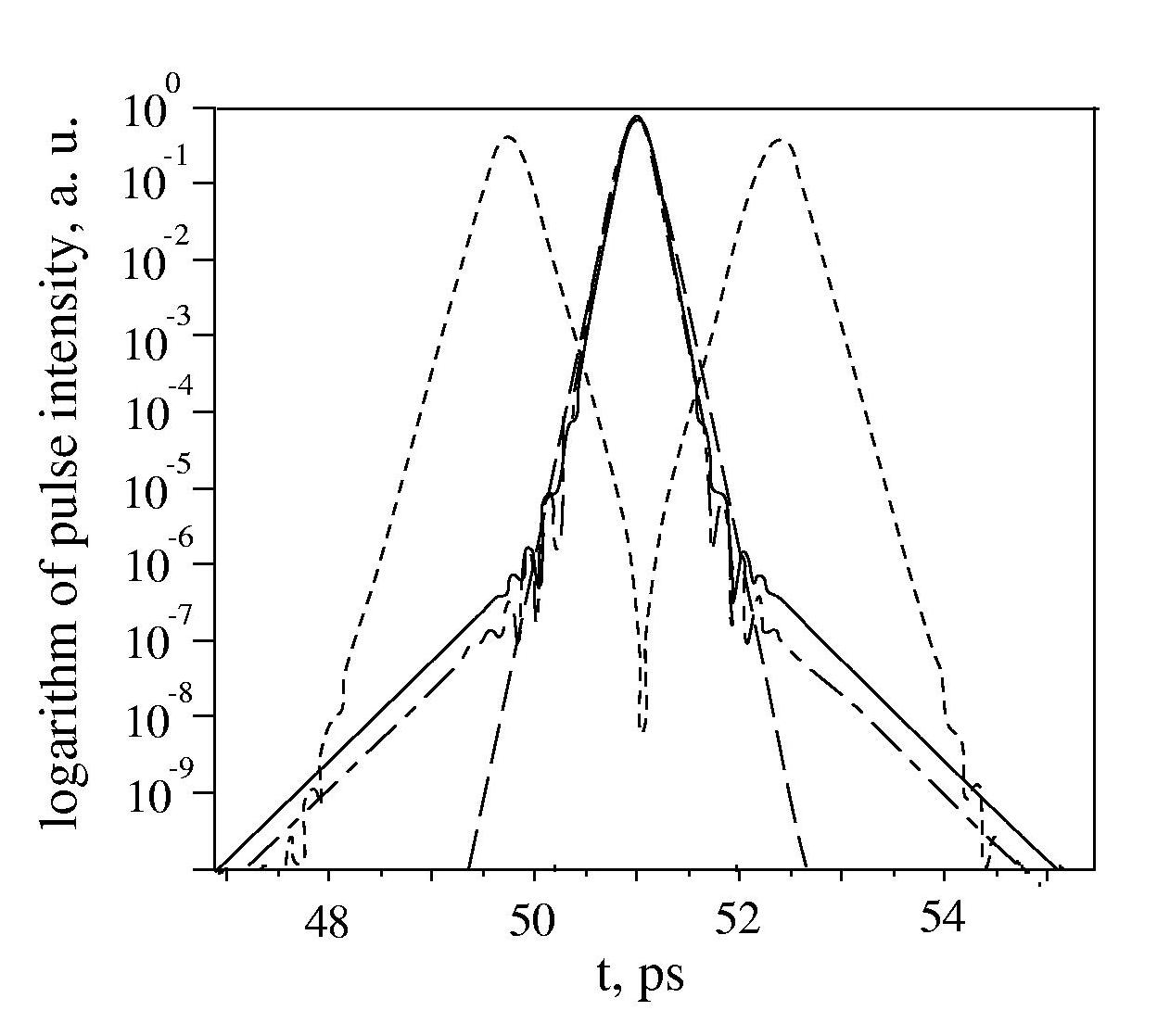
absence of the background amplification [43]. The wings of
such perturbations are visible in Fig.
. Here the solid
and dash-dotted curves show the logarithm of the field intensity
in the vicinity of the stability threshold and far from it,
respectively. The dashed line corresponds to the profile of the
sech-pulse. The slowly decaying exponential wings
corresponds to the ``bounded'' perturbations, which increase as a
result of the approach to the stability boundary (transition from
the dash-dotted to the solid curve). As the increase of the pulse
intensity saturates the fast absorber, its discrimination strength
decreases [13], thus favoring the perturbation growth
and the pulse dissociation (dotted curve). The described picture
agrees qualitatively with the analytical analysis presented in
[45], where the complex amplitude of the perturbation is
proportional to the pulse energy and the parameter of the
saturation of the self-amplitude modulation. The profile of this
perturbation is close to the dotted curve in Fig.
[45].
1) the satellite growth can be described by the
excitation of the perturbation modes with continuous spectrum,
while the pulse dissociation corresponds to the discrete spectrum
of the perturbations. The loss saturation forms the ``potential
well'', which can contain the nondecaying bounded ``states''
corresponding to the perturbations. This property is enhanced by
the potential deepening and widening, i. e. with the pulse energy
growth. For the examples of slow saturable absorber case, see
[41,42]. The numerical analysis outside the weak
nonlinear approximation also demonstrates the pulse
destabilization due to the self-amplitude modulation growth in the
absence of the background amplification [43]. The wings of
such perturbations are visible in Fig.
. Here the solid
and dash-dotted curves show the logarithm of the field intensity
in the vicinity of the stability threshold and far from it,
respectively. The dashed line corresponds to the profile of the
sech-pulse. The slowly decaying exponential wings
corresponds to the ``bounded'' perturbations, which increase as a
result of the approach to the stability boundary (transition from
the dash-dotted to the solid curve). As the increase of the pulse
intensity saturates the fast absorber, its discrimination strength
decreases [13], thus favoring the perturbation growth
and the pulse dissociation (dotted curve). The described picture
agrees qualitatively with the analytical analysis presented in
[45], where the complex amplitude of the perturbation is
proportional to the pulse energy and the parameter of the
saturation of the self-amplitude modulation. The profile of this
perturbation is close to the dotted curve in Fig.
[45].
Figure:
The logarithm of the pulse intensity for
=38 (solid), 30 (dash-dotted), 39 (dotted). Dashed curve
correspond to the soliton profile.
|
|
We have to note also the existence of the strong multistability as
a result of the
increase (see Figure
). The
region of the single and double (and even triple) pulses
coexistence is wide and becomes apparent as a result of the
variation of the initial field in the simulations. If we start
from the arbitrary initial (regular) field, the probability of the
multiple pulse generation is increased by the
increase.
Next: Bounded multiple pulses
Up: Multiple pulse operation
Previous: Positive GDD
V.L. Kalashnikov
2002-12-28