Next: Variation of the self-amplitude
Up: Multiple pulse operation
Previous: Negative GDD
Positive GDD
A very interesting property of the system is the stable multipulse generation in
the region of the positive GDD. This regime excludes the Schrödinger soliton
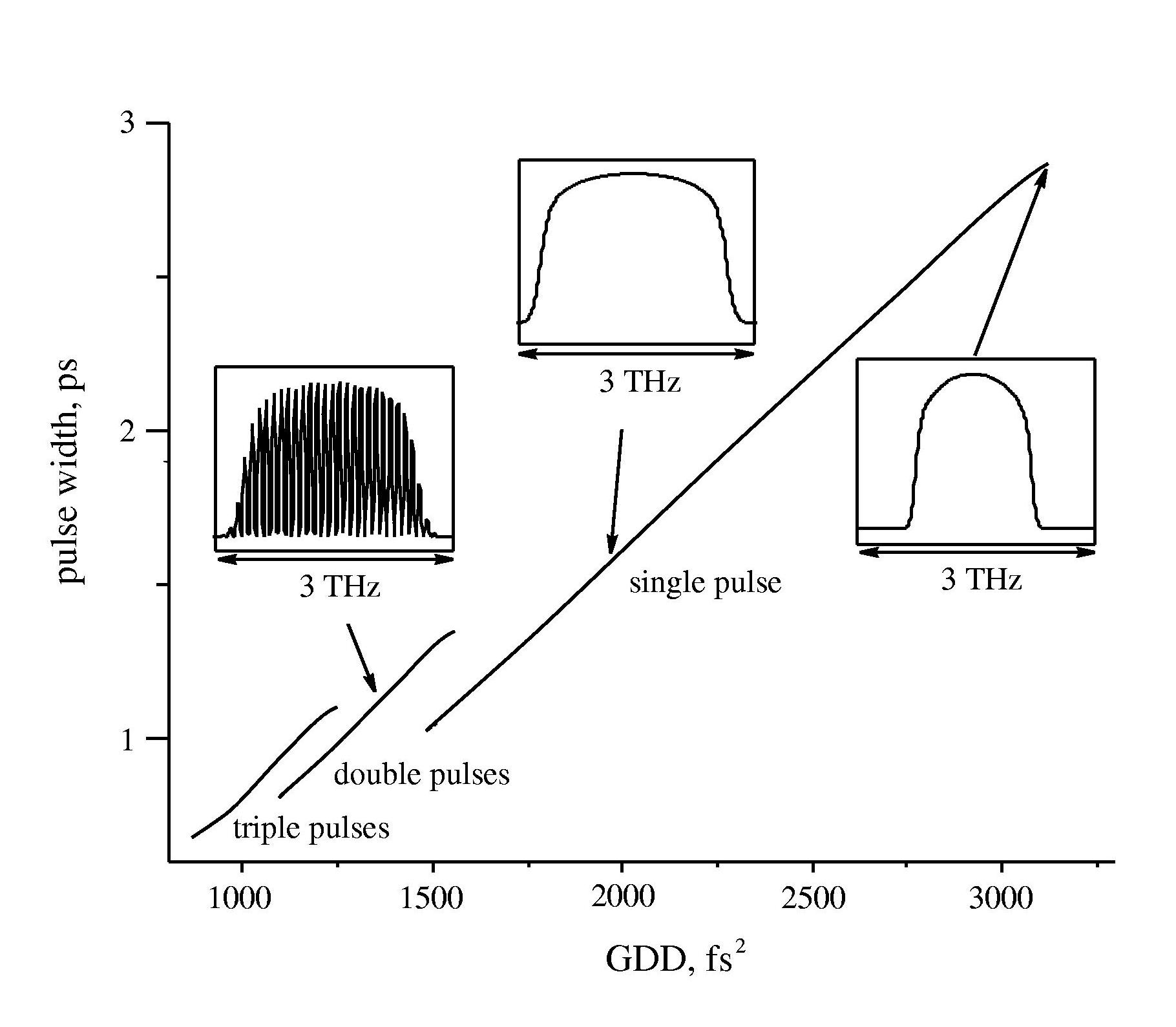
formation mechanism. The pulse width is shown in Fig.
![[*]](crossref.gif) in the dependence on GDD. The transition to the
multiple pulse generation, as a result of
in the dependence on GDD. The transition to the
multiple pulse generation, as a result of
 0,
has the hysteresis character and allows to reduce the ultrashort
pulse durations essentially. In the Figure
only
double and triple pulse regimes are presented, but in the vicinity
of zero GDD there may exist even larger number of pulses (up to 28
in our model), which have durations reduced down to 300 fs. There
exist certain parameter sets when the pulses fill the whole
simulation window. In the vicinity of zero GDD the accuracy of the
pulse characteristics is rather low,
because our model doesn't take into account
the higher-order dispersion, which strongly contributes to the
pulse dynamics in this case.
0,
has the hysteresis character and allows to reduce the ultrashort
pulse durations essentially. In the Figure
only
double and triple pulse regimes are presented, but in the vicinity
of zero GDD there may exist even larger number of pulses (up to 28
in our model), which have durations reduced down to 300 fs. There
exist certain parameter sets when the pulses fill the whole
simulation window. In the vicinity of zero GDD the accuracy of the
pulse characteristics is rather low,
because our model doesn't take into account
the higher-order dispersion, which strongly contributes to the
pulse dynamics in this case.
Figure:
The dependence of the pulse width on the
GDD coefficient (only single, double and triple pulses regimes are
shown). P=
 ,
,
 =20. The
insets show the pulse spectrum profiles (a.u. at vertical axes).
=20. The
insets show the pulse spectrum profiles (a.u. at vertical axes).
|
|
As it was in the case of the negative net-GDD, the round-trip
phase retardation is not sufficient for the pulse spectrum
fragmentation, although it has a more strong dependance on
 (see Fig.
).
Our analysis demonstrates that the signatures of the transition to
the multipulse generation are similar to those for the case of the
negative GDD: 1) the approach to zero GDD increases the pulse
intensity due to the dispersion spreading decrease; 2) as a
result, the fast absorber saturates (although less than in the
negative GDD domain); 3) the gain saturation decreases; 4) the
multipulse generation appears due to the background amplification
(the net-gain becomes positive, see Fig.
). The
decrease of the gain saturation results from the pulse energy
decrease. The source of the energy decrease for the positive GDD
is the spectrum broadening (see inserts in Fig.
) due
to the self-phase modulation increase for small
, which is
caused by the pulse intensity growth in the vicinity of zero GDD.
We have thus identified the actual pulse break-up condition which
is the same for positive and negative GDD regimes: crossing of the
net-gain
(see Fig.
).
Our analysis demonstrates that the signatures of the transition to
the multipulse generation are similar to those for the case of the
negative GDD: 1) the approach to zero GDD increases the pulse
intensity due to the dispersion spreading decrease; 2) as a
result, the fast absorber saturates (although less than in the
negative GDD domain); 3) the gain saturation decreases; 4) the
multipulse generation appears due to the background amplification
(the net-gain becomes positive, see Fig.
). The
decrease of the gain saturation results from the pulse energy
decrease. The source of the energy decrease for the positive GDD
is the spectrum broadening (see inserts in Fig.
) due
to the self-phase modulation increase for small
, which is
caused by the pulse intensity growth in the vicinity of zero GDD.
We have thus identified the actual pulse break-up condition which
is the same for positive and negative GDD regimes: crossing of the
net-gain
 of the zero line, caused by the
spectral widening of the pulse at decreasing the GDD.
of the zero line, caused by the
spectral widening of the pulse at decreasing the GDD.
Next: Variation of the self-amplitude
Up: Multiple pulse operation
Previous: Negative GDD
V.L. Kalashnikov
2002-12-28