Next: Positive GDD
Up: Multiple pulse operation
Previous: Multiple pulse operation
Negative GDD
First, let us consider the case, when

 0, which assures the
quasi-Schrödinger soliton formation. As it was shown in
[17] on the basis of the aberrationless approximation,
the soliton-like pulse, i. e. the pulse with the
0, which assures the
quasi-Schrödinger soliton formation. As it was shown in
[17] on the basis of the aberrationless approximation,
the soliton-like pulse, i. e. the pulse with the
 -time
profile and the negligible chirp, exists in the parameter range,
which is wider than it follows from the soliton model, and becomes
unstable in the vicinity of
= 0 due to the
automodulational instability.
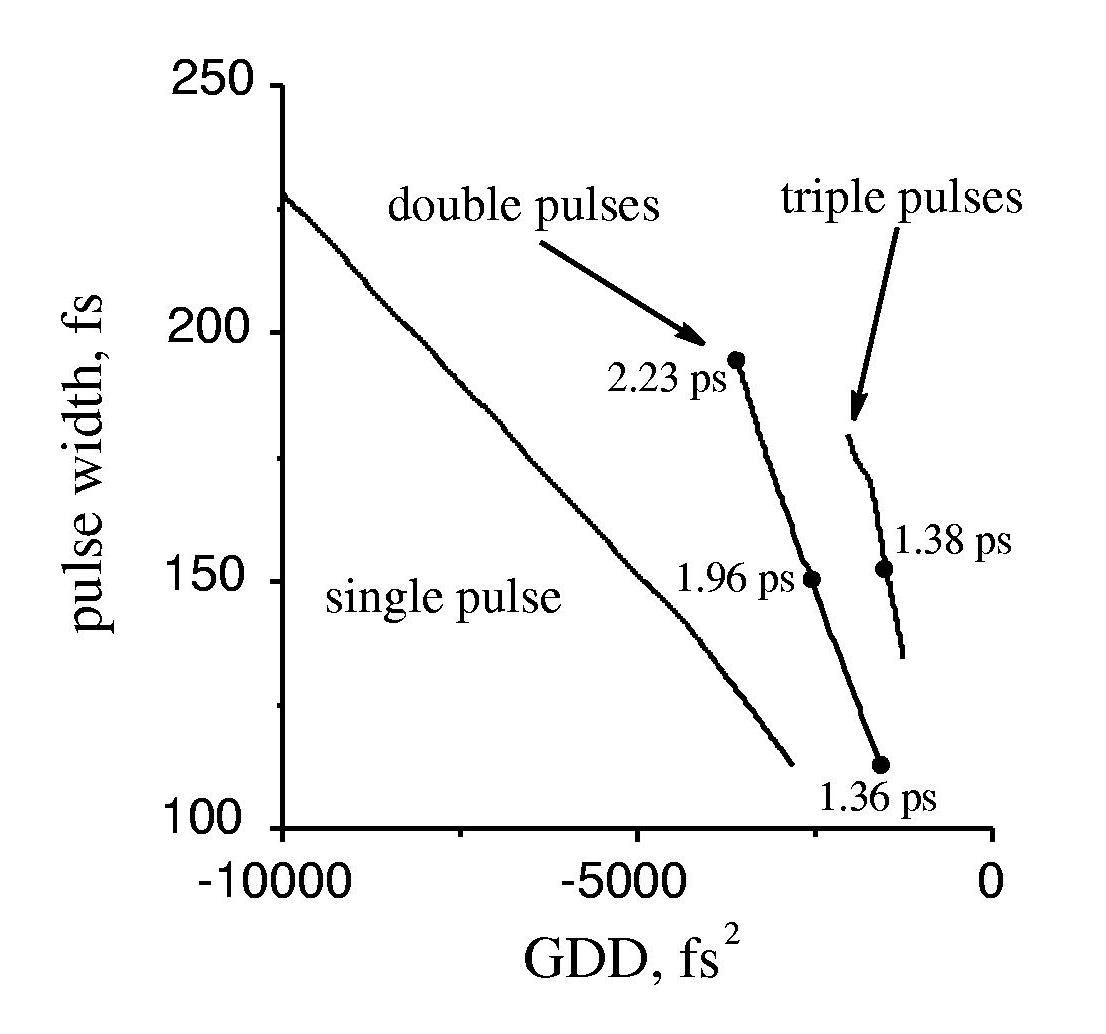
The behavior of the pulse width in our case is presented in Fig.
-time
profile and the negligible chirp, exists in the parameter range,
which is wider than it follows from the soliton model, and becomes
unstable in the vicinity of
= 0 due to the
automodulational instability.
The behavior of the pulse width in our case is presented in Fig.
![[*]](crossref.gif) in dependence on the GDD variation. Approaching zero
GDD results in the generation of the multiple pulses (up to 24 for
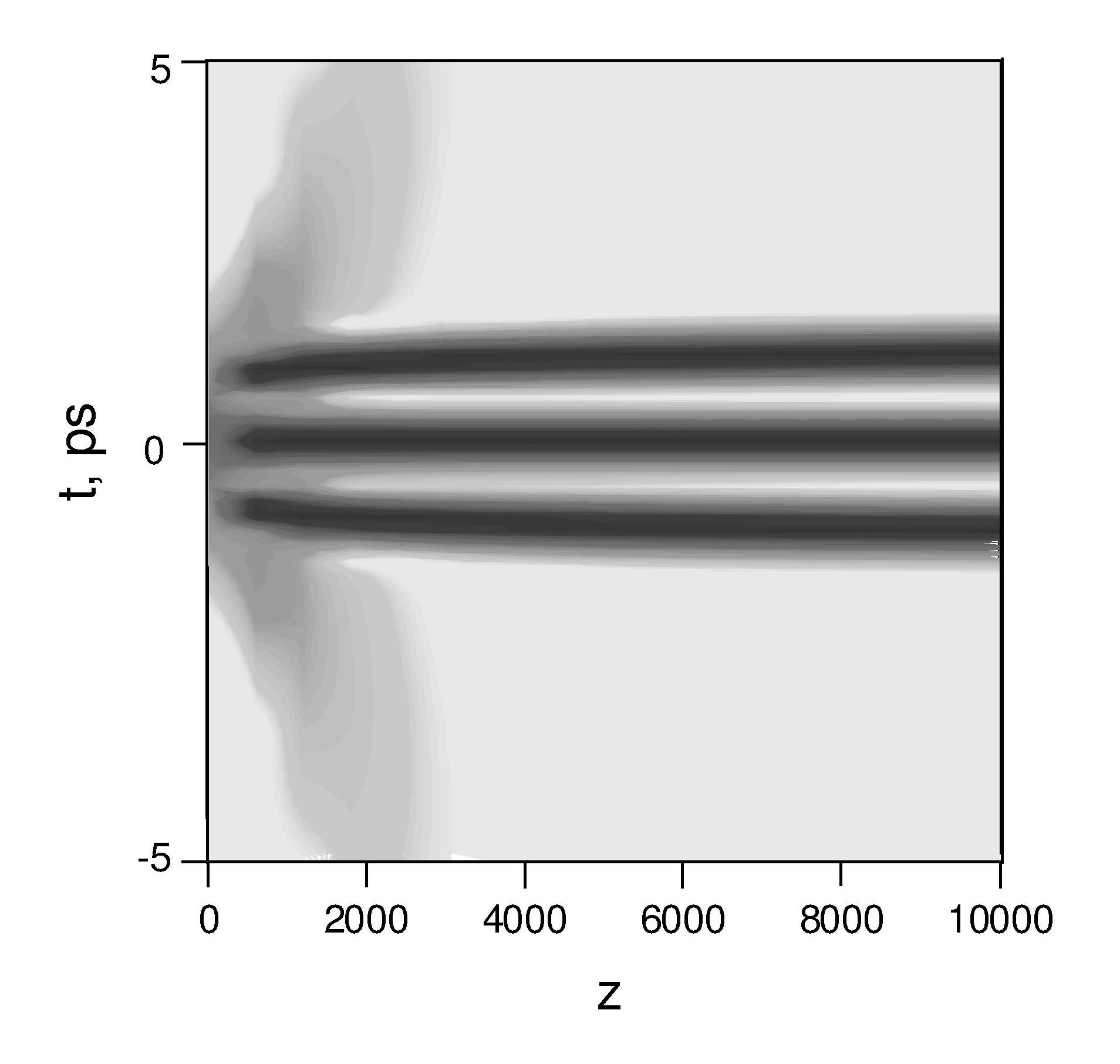
given parameters, the example of the triple pulses is shown in
Fig.
, the intensity of filling corresponds to value
of
in dependence on the GDD variation. Approaching zero
GDD results in the generation of the multiple pulses (up to 24 for
given parameters, the example of the triple pulses is shown in
Fig.
, the intensity of filling corresponds to value
of
 ). In Fig.
we depict only
parameters of the double and the triple pulses. The single pulse
shortening caused by decreasing
). In Fig.
we depict only
parameters of the double and the triple pulses. The single pulse
shortening caused by decreasing
 transforms into the
double pulse generation, then the triple pulse generation etc.
Each bifurcation is accompanied by the drastic pulse width
increase. The characteristic feature is the multistable lasing in
the region of the multiple pulse generation: there exists a
distinct hysteresis in the pulse parameters behavior (see Figure
). The pulse multiplication results in the strong
instability in the vicinity of
= 0. Such behavior is not
the noise or the continuous-wave operation, but the multiple pulse
generation with strong coupling
between the pulses and nonregular changes of their parameters.
transforms into the
double pulse generation, then the triple pulse generation etc.
Each bifurcation is accompanied by the drastic pulse width
increase. The characteristic feature is the multistable lasing in
the region of the multiple pulse generation: there exists a
distinct hysteresis in the pulse parameters behavior (see Figure
). The pulse multiplication results in the strong
instability in the vicinity of
= 0. Such behavior is not
the noise or the continuous-wave operation, but the multiple pulse
generation with strong coupling
between the pulses and nonregular changes of their parameters.
Figure:
The dependence of the pulse width on the
GDD coefficient. Only single, double and triple steady-state pulse
characteristics are shown. Captions at points denote the
inter-pulse distances. P=
 ,
,
 =10,
=10,
 =1.3
=1.3
 ,
,
 =0.02,
 =0.01. Other parameters are mentioned in the text.
|
|
Figure:
The contour-plot of the
 logarithm for the stable triple pulse operation. P=
 ,
=10,
=-2188
,
=10,
=-2188
 (other parameters correspond to Fig.
). Darker
regions correspond to higher intensity.
(other parameters correspond to Fig.
). Darker
regions correspond to higher intensity.
 is the number of
round-trips.
is the number of
round-trips.
|
|
To analyze the nature of the ultrashort pulse destabilization we
shall consider the influence of the basic lasing factors:
self-phase modulation, GDD, self-amplitude modulation due to the
fast saturable absorber and the gain saturation, and the spectral
filtering.
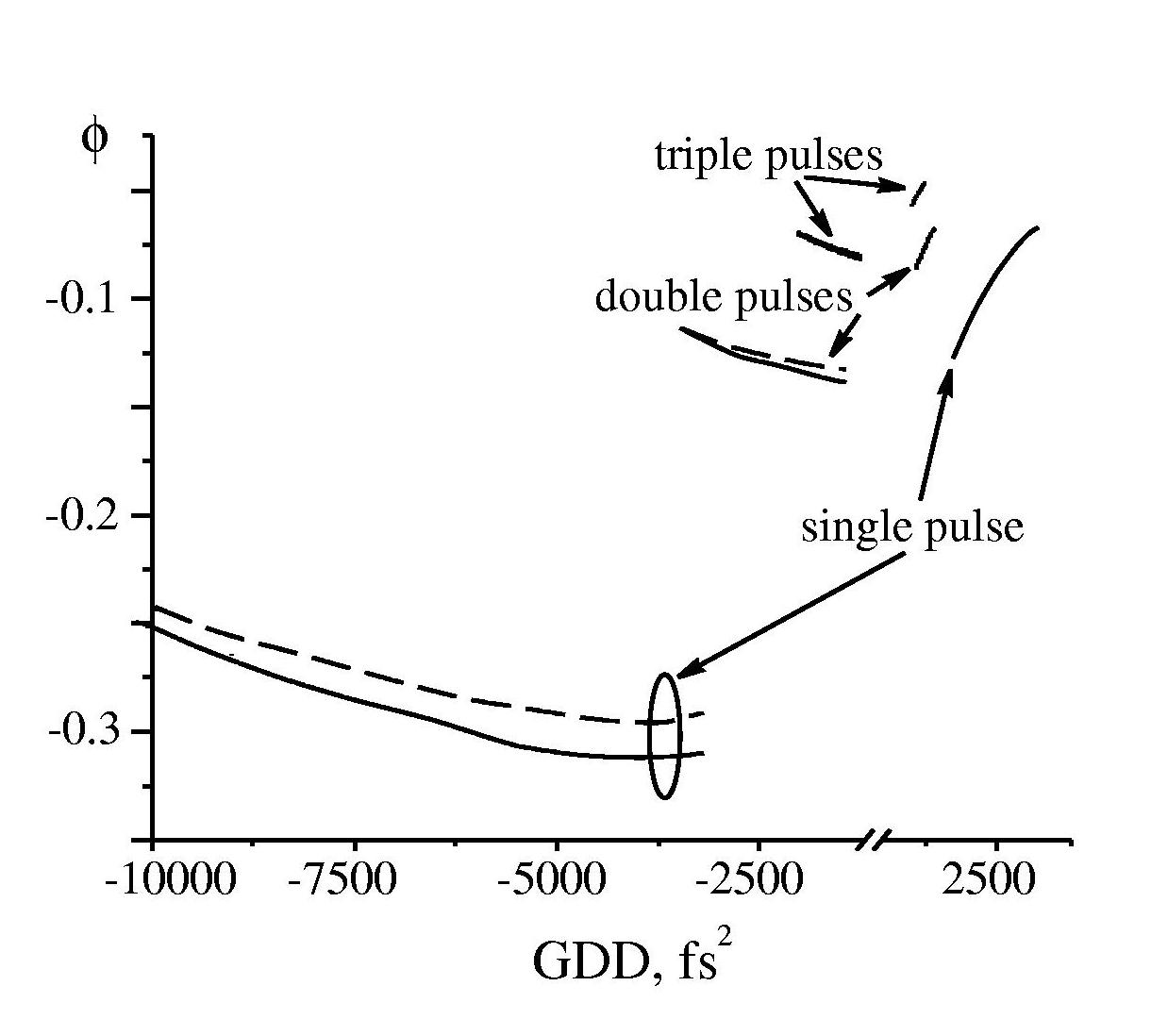
First, let us examine the nonlinear phase shift contribution. The
solid curves in Fig.
show the phase-retardation
 at the steady-state pulse peak after the full cavity
round-trip. One can see, that the phase shift is close to that for
the Schrödinger soliton (dashed curves) and is small in
comparison to
at the steady-state pulse peak after the full cavity
round-trip. One can see, that the phase shift is close to that for
the Schrödinger soliton (dashed curves) and is small in
comparison to
 (especially for the lower intensity
multipulse regimes). Hence the self-phase modulation can not
produce the pulse spectrum fragmentation. Moreover, approaching
the stability boundary does not cause any significant phase shift.
As a result, there is no the spectrum fragmentation in our case.
(especially for the lower intensity
multipulse regimes). Hence the self-phase modulation can not
produce the pulse spectrum fragmentation. Moreover, approaching
the stability boundary does not cause any significant phase shift.
As a result, there is no the spectrum fragmentation in our case.
Figure:
The dependence of the single-transit
phase retardation on the GDD coefficient. The negative GDD
branches correspond to parameters of Fig. 1, the positive GDD
branches correspond to P=
,
=20. The dashed curves show
corresponding to
Schrödinger soliton.
|
|
As an additional destabilizing factor, the dispersive
perturbations in the laser system with self-phase modulation and
negative net-GDD give rise to the spectral side-bands
[37,1,38]. Their position in the absence of the
higher-order dispersion can be found from the condition
 =
=
 , where
=
, where
=
 ,
,
 =
=
 , and
, and
 =
=
 are the normalized to inverse cavity
length wave numbers of the dispersive wave, solitary wave, and
periodic perturbation, respectively;
are the normalized to inverse cavity
length wave numbers of the dispersive wave, solitary wave, and
periodic perturbation, respectively;
 is the
side-band frequency,
is the
side-band frequency,
 is the width of the soliton-like
pulse with the shape
is the width of the soliton-like
pulse with the shape
 ,
,
 is an integer. When
 , we have
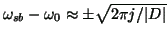 . Our simulations show that the spectral loss
for the side-bands is too large in our case. Thus, the side-band
generation does not contribute to the ultrashort pulse
destabilization for the given parameters.
We thus see that in our case neither the self-phase modulation
induced spectral fragmentation nor the side-bands generation
caused by the dispersion perturbations produce the multiple pulse
operation. However, the former mechanism can cause the chaotical
behavior for
. Our simulations show that the spectral loss
for the side-bands is too large in our case. Thus, the side-band
generation does not contribute to the ultrashort pulse
destabilization for the given parameters.
We thus see that in our case neither the self-phase modulation
induced spectral fragmentation nor the side-bands generation
caused by the dispersion perturbations produce the multiple pulse
operation. However, the former mechanism can cause the chaotical
behavior for
 , where the abrupt nonlinear
transformation due to self-phase modulation is not compensated by
GDD. The latter mechanism, i. e. the side-band generation, can
significantly influence the lasing due to the dispersion wave
amplification when the pulse width approaches
, where the abrupt nonlinear
transformation due to self-phase modulation is not compensated by
GDD. The latter mechanism, i. e. the side-band generation, can
significantly influence the lasing due to the dispersion wave
amplification when the pulse width approaches
 .
The transition to the multiple pulse generation can not be
comprehended without taking into account the dissipative laser
factors, such as the spectral filtering, the saturable, linear and
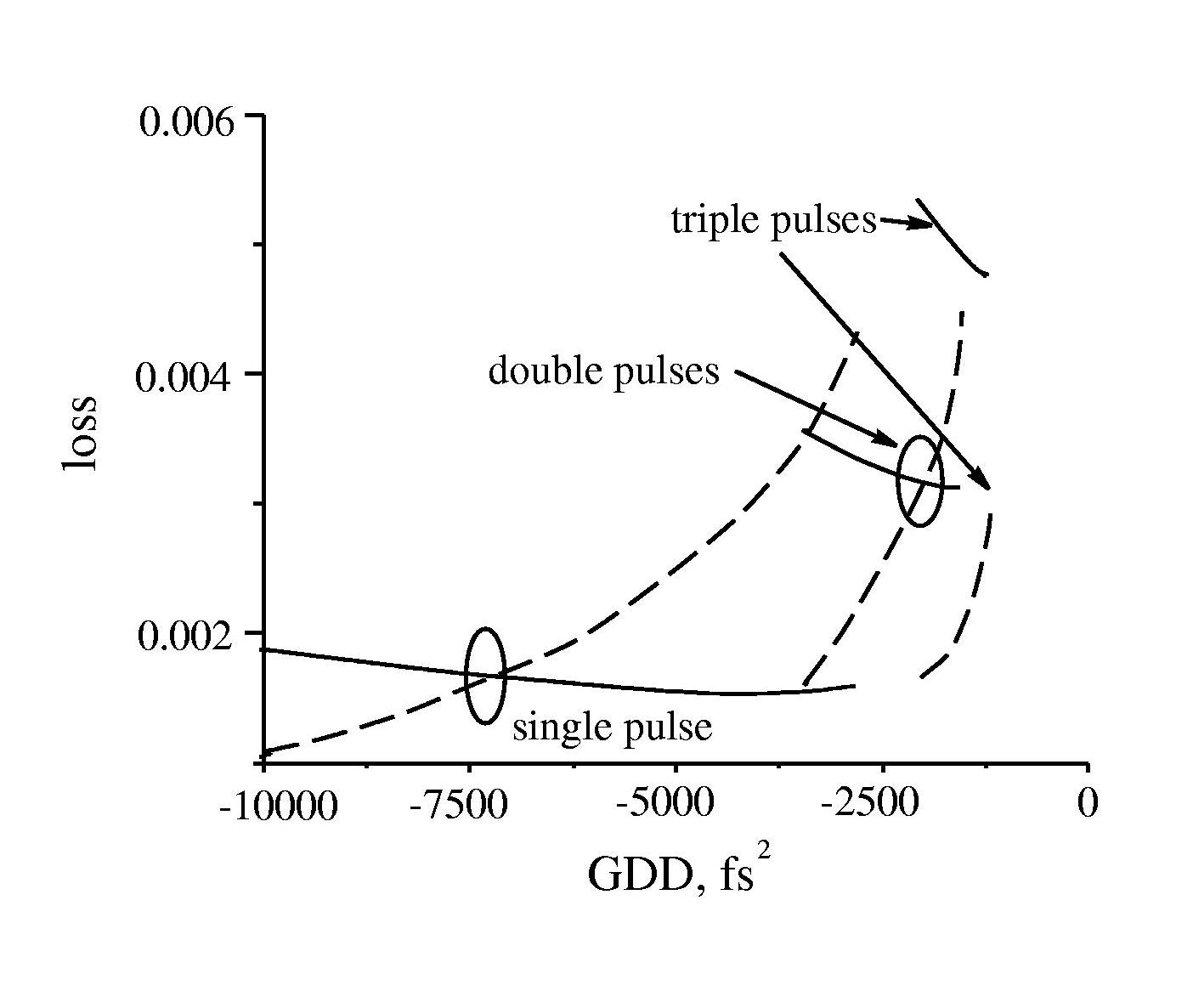
spectral losses. Fig.
shows the dependencies of the
absorber loss saturated by the pulse peak intensity and the
spectral loss for the soliton-like pulse on GDD. One can see, that
the absorber is saturated (solid curves) and almost does not
contribute to lasing. At the same time, approaching zero GDD leads
to the shortening of the pulse width and broadening of the
spectrum. This produces the pronounced spectral loss growth
(dashed curves). Alternatively, for the comparatively large pulse
durations caused, for example, by the large
, the essential
spectral broadening results from the chirp growth in the vicinity
of the stability boundary (but without spectral fragmentation). In
both cases the spectral loss decreases the pulse energy.
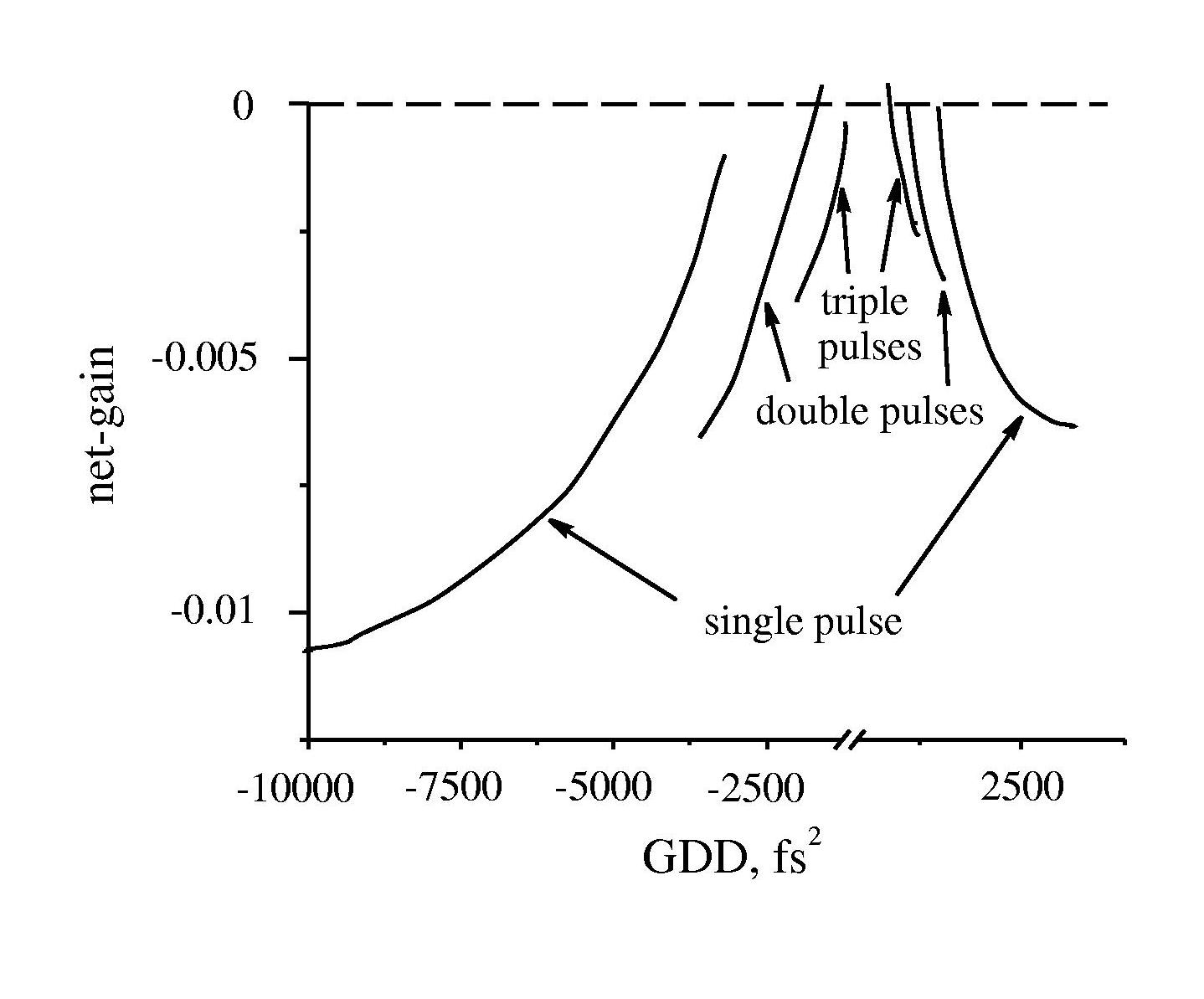
Consequently, the gain saturation is reduced and the net-gain
.
The transition to the multiple pulse generation can not be
comprehended without taking into account the dissipative laser
factors, such as the spectral filtering, the saturable, linear and
spectral losses. Fig.
shows the dependencies of the
absorber loss saturated by the pulse peak intensity and the
spectral loss for the soliton-like pulse on GDD. One can see, that
the absorber is saturated (solid curves) and almost does not
contribute to lasing. At the same time, approaching zero GDD leads
to the shortening of the pulse width and broadening of the
spectrum. This produces the pronounced spectral loss growth
(dashed curves). Alternatively, for the comparatively large pulse
durations caused, for example, by the large
, the essential
spectral broadening results from the chirp growth in the vicinity
of the stability boundary (but without spectral fragmentation). In
both cases the spectral loss decreases the pulse energy.
Consequently, the gain saturation is reduced and the net-gain
 increases and becomes positive (Fig.
). This causes the background amplification on the
pulse wings resulting in the multiple pulse generation (the
analysis of the stability loss in the case of
increases and becomes positive (Fig.
). This causes the background amplification on the
pulse wings resulting in the multiple pulse generation (the
analysis of the stability loss in the case of
 1 is given in [39]). The rise of the background with the
subsequent multiple pulses appearance is clearly visible in Fig.
.
1 is given in [39]). The rise of the background with the
subsequent multiple pulses appearance is clearly visible in Fig.
.
Figure:
The dependence of the saturated absorber
loss
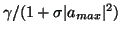 (solid) and spectral loss
(dashed) on the GDD coefficient for the parameters of Fig.
.
(solid) and spectral loss
(dashed) on the GDD coefficient for the parameters of Fig.
.
 is the steady-state pulse peak
intensity.
is the steady-state pulse peak
intensity.
|
|
Figure:
The dependence of the net-gain
coefficient
on
for the parameters of
Fig.
.
|
|
Next: Positive GDD
Up: Multiple pulse operation
Previous: Multiple pulse operation
V.L. Kalashnikov
2002-12-28