


Next: Parameters of the model
Up: Model and parameters of
Previous: Model and parameters of
Model
The main challenge in the simulation of the Kerr-lens mode-locked
lasers is a formulation of the model, which would adequately
describe the laser dynamics and at the same time would not be too
complicated to remain physically meaningful. The soliton approach,
which fulfills the latter requirement, does not take into account
the strong nonlinear behavior of the real-world femtosecond
solid-state lasers. Therefore we make use of the relatively
simple, but sufficiently general numerical model, first presented
in Ref. [34].
The split-step scheme for the simulations of the slowly varying
field amplitude
 evolution can be represented as:
 |
(1) |
 |
(2) |
 |
(4) |
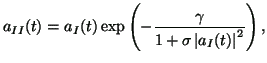
where the different steps within the full cavity
round-trip describe: I - the self-phase modulation action (Eq.
(![[*]](crossref.gif) )), where
)), where
 means the field intensity,
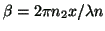 (here
(here
 and
and
 are
the nonlinear and linear refraction indices, respectively;
are
the nonlinear and linear refraction indices, respectively;
 is the double length of the active medium;
 is the
central oscillation wavelength); II - the Kerr-lens induced fast
saturable absorber action defining the self-amplitude modulation
of the field,
is the
central oscillation wavelength); II - the Kerr-lens induced fast
saturable absorber action defining the self-amplitude modulation
of the field,
 is the modulation depth,
 is
the inverse intensity of the loss saturation (Eq. ();
note, that consideration of the strong modulation is necessary in
our case owing to the low critical self-focusing power in ZnSe,
which is only
is
the inverse intensity of the loss saturation (Eq. ();
note, that consideration of the strong modulation is necessary in
our case owing to the low critical self-focusing power in ZnSe,
which is only
 0.2 MW [26] as a result of the
large value of
); III - the spectral filter action with the
inverse bandwidth
0.2 MW [26] as a result of the
large value of
); III - the spectral filter action with the
inverse bandwidth
 , which coincides with the gain
bandwidth,
, which coincides with the gain
bandwidth,
 is the field carrier frequency coinciding
with the minimum of the spectral loss (Eq. ()); IV -
the homogeneously saturated gain and the output loss action with
coefficients
is the field carrier frequency coinciding
with the minimum of the spectral loss (Eq. ()); IV -
the homogeneously saturated gain and the output loss action with
coefficients
 and
and
 , respectively (Eq.
()); and, finally, the net-GDD action with the dispersion
coefficient
, respectively (Eq.
()); and, finally, the net-GDD action with the dispersion
coefficient
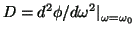 , where
 is the
linear phase retardation of the field (Eq. ()). The full
round-trip results from setting
is the
linear phase retardation of the field (Eq. ()). The full
round-trip results from setting
 =
=
 .
In practice, when the field change over the round-trip is small
(this is valid in our case), the scheme represents the distributed
dynamical equation of Ginzburg-Landau type in the presence of an
arbitrary strong loss saturation:
.
In practice, when the field change over the round-trip is small
(this is valid in our case), the scheme represents the distributed
dynamical equation of Ginzburg-Landau type in the presence of an
arbitrary strong loss saturation:
where
 is the formal longitudinal coordinate (the
cavity round-trip number).
The scheme (-) or, equally, Eq. () has
to be supplemented with an equation for the gain coefficient
evolution, which for the quasi-two level amplification scheme has
the following form:
is the formal longitudinal coordinate (the
cavity round-trip number).
The scheme (-) or, equally, Eq. () has
to be supplemented with an equation for the gain coefficient
evolution, which for the quasi-two level amplification scheme has
the following form:
 |
(7) |
where
 is the pump intensity,
 and
and
 are the pump and the lasing field frequencies,
respectively;
are the pump and the lasing field frequencies,
respectively;
 is the maximal gain for the full
population inversion;
is the maximal gain for the full
population inversion;
 and
and
 are
the absorption and the gain cross-sections, respectively;
are
the absorption and the gain cross-sections, respectively;
 is the gain relaxation time. When the pulse is much shorter
than the cavity round-trip period
is the gain relaxation time. When the pulse is much shorter
than the cavity round-trip period
 , which is
obviously true in our case, and the dynamical gain saturation is
negligible (i. e. there is no time dependence of
on the
scale of the pulse duration), which is correct for the
sub-picosecond solid-state lasers, Eq. () can be easily
integrated to eliminate the time dependence:
, which is
obviously true in our case, and the dynamical gain saturation is
negligible (i. e. there is no time dependence of
on the
scale of the pulse duration), which is correct for the
sub-picosecond solid-state lasers, Eq. () can be easily
integrated to eliminate the time dependence:
 |
(8) |
where
 =
=
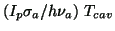 is the dimensionless pump intensity,
 is the pulse energy
flux,
is the pulse energy
flux,
 =
=
 is the gain saturation
energy flux.
The integration of Eq. () over
yields
[17]:
is the gain saturation
energy flux.
The integration of Eq. () over
yields
[17]:
 |
(9) |
 |
|
It is convenient to use dimensionless quantities in the
calculations and we shall normalize the time to
, and
the field intensities to
 . However, we will keep
the dimensional values, where it is necessary for the physical
interpretation. Then the pulse energy flux is normalized to
. However, we will keep
the dimensional values, where it is necessary for the physical
interpretation. Then the pulse energy flux is normalized to
 , resulting in the expression for the dimensionless
inverse saturation energy flux
, resulting in the expression for the dimensionless
inverse saturation energy flux
 =
=
 . This parameter plays a crucial role in
our model since it describes the contribution of the gain
saturation in the lasing dynamics in comparison to the
contribution of the self-phase modulation. Other key parameters
are
, which has the meaning of the pump energy stored
during the cavity period (in the units of absorption saturation
energy), and the dimensionless parameter
, which describes
the strength of the self-amplitude modulation relatively to the
self-phase modulation. With this normalization, the field
intensity
. This parameter plays a crucial role in
our model since it describes the contribution of the gain
saturation in the lasing dynamics in comparison to the
contribution of the self-phase modulation. Other key parameters
are
, which has the meaning of the pump energy stored
during the cavity period (in the units of absorption saturation
energy), and the dimensionless parameter
, which describes
the strength of the self-amplitude modulation relatively to the
self-phase modulation. With this normalization, the field
intensity
 has the physical meaning of
the dimensionless
has the physical meaning of
the dimensionless
 ratio, where
 is
the instantaneous power in the laser beam and
is
the instantaneous power in the laser beam and
 [33] is the critical power of
self-focusing.
In the present form the model is valid not only for the
description of the Kerr-lens mode-locked solid-state lasers but
also for other laser systems with the fast saturable absorber,
viz., the additive-pulse and self-polarization rotation
mode-locked solid-state and fiber lasers. However, we have to note
that in such schemes the strong loss saturation can invert into
self-darkening, which produces the passive negative feedback and
influences the pulse stability [35]. This effect can not
be described by the Eq. () and the results of this paper
can be applicable to additive-pulse and self-polarization rotation
mode-locked systems only as a week nonlinear approximation.
[33] is the critical power of
self-focusing.
In the present form the model is valid not only for the
description of the Kerr-lens mode-locked solid-state lasers but
also for other laser systems with the fast saturable absorber,
viz., the additive-pulse and self-polarization rotation
mode-locked solid-state and fiber lasers. However, we have to note
that in such schemes the strong loss saturation can invert into
self-darkening, which produces the passive negative feedback and
influences the pulse stability [35]. This effect can not
be described by the Eq. () and the results of this paper
can be applicable to additive-pulse and self-polarization rotation
mode-locked systems only as a week nonlinear approximation.
Next: Parameters of the model
Up: Model and parameters of
Previous: Model and parameters of
vova
2002-12-28






