


Next: Ti:sapphire laser (negative GDD)
Up: Multiple pulse operation
Previous: Bounded multiple pulses
Cr:ZnSe laser (positive GDD)
For modelling, we have chosen the experiment described in Ref.
[26] with the following simulation parameters:
 (corresponds to 1.5 W absorbed pump power at 1.61
 m), output coupling
 , and GDD = 3500 fs
 (material dispersion of the Cr:ZnSe crystal and acousto-optic
modulator). As Kerr-lens mode locking mechanism was of the
"soft-aperture" type, the exact value of the
(material dispersion of the Cr:ZnSe crystal and acousto-optic
modulator). As Kerr-lens mode locking mechanism was of the
"soft-aperture" type, the exact value of the
 parameter is
unknown. The level of saturable losses
parameter is
unknown. The level of saturable losses
 was estimated from
the output power level to be up to two times higher than the
losses due to the output coupler. In the simulation, the ranges of
and
are 0.01
was estimated from
the output power level to be up to two times higher than the
losses due to the output coupler. In the simulation, the ranges of
and
are 0.01 0.02 and 510,
respectively.
Within these ranges, the modelling predicts the stable
multipulsing with 2 to 28 pulses simultaneously present in the
cavity. The typical pulse duration was 0.3-5 ps, distance between
pulses 1 - 15 ps. Figure
0.02 and 510,
respectively.
Within these ranges, the modelling predicts the stable
multipulsing with 2 to 28 pulses simultaneously present in the
cavity. The typical pulse duration was 0.3-5 ps, distance between
pulses 1 - 15 ps. Figure
![[*]](crossref.gif) compares the simulated
autocorrelation trace (pulse duration 4.4 ps, pulse distance 11.3
ps) with the experimental autocorrelation signal [26]
(pulse duration 4.5 ps, distance 13.5 ps). The result was obtained
using
compares the simulated
autocorrelation trace (pulse duration 4.4 ps, pulse distance 11.3
ps) with the experimental autocorrelation signal [26]
(pulse duration 4.5 ps, distance 13.5 ps). The result was obtained
using
 and
and
 parameters, both within
the expected range of parameters and demonstrates validity of the
model in the positive GDD regime.
parameters, both within
the expected range of parameters and demonstrates validity of the
model in the positive GDD regime.
Figure:
Simulated and experimental
autocorrelations of the multiple pulse Kerr-lens mode-locked Cr:ZnSe laser
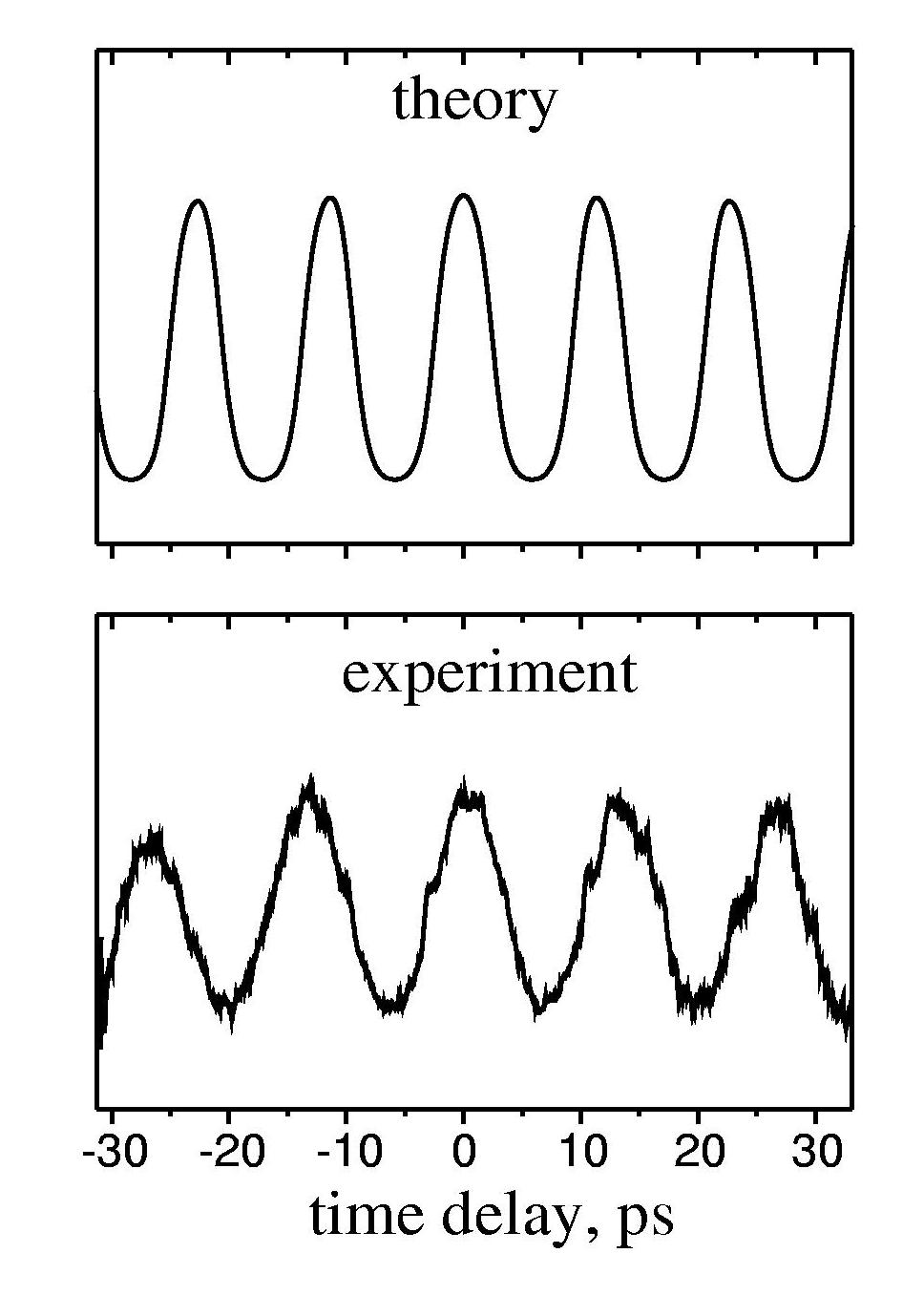 .
|
Next: Ti:sapphire laser (negative GDD)
Up: Multiple pulse operation
Previous: Bounded multiple pulses
V.L. Kalashnikov
2002-12-28