Next: Limits of ultrashort pulse
Up: Multiple pulse operation
Previous: Cr:ZnSe laser (positive GDD)
Ti:sapphire laser (negative GDD)
The multipulsing behavior of this laser is well-documented (see,
for example, [19,20,4,13]). We will apply
our model to the experiment from Ref. [13] inasmuch as
in this work the stability of the single pulse generation was the
subject of the special investigation and comprehensive
experimental data is available.
We choose the following simulation parameters:
 =
1.44
=
1.44
 , corresponding to 2.5 W pump power at 488 nm
with 28
, corresponding to 2.5 W pump power at 488 nm
with 28
 m Gaussian beam diameter; output coupling
 =0.025;
 =0.044, 0.024, 0.015, that corresponds to
1.5, 2 and 2.5 mm aperture diameters, respectively.
We obtained the following results of the simulations. For the
maximal diffraction loss (=0.044) both CW and ultrashort
pulse generation are suppressed as it took place in the
experiment. The choice of the other two values of
results
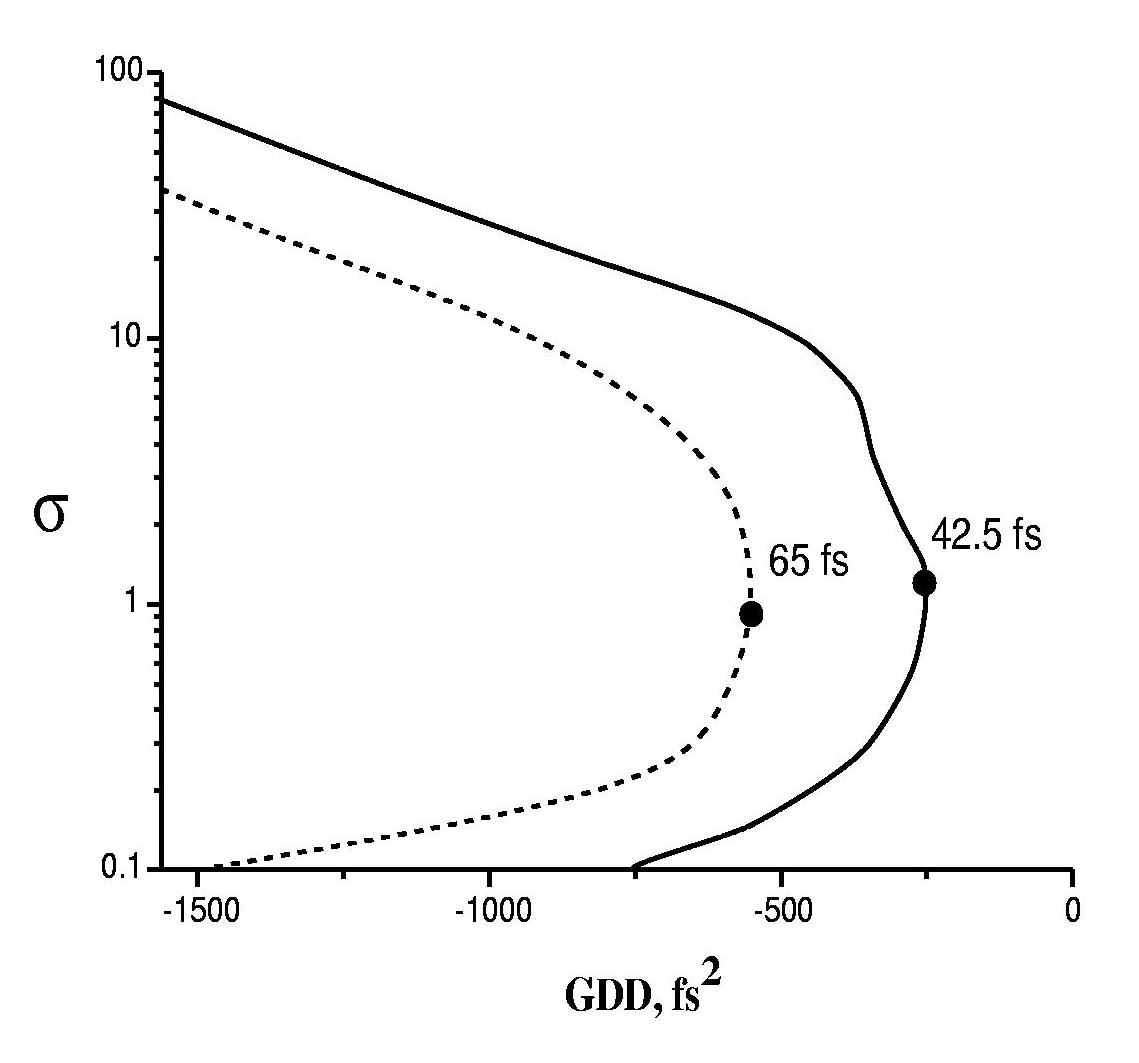
in the stable single pulse generation. The corresponding regions
are shown in Fig.
=0.044, 0.024, 0.015, that corresponds to
1.5, 2 and 2.5 mm aperture diameters, respectively.
We obtained the following results of the simulations. For the
maximal diffraction loss (=0.044) both CW and ultrashort
pulse generation are suppressed as it took place in the
experiment. The choice of the other two values of
results
in the stable single pulse generation. The corresponding regions
are shown in Fig.
![[*]](crossref.gif) , where the curves, as usually,
represent the boundaries of the single pulse stability regions.
=0.024 is close to the optimal value of the modulation
depth (see Fig. 1 in [13]). In this case the single
pulse generation takes place in the widest region on our
parametrical plane (solid curve). The minimal pulse duration is
42.5 fs, which is in good agreement with the experimental data
(see Fig. 2 in [13]). The estimated experimental values
of
, where the curves, as usually,
represent the boundaries of the single pulse stability regions.
=0.024 is close to the optimal value of the modulation
depth (see Fig. 1 in [13]). In this case the single
pulse generation takes place in the widest region on our
parametrical plane (solid curve). The minimal pulse duration is
42.5 fs, which is in good agreement with the experimental data
(see Fig. 2 in [13]). The estimated experimental values
of
 were
were
 0.5
0.5 0.7, which are close to the
optimal values in our simulations (see Fig.
) and
are located on the lower stability boundary. The destabilization
for these
occurs when
0.7, which are close to the
optimal values in our simulations (see Fig.
) and
are located on the lower stability boundary. The destabilization
for these
occurs when
 -350 fs
 . This quite agrees
with the experimental data.
. This quite agrees
with the experimental data.
Figure:
The regions of the pulse stability for
Ti:sapphire. Solid and dashed lines represent the single pulse
stability boundary for
=0.024 and
=0.015,
respectively.
|
|
The decrease of
produces the shortening of the single
pulse stability region (dashed curve in Fig.
). In
this case, as it was found in [13], the single pulse
operation is suppressed by the multipulsing or CW generation. As a
result, the minimal pulse duration increases due to higher minimal
 .
This comparison demonstrates that the model is in quantitative
agreement with the experimental data for the Ti:sapphire laser and
the pulse destabilization scenarios in question have a general
character.
.
This comparison demonstrates that the model is in quantitative
agreement with the experimental data for the Ti:sapphire laser and
the pulse destabilization scenarios in question have a general
character.
Next: Limits of ultrashort pulse
Up: Multiple pulse operation
Previous: Cr:ZnSe laser (positive GDD)
V.L. Kalashnikov
2002-12-28