Next: Nature of the stability
Up: Multipulse Operation and Limits
Previous: Ti:sapphire laser (negative GDD)
Limits of ultrashort pulse stability
As it was shown in Section
![[*]](crossref.gif) , there exist two basic
mechanisms of the ultrashort pulse destabilization, which cause
stable multipulse operation, viz., background amplification due to
insufficient gain saturation by the pulse with reduced energy or
excitation of the perturbation bounded within the high-energy
ultrashort pulse. Hence there may exist a certain range of
parameters providing a stable ultrashort pulse operation.
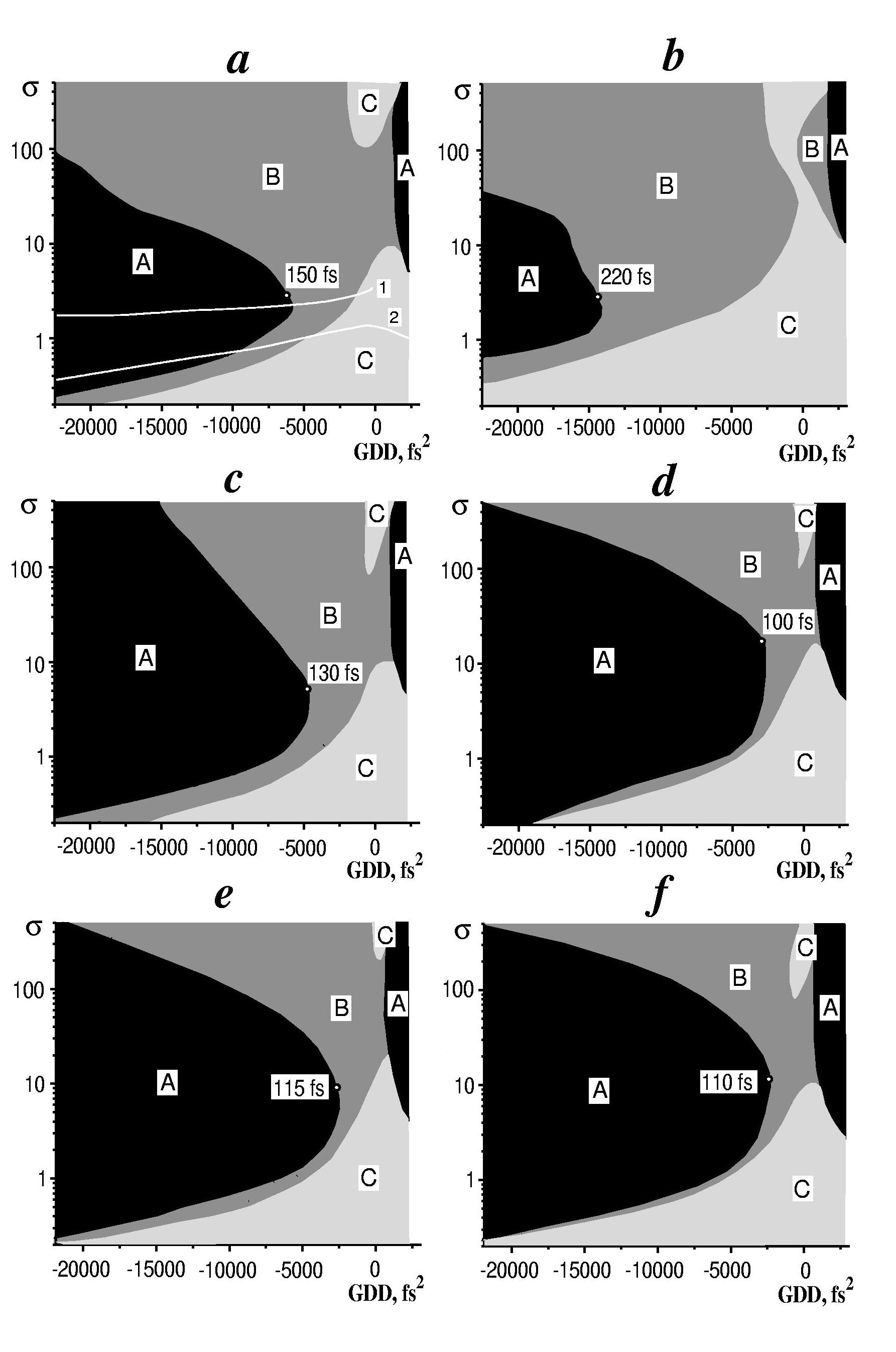
The Figs.
, a - f demonstrate such regions on
the parametric plane, viz., the GDD and
, there exist two basic
mechanisms of the ultrashort pulse destabilization, which cause
stable multipulse operation, viz., background amplification due to
insufficient gain saturation by the pulse with reduced energy or
excitation of the perturbation bounded within the high-energy
ultrashort pulse. Hence there may exist a certain range of
parameters providing a stable ultrashort pulse operation.
The Figs.
, a - f demonstrate such regions on
the parametric plane, viz., the GDD and
 coefficients.
Increase of
corresponds to a shift towards the edge of
the cavity stability region. The confined regions A
correspond to the stable single pulse operation (for negative as
well as positive values of the GDD coefficient). The B
regions depict the stable multipulse operation. And, finally, the C regions are the domains of the unstable pulsed operation
or the CW generation (on the lower boundaries of B). In Fig.
, graph a is used as the reference and other
pictures b - f are obtained by variation of only one of
the parameters. In particular, graph b illustrates the
decrease of the modulation depth
coefficients.
Increase of
corresponds to a shift towards the edge of
the cavity stability region. The confined regions A
correspond to the stable single pulse operation (for negative as
well as positive values of the GDD coefficient). The B
regions depict the stable multipulse operation. And, finally, the C regions are the domains of the unstable pulsed operation
or the CW generation (on the lower boundaries of B). In Fig.
, graph a is used as the reference and other
pictures b - f are obtained by variation of only one of
the parameters. In particular, graph b illustrates the
decrease of the modulation depth
 , graph c - the
increase of the output loss
, graph c - the
increase of the output loss
 , graph d - the
increase of the
, graph d - the
increase of the
 parameter, graph e - the
decrease of the pump
parameter, graph e - the
decrease of the pump
 , and finally graph f - the
decrease of the gain relaxation time
, and finally graph f - the
decrease of the gain relaxation time
 .
.
Figure:
The regions of a pulse stability. The
parameters are varied relatively the figure (a):
(b) corresponds to the
decrease, (c) -
the
increase, (d) - the
increase,
(e) - the pump decrease, (f) - the
decrease. P=
 (a - d, f),
 (e);
(e);
 =6
=6
 s (a -
e), 3 (f);
=0.0013 (a - c, e, f),
0.0026 (d);
=0.01 (a, b, d - f), 0.02
(c);
=0.02 (a, c - f), 0.01
(b). A are the regions of the stable single pulse
generation, B are the regions of the stable multiple pulse
operation and C are the regions of the chaotical or CW
lasing. Curve 1 shows the parameters providing the chirp-free
pulse generation in the soliton model, curve 2 is the limit of the
pulse stability from the soliton model.
s (a -
e), 3 (f);
=0.0013 (a - c, e, f),
0.0026 (d);
=0.01 (a, b, d - f), 0.02
(c);
=0.02 (a, c - f), 0.01
(b). A are the regions of the stable single pulse
generation, B are the regions of the stable multiple pulse
operation and C are the regions of the chaotical or CW
lasing. Curve 1 shows the parameters providing the chirp-free
pulse generation in the soliton model, curve 2 is the limit of the
pulse stability from the soliton model.
|
|
As we can see, there always exist certain upper and lower limits
on
for stable single pulse operation. The lower boundary
(small
, i. e. the absorber is too "hard" to be saturated)
is caused by the background amplification and can separate the
single pulse operation from the multiple pulses as well as also
from CW lasing (for the positive and large negative GDD). The
upper boundary (large
, i. e. "soft" absorber with low
saturation intensity) results from the destabilization due to the
bounded perturbation growth. It should be noted, that as a result
of the strong hysteresis, the upper stability boundary has a
"fuzzy" character (Fig.
)
Subsections
Next: Nature of the stability
Up: Multipulse Operation and Limits
Previous: Ti:sapphire laser (negative GDD)
V.L. Kalashnikov
2002-12-28