 KNOWING
ME
IS KNOWING
YOU
KNOWING
ME
IS KNOWING
YOU
|Home| |About Us| |Participants| |Digital Learning and Teaching Modules| |Teachers' Corner| |Feedback| |Recognition| |Contact Us|
|
|Home| |About Us| |Participants| |Digital Learning and Teaching Modules| |Teachers' Corner| |Feedback| |Recognition| |Contact Us| |
|
ACTIVITIES Famous Stories Travel around the World
|
CUSTOMS AND TRADITIONS Click here to see other contributions
It’s celebrated on the 21st of March. In cities, towns and villages people celebrate this holiday, the eastern New Year, which is a holiday that celebrates the awakening of nature, and promotes friendship, fraternity and cultural and historical traditions. March is the spring equinox, meaning that the day is equal to the night everywhere on the planet. Our ancestors considered this day the beginning of the astronomical year. Uzbek scientists of the past wrote that Navruz was celebrated long, and long ago. During the Arab invasion in Central Asia, Navruz was prohibited, but after the downfall of the Arab Khalifate in the 9th and 10th centuries it was revived again. The young and the old prepare for Navruz in a flurry of spring cleaning, washing, scrubbing, painting and decorating of homes. A week before the holiday many people take part in public wide khashars, (voluntary, unpaid work performed collectively). Women cook a wide variety of delicious food such as palov, shashlik, khasip, kuk somsa and monti, and different sweets. Only the best of cooks are entrusted with the important task of making sumalak. Sumalak is boiled for more than 24 hours in big cauldrons, the bottoms of which are covered with little washed river stones and nuts. According to customs, those who get a stone when the dish is served in plates or cups will be fortunate in the coming year and their dreams will come true. Ramadan and Id-ul-Fitr Qurban Hait
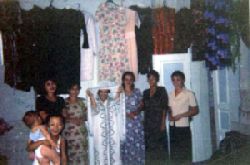
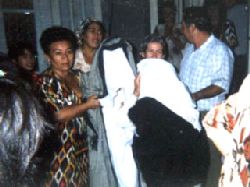
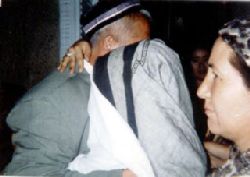
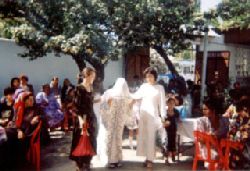
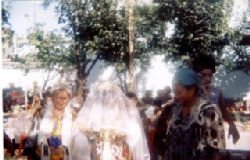
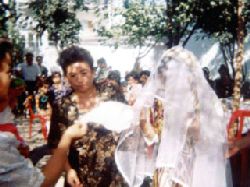
By a tradition, first, groom’s parents go to the bride’s home to ask if her parents agree to connect their children's' life. Before going to bride’s home, they ask from everyone: neighbours, teacher and from other bride’s friends to find the answer for the question “what kind of girl is she?” The groom’s side usually asks many questions. Who were seven ancestors of this girl? Does she cook well? Is she going to be a good housewife or a good wife for their son? Usually Uzbek boys usually agree with their parents choice. Then parents or boy’s grandparents go to the girl’s home to ask for the girl’s hand. When they go for the first time to the bride’s home, boy’s side bring 10 “non “s, sweets and white dress for new bride with themselves in a white tablecloth. There are symbols for each of these things. For example candies “New couple's life will be sweet as candy”, white tablecloth means future bride’s sole to be as white as that tablecloth. If the bride’s side agrees, they share non (bread), and they many handkerchiefs for groom. “Ok kiydi” means “white dressing” and it symbolizes that new couples are engaged. After “ok kiydi” groom’s side should bring 80 kg of refined cotton and 60 kg of flour and some other candies. What do you think? Bride’s side gives more things than groom’s side. They buy all dresses for groom. Usually in Zags new couples of friends go to eat ice- cream and put flowers to Al-Fargoniy. After this, they go to the registration office (in Uzbek it is ZAGS). In registration office they sign some documents and they will be married legally. After this ceremony new couples go to the boy’s home. When they will be coming to the groom’s house, candies are spread over their head. It means new couple’s new steps will bring happiness to this home. After this they go back to the bride’s home for religious agreement which will be hold by DOMLA. In this ceremony the groom's uncle should pay some money for BRIDE’S aunt. If the money is not so enough, girl’s side usually can make “discounts” with the boy’s relatives. During entreat domla asks 3 times, if the girl agrees to connect her life with the groom. After this ceremony they go to the brides’ home to have our big wedding party. There will be Uzbek singers who sing really fast songs. Everyone dances and congratulates new brides. In the wedding bride usually wears a white dress. In Uzbek it is “kelin kuylak”. The girl often cries a lot when she says “bye” to everyone. Usually new “kelin” goes from her parent’s home forever. By the way to the boy home kelin’s relatives sing a song. Usually kelin’s relatives go to the boy’s home by bus. On the bus they sing our traditional song. This is “yiglama yor-yor to’y saniki yor yor”. It means “don’t cry, this is your day, why are you crying, on this day you should be happy”. When the bus comes to the boy’s house, boy’s mum gives sweet water. Then the boy bride carries her down the bus. If the boy side doesn’t give a knife to the girl’s brother, the bride will not get off the bus. Near the boy’s home, there will be often a fire and new brides should walk around the fire three times. It means that new brides’ life will be as warm as fire.
After this the wedding starts. First, bride should pray for everyone
and to the boy’s relatives, neighbours. For this moment we’ve a special song.
For each guest special song. After this songs end, the wedding party will begin,
fiancée’s and bride’s friends congratulate them. After five or 6 hours long
party wedding ends. On the second day there is another part of the wedding
called “Yuz ochdi”. It means “face opening”. Only women participate in this
ceremony. The bride wears a handkerchief covering her face with it. Fiancée's
nephew opens her face later. The Fiancée's side gives gifts to the bride. After
10 days another ceremony, called “Ota ko’rdi” takes place. The bride’s father
brings gifts to her daughter. The bride can’t go to her own house unless her
parents call her with another special ceremony.
|
Coming up soon Our Global Calendar
|
|
© Project coordinator: Andreea Silter, Department of English, School No. 191, Bucharest, Romania Last updated: 03/05/2008 |
 Gymnasium No. 9, Asaka, Andijan region,
Uzbekistan
Gymnasium No. 9, Asaka, Andijan region,
Uzbekistan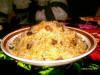 On Arafa (a day
before Qurban Hait) we give Polov (our tasty national food) to our
neighbors and so do they. After that we have the holiday called Qurban
Hait. That day we give alms to poor families and money to kids. That day
we remember our dead relatives and visit their tombs in memory. It is a
very old holiday like Navruz.
On Arafa (a day
before Qurban Hait) we give Polov (our tasty national food) to our
neighbors and so do they. After that we have the holiday called Qurban
Hait. That day we give alms to poor families and money to kids. That day
we remember our dead relatives and visit their tombs in memory. It is a
very old holiday like Navruz.