|
Surround Sound Formats
2.1 Dolby Surround and Dolby Pro
Logic
2.2 Dolby Digital
2.3 Digital Theater System (DTS)
Chapter 2: Surround Sound
Formats
In the early days of sound recordings, all recordings
were monophonic offering only one single channel of recording and reproduction
[1]. As technology progress, Stereo sound recording was developed in the 1930�s
for the motion picture industry. This uses three discrete audio channels �
Left, Center and Right - to create a sound field that could surround the
audiences, as well as ambient sound from all directions. In the mid 1950�s rear
channel loudspeakers were introduced in motion picture theaters for both
ambience and especially sound effects.
For home audiences, simple three channels � left, right,
and rear � system was proposed in the 1970�s. This uses an additional
loudspeaker placed behind the listener to enhance the sense of envelopment of a
conventional stereo effect. Refer to figure 2.1 below for a simple
three-channel system proposed by David Hafler. The difference signal (Left
minus Right) of conventional stereo program material is used to derive the rear
channel information.
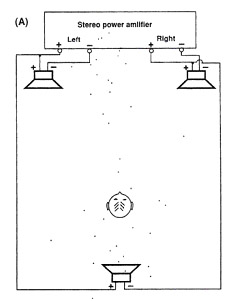
Figure 2.1:
Single rear loudspeaker employing the Hafler System.
For further enhancement, two rear loudspeakers were used
to increase the sense of spaciousness. These speakers were placed at the sides
behind the listener. Refer to figure 2.2 below.
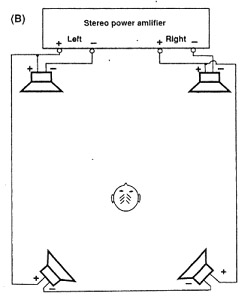
Figure 2.2:
Increased spatial envelopment can be achieved by using two loudspeakers. The
signals produced by the two rear loudspeakers are out of phase (wired
out-of-polarity) with each other.
As we progress into the present years, advances in
technology and research and development in sound recording and reproduction
leads to various sophisticated surround systems such as the Dolby Surround,
Dolby Pro Logic, Dolby Digital (AC-3), and Digital Theater System (DTS), which
incorporate highly sophisticated encode/decode processes and more complex
loudspeaker arrangements.
All of these developments on surround sound technology
contributed significantly to the total experiences of the audience.
2.1 Dolby Surround and Dolby Pro Logic
Dolby Surround:
Developed in the 1970�s, Dolby Surround is a matrix
system that combines four audio channels into two channels for storage on
recording media. When playback in home-theater system with Dolby decoder, the
two channels will be separated into the original four channels. The four
decoded channels correspond to the left, center, right, and surround
loudspeakers. The two surround speakers are fed the same monaural signal.
Refer to figure 2.3 [2] below.
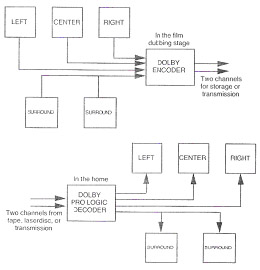
Figure 2.3: Dolby Surround encoding
and decoding
Limitation of Dolby Surround System:
Dolby Surround, because it is a matrix system, have
inherent poor channel separation problem � i.e. sounds in one channel can leak
into other channels. This resulted in less precise localization of onscreen
sounds.
Another problem is that the surround channel is monaural
� the same signal feeds both the left and right surround loudspeakers. There is
no way to �steer� sounds on these two loudspeakers.
Dolby Pro Logic:
Dolby Pro Logic is an enhanced version of Dolby Surround
decoding. It differs in providing a center-channel output, greater separation
of sounds in the channels, and better localization of onscreen sounds.
In additional to decoding the recorded two audio channels
into left, center, right, and surround channels, Pro-Logic decoders usually have
a sixth output for driving a subwoofer, whose output is a monaural mix of the
front-channel information below 100Hz. It is created simply by mixing the bass
from the front channels together, releasing the main left and right loudspeakers
in producing low bass, and thus can be small and unobtrusive.
Refer to figure 2.4 [1] below. In summary Pro Logic
provides four playback channels for six loudspeakers � left, center, right, 2x
surround, and subwoofer.
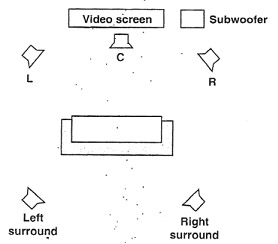
Figure 2.4:
Dolby Pro Logic loudspeakers layout
2.2 Dolby Digital
Developed in the 1990�s, also known as AC-3, Dolby
Digital is a digital format system. Dolby Digital overcomes the limitation of
Dolby Surround. It provides six discrete (separate) audio channels, eliminating
any chance of unwanted sound from one channel leaking into another like in the
matrix system Dolby Surround that �folded� surround and center channels
information into left and right channels for separation on playback. With the
�split� surround channels rather than a monaural surround channel, we can now
hear sounds to the left or right rear, resulting in an unprecedented ability to
precisely steer sounds around.
Unlike Dolby Surround where the subwoofer output is
merely a monaural mix of front three channels� bass information below 100Hz,
Dolby Digital provides a separate channel for low bass called Low-Frequency
Effects (LFE).
With five discrete, full bandwidth channels plus the
separate LFE channel, Dolby Digital is called a �5.1-channel� format.
Limitation:
Dolby Digital sound storage-format is near-CD-quality.
It produces a single data stream with a data rate of 384,000 bits per second for
all six channels, compared to a CD two channels of digital audio with 1,411,200
bits per second. Dolby Digital encodes each channel with less than a tenth as
many bits as are used on a CD. Thus the sound quality is inferior to that of a
CD.
2.3 Digital Theater System (DTS)
A competing digital surround format to Dolby Digital, the
Digital Theater System (DTS) offers higher audio quality than Dolby Digital.
Generally known as DTS format, it uses 1,411,200 bits per second in �master
quality� mode to produce a higher quality six channel audio signal.
Like Dolby Digital, it delivers 5.1 channels of
surround-sound audio, and can also be used as a 7.1-channel system with
additional two more surround speakers.
|