|
Introduction
1
1.1 Understanding the human
auditory system 1
1.2 Interaural Level Difference (ILD)
1
1.3 Interaural Time Difference (ITD)
1
1.4 Head-Related Transfer Function
(HRTF) 2
Chapter 1: Introduction
Our sense of hearing is a heavenly gift in life. It let
us have acoustic localization in addition to visual imaging. In recent years of
mankind, we have developed means of recording our speeches and music, and
reproducing them for appreciation.
1.1
Understanding the human auditory system
Before proceeding further, it is important to understand
how human auditory system makes use of the various localization cues to locate
an auditory event.
John William Strutt (Lord Rayleight) understood at least
part of the localization process more than 120years ago [5]. Because human have
two ears, there will be difference in the sound arriving at the left and right
ear, and this difference is an important clue to where the location of the sound
source. This leads to the following important cues where our brains recreate a
three-dimensional image of the acoustic landscape from the sounds we hear.
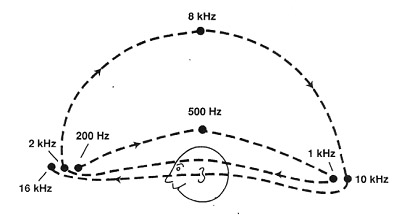
Figure 1.1:
The apparent direction of tonal signals from
loudspeakers in the median plane depends on the frequency of the tone .
1.2
Interaural Level Difference (ILD) [3]
The standard comparison between intensities in the left
and right ears is known as the interaural level difference (ILD). The ILD is a
strong function of frequency over much of the audible frequency, 20 � 20 000Hz.
For frequency below 500Hz, because of the wavelength longer than the diameter of
our human head, sound waves are effectively diffracted, and therefore the
difference is too small to be used as cue. And at 4000Hz, the human head casts
a significant shadow to prevent any sound to the other ear.
Figure 1.2 below summaries the above cues and their
effectiveness in the frequency spectrum.

Figure 1.2:
Localization cues effectiveness
1.3
Interaural Time Difference (ITD) [3]
Psychoacoustical experiments show that human can make use
of the difference in phases of sound arriving in each ear � interaural time
difference (ITD) to localize sound. At 500Hz, near the forward direction,
listeners are sensitive to differences as small as 1 to 2 degrees. However the
binaural system rapidly loses sensitivity to any ITD at all as the frequency of
the wave increases from 1000 to 1500Hz, exactly the range in which the interaural phase difference becomes ambiguous.
1.4
Head-Related Transfer Function (HRTF)
Sound waves are also scattered by our head, shoulders,
upper torso, and outer ears, and leads to an acoustic filtering of the signals
appearing at the left and right ears. This filtering can be described by a
complex response function known as the head-related transfer function (HRTF).
Because of the HRTF, the followings were observed.
Waves from behind tend to be boasted in the 1000Hz
region.
Waves from forward are boasted near 3000Hz.
At 6KHz and above, elevation of a sound source increases
from below to above the head. In particular, at 7KHz to 8KHz, is though to be a
prominent cue for a source overhead. Refer to figure 1.1 for localization in
the median plane.
The strategy of parallel processing and re-weighting of
ILD and ITD localization cues, and precedence effect are used to help human
localize sound.
|