|














Best viewed at 1400 x 1050 on Internet Explorer
5.5
Please take the time to sign our guest
book. This enables us to see who our site is getting to, and improve on
how we are doing.
Sign
Guest book
View
Guest book

| |
|

Listed are two charts, the first from the Ontario
Ambulance Act, and the second from a document written by the Thunder Bay
Regional Base Hospital Program. These are baseline skills, which are
set out for Paramedics across the province of Ontario. Depending on
the service (District), and the wishes of the taxpayers, depends on the
skills each level of Paramedic is allowed to provide.
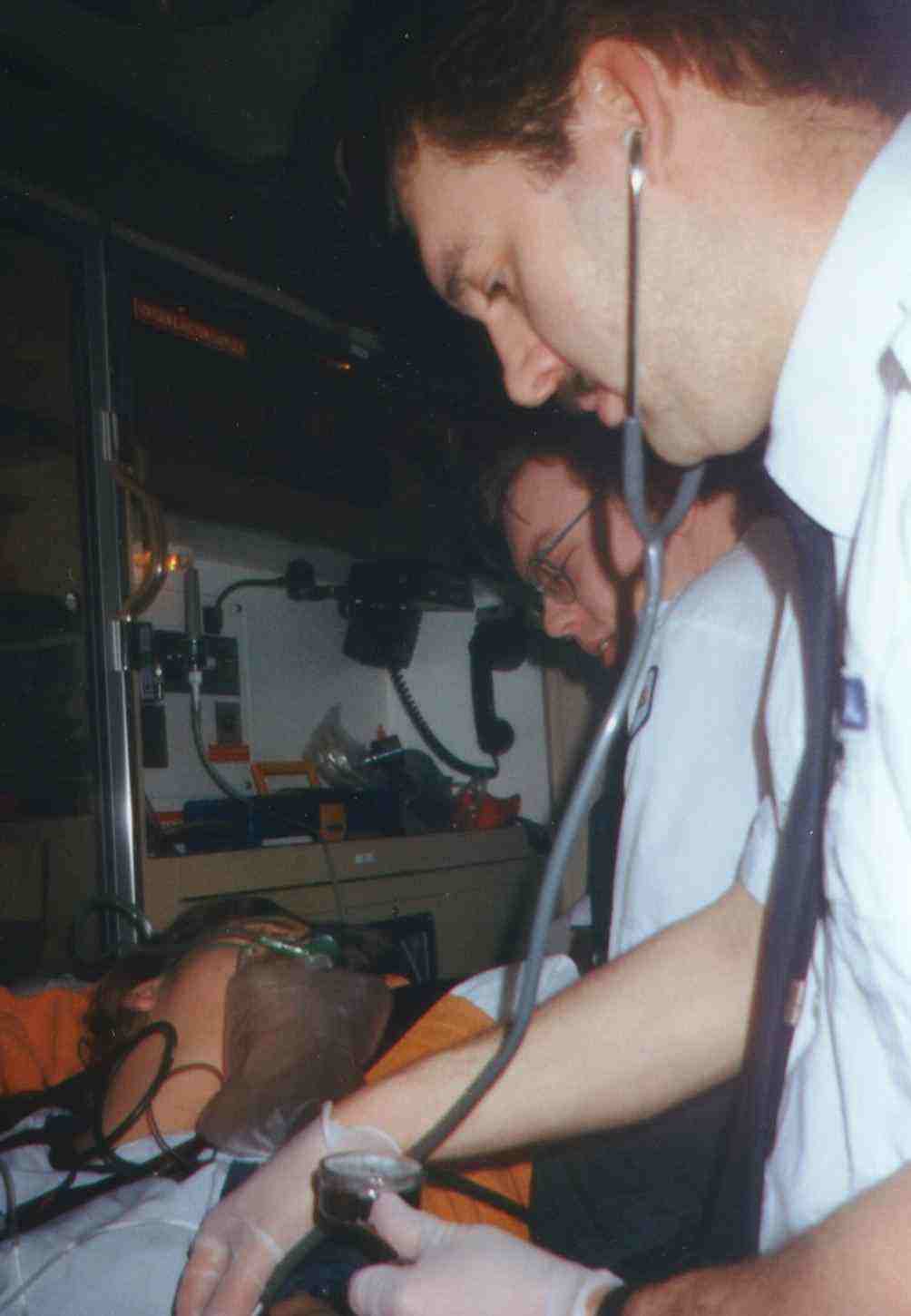
Ontario Land Ambulance Paramedic Skills
Information taken from the Ambulance Act of Ontario
| |
Primary Care Paramedic |
Advanced Care Paramedic |
Critical Care Paramedic |
| 1 |
Administration of glucagon, oral glucose,
nitroglycerin, epinephrine, salbutamol and ASA (80mg form) |
x |
x |
x |
| 2 |
Semi-Automated external cardiac defibrillation |
x |
x |
x |
| 3 |
Administration of drugs referred to in item 1, in
addition to any other drug approved by the Director on the
recommendation of one or more medical directors of base hospital
programs |
|
x |
x |
| 4 |
Peripheral intravenous therapy |
|
x |
x |
| 5 |
Endotracheal intubation |
|
x |
x |
| 6 |
Non-Automated external cardiac defibrillation and
monitoring |
|
x |
x |
| 7 |
Administration of any drug that an advanced care
paramedic may administer under item 3, in addition to any other drug
approved by the Director on the recommendation of one or more
medical directors of base hospital programs |
|
|
x |
| 8 |
Non-Automated external cardiac defibrillation,
electrical cardioversion and pacing |
|
|
x |
| 9 |
Maintenance and monitoring of arterial and central
venous catheters |
|
|
x |
| 10 |
Gastric intubation and suction |
|
|
x |
| 11 |
Ventilation (mechanical) and setting of ventilatory
parameters |
|
|
x |
| 12 |
Lab blood value interpretation |
|
|
x |
| 13 |
Chest x-ray interpretation |
|
|
x |
| 14 |
Urinary catheter insertion |
|
|
x |
| 15 |
Intravenous blood product administration |
|
|
x |
| 16 |
Doppler flow monitor use |
|
|
x |
| 17 |
Pulse oximeter use and tidal volume carbon dioxide
monitoring |
|
|
x |
| 18 |
Use of infusion pumps |
|
|
x |
| 19 |
Other advanced airway techniques, e.g. needle
thoracostomy, cricothyroidotomy |
|
|
x |
Note: Depending on
the area of the province, Primary or Advanced Care Paramedics may also
perform other skills under control of the local Base Hospital and Service
management. This allows areas (services) to meet the demands of the
patients whom they serve. Therefore, you may see Primary Care
Paramedics using Pulse Oximetry, Manual Defibrillation, Intubation, I.V.
initiation, etc... or Advanced Care Paramedics doing some of the skills of
a Critical Care Paramedic.
Air Ambulance Paramedic Skills
NOTE:
INFORMATION
OBTAINED FROM THE DOCUMENT
"THE
ONTARIO AIR AMBULANCE SYSTEM"
PREPARED
BY THUNDER BAY REGIONAL BASE HOSPITAL PROGRAM
| Airway/Ventilatory
Compromise Skills |
Primary
Care Paramedic |
Advanced
Care Paramedic |
Critical
Care Paramedic |
| Oral/Nasal Airway |
Y |
Y |
Y |
| Positive Pressure Ventilation with BVM |
Y |
Y |
Y |
| Suctioning Mouth and Nose |
Y |
Y |
Y |
| Oximetry |
Y |
Y |
Y |
| Endotracheal Intubation (oral/nasal) |
|
Y |
Y |
| Endotracheal Suctioning |
|
Y |
Y |
| Magill Forcep Utilization |
|
Y |
Y |
| Needle Thoracostomy |
|
Y |
Y |
| Gastric Intubation (oral/nasal) and Suction |
|
Y |
Y |
| Capnography |
|
Y |
Y |
| Chest X-ray Interpretation |
|
Y |
Y |
| Percutaneous Cricothyroidotomy |
|
Y |
Y |
| Arterial Blood Gas Interpretation |
|
|
Y |
| Mechanical Vent with Manometry and Respirometry |
|
|
Y |
| Pharmacologically Assisted Airway Management |
|
|
Y |
| Chest Tube with Underwater Seal Maintenance |
|
|
Y |
| Surgical Airways |
|
|
799 |
| Cardiovascular
Compromise |
Primary
Care Paramedic |
Advanced
Care Paramedic |
Critical
Care Paramedic |
| Defibrillation for Ventricular Fibrillation |
Y |
Y |
Y |
| Defibrillation for Pulseless Ventricular Tachycardia |
Y |
Y |
Y |
| Intravenous Cannulation |
|
Y |
Y |
| Fluid Bolus Initiation |
|
Y |
Y |
| Intraosseous Access |
|
Y |
Y |
| Drug Administration |
|
Y |
Y |
| EKG Interpretation |
|
Y |
Y |
| Synchronized Cardioversion |
|
Y |
Y |
| Transcutaneous Pacing |
|
Y |
Y |
| Urinary Catherization |
|
Y |
Y |
| Blood Product Administration |
|
|
Y |
| PASG Application and Inflation |
|
|
Y |
| Pentaspan Administration |
|
|
Y |
| Arterial/Central Line Monitoring |
|
|
Y |
| Maintenance of Transvenous Pacing |
|
|
Y |
| Obstetrical/Neonatal
Transfer |
Primary
Care Paramedic |
Advanced
Care Paramedic |
Critical
Care Paramedic |
| Assess and Recognize Obstetrical Emergencies |
Y |
Y |
Y |
| Delivery of Neonate |
Y |
Y |
Y |
| Assess Fetal Heart Rate with Doppler Monitor |
|
|
Y |
| Operate Transport Incubator |
|
|
Y |
| Use Meconium Aspirator |
|
|
Y |
| Drug
Administration |
Primary
Care Paramedic |
Advanced
Care Paramedic |
Critical
Care Paramedic |
| Administer Drugs via S/L; S/C; PO; PR and Nebulized
Routes |
Y |
Y |
Y |
| Administer Nitro Spray; ASA, Epi 1: 1,000 |
Y |
Y |
Y |
| Administer Glucagon and Ventolin |
Y |
Y |
Y |
| Administer Drugs via ETT; IV; IO; and IM Routes |
|
Y |
Y |
| Administer Drugs via Infusion Pump , Transdermal and
Aerosol |
|
Y
|
Y
|
Note: Depending on
the area of the province, Primary or Advanced Care Paramedics may also
perform other skills under control of the local Base Hospital and Service
management. This allows areas (services) to meet the demands of the
patients whom they serve. Therefore, you may see Primary Care
Paramedics using Pulse Oximetry, Manual Defibrillation, Intubation, I.V.
initiation, etc... or Advanced Care Paramedics doing some of the skills of
a Critical Care Paramedic.
Are
you a practicing Paramedic in another province or state and looking to
work in Ontario? Please go to this page from the Ministry of Health
and Long-Term Care, Emergency Health Services (Land and Air Ambulance) and
see what is required to
work in Ontario.
|
|
 Region 6 - Northwest Chapter