|
BUS TOPOLOGY
Definition :
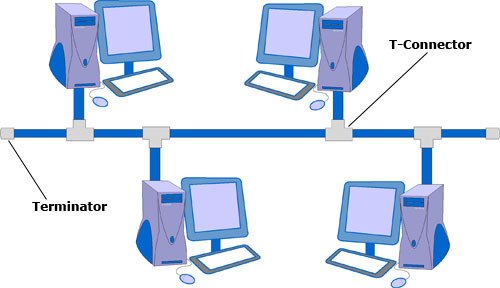
- A bus network consists of a single central cable (backbone trunk), to which all computers and others devices connect (node).
- The bus is the physical cable that connects the computers and other devices.
- Each devices is connected to the single bus cable through T-connecter.
- A terminator is required at each end of the bus cable to prevent the signal from bouncing back, and forth on the bus cable.
How data is transmit :
- In a bus network, it transmit data, instructions and
information (the adress of the receiving device is included) as a
series of signal in both directions where all nodes receive the
signal but only the intended recipient will accept the signal and the
rest will ignore.
Advantages :
| 1. Failure of one device usually does not affect the rest of the bus network. |
| 2. Bus networks are inexpensive and easy to install. |
Disadvantages :
| 1. A break in the backbone (single central cable) will prevent all systems from accessing the network. |
| 2. It is difficult to identify the problem if the entire network shut down. |
|
Network Topology
|