The Klydel Wetland
News Archives for the Year 2000

 Hit this link for the Fall 2000 Sierra Atlantic magazine article about the Klydel Wetland controversy (including photos taken in the wetland).
 The Newsletter of the Great Lakes Aquatic Habitat Network and Fund headlined the struggle to save the Klydel Wetland.
People, Inc. announced they won't build a senior complex in the Klydel Wetland. We wish them well on their search for a new site. Thanks also to Sierra Club for their support for the preservation of the Klydel Wetland.
WETLAND PROJECT PLACED ON HOLD
�
by Brian Arrington,
Staff Writer, Tonawanda News
�
Front page - July 11,
2000
�
The North Tonawanda Planning Commission delayed
plans for a three-story senior citizen home in the Klydel Wetlands Monday,
citing a range of concerns with the project.� Three conditions must be met
before the commission can approve the sketch of the development, submitted by
Herman Probst, who owns 18 of the nearly 70 acres in the wetland.
�
The commission held off its approval of the plan until the [New York] State Department of Environmental Conservation can review the State Environmental Quality Review forms submitted to the commission by Probst.� Probst was told last month by the commission to complete and
submit the form, detailing the environmental impact the senior home would have
in the wetland behind Meadow Drive.�
Local environmentalists have fought the project, fearing it will damage the
ecosystem.
�
The board also requested that Probst review the
concerns of city department heads regarding the project and it must also be
determined if the site proposal is in a properly zoned area.� "We can't
move on with the conceptual sketch plan at this point until we have department
heads discuss their comments and that this has complied with zoning
(ordinances)," Commission Chairman Suzanne Needler said.�
�
City Engineer Dale Marshall, in a letter which
detailed his questions about the proposed home, said "an analysis of the
domestic and fire (traffic) flows should be performed to ensure there is
adequate domestic service and fire protection."� Marshall recommended that Probst force traffic flow to the
Kinkead/Meadow Drive traffic light.� He said the DEC and United States
Corps of Army Engineers should review the wetland delineations in the wetland
before the site is approved.� Marshall also raised questions about sewers
and water flow in his letter.
�
City Code Enforcement Officer Stephen Kurbiel
states in his letter that the home should not be built because a home would
result in apartment vacancies in the city, causing a poor rental
market.
�
Assistant City Attorney Robert Sondel said a
zoning survey should be conducted to see if the home can be placed on the
property.� He said he was unclear what the parcel is currently zoned
as.� Probst said he did meet with the
city building inspector last year and the parcel was zoned to support a senior
citizen home.
�
If all of the three conditions are met,
government agencies approve the wetland delineations and the commission approves
the site, it would be hard to stop Probst from building on the land, Sondel
said.� "It would be hard to say no," Sondel said.� "If he has the
right to build, we have to let him build.� Certainly we want the (DEC and
Corps of Engineers) to tell us that it is OK for him to build," Sondel
said.
�
Elizabeth Kaszubski of Citizens for a Green
North Tonawanda said that she wants the commission to consider the DEC and Corps of Engineers recommendations before going any further.� "I just want to
make sure that they wait until the federal and state government decide where the wetlands are before they approve anything," Kaszubski said.
�
The Sierra Club, a conservation group, filed a
notice of appeal with the New York State Freshwater Wetlands Appeal Board on
June 16, 2000, according to the Citizens for a Green North Tonawanda website.�
The appeal is based on the state Department of Conservation's altering of the
Klydel Wetland boundary without public notice, according to the website.�
Other groups such as the Citizens for a Green North Tonawanda and the Buffalo
Audubon Society were joint appellants of the appeal.
�
The June 6 planning commission meeting was cut
short after protesters refused to yield the floor after they were told there was not time allotted for public discussion.� The July commission meeting ran
without incident.

Protect or
Develop?� Klydel Wetlands Under Debate in NT
�
By Brian
Arrington, Front Page - Tonawanda News - Published
06/18/00
�
For some residents, the Klydel
Wetlands is the last stretch of land that represents the North Tonawanda of the
past.
�
For others, the 70-acre parcel is an
idea spot for big development.
�
Either way, the emotion surrounding
Klydel -- ironically named after a Canadian developer -- has reached a boiling
point.
�
Land developer Herman Probst of
Wheatfield has announced his plans to build a three-story, 50 unit senior
citizen home in the wetland, behind Marcia and Meadow Drives, an area that
conservationists say is government-protected wetland.
�
Last month, state Department of
Environmental Conservation officials said Probst's wetland maps accurately
reflect the state's delineations of the Klydel Wetlands and the development will
not have an impact on the wetland.
�
Members of the environmental group
Citizens for a Green North Tonawanda say Probst's map was a poor representation
of the state's delineation and is not accurate.
�
An original plan for the home did
intrude on the wetland.� Probst came up with an alternative plan, which
would keep the building and 100-car parking lot off the wetland, according to
state officials.
�
U.S. Army Corps of Engineer
officials said they have not determined if Probst's maps represent their
delineations yet.
�
Probst, who owns 18 acres of the
70-acre wetland, must get the approval of the DEC, Army Corps of Engineers and
the city's planning commission.
�
With development in the wetland tied
up in government agencies for now, conservationists are plotting their next
move, vowing that they "haven't begun to fight."
�
The race between conservationist
groups' efforts to preserve and buy the wetland and Probst's development plans
is on.
�
The
Wetland
�
"Wetland" is a generic
term for different kinds of wet habitats where the land has some accumulation of
water for a period of time each year, but not necessarily permanently wet,
according to the National Audubon Society [NAS].
�
Environmentalists say
there are more than 100 species of birds in the Klydel Wetlands in addition to
fish, bats, foxes, and deer.
�
Many wetlands occur in
areas where surface water collects or where underground water discharges to the
surface, making the area wet for extended periods of time.� Other wetlands
occur along coastal regions, such as salt marshes, and are created by the
tide.
�
The Federal Clean Water
Act defines wetlands as "areas that are inundated or saturated by surface or
ground water at a frequency and duration sufficient to support, and that under
normal circumstances do support, a prevalence of vegetation typically adapted
for life in saturated soil conditions.� Wetlands generally include swamps,
marshes, bogs and similar areas."
�
The Klydel Wetlands in
North Tonawanda contains a substantial amount of vernal pools, according to
Steve Slivan, co-director of the Citizens for a Green North Tonawanda.�
Vernal pools are spring pools that tend to fill up in spring and dry up in
summer.� Biological activity peaks in spring.
�
In general, vernal pools
are small, temporary and "isolated" from other wetlands, streams, or other water
bodies.� They provide essential breeding habitat for certain animals,
according to the NAS.
�
While not all vernal
pools dry up completely, the essential ingredient is that the pond has no
fish.
�
Wetlands like Klydel help
clean the region's water, trapping sediment and capturing nutrients from waters
that flow through them.
�
According to the NAS,
wetlands save communities millions every year that otherwise would be spent on
drinking water treatment plants.� By soaking up and storing storm water,
wetlands help prevent flooding, which can save families and communities from
tragedy and great expense.
�
In a 1983 study, the U.S. Army Corps of Engineers found that protecting wetlands along the Charles River near Boston resulted in annual savings of $17 million in prevented flood
damage.
�
The
Disappearing Wetland
�
According to the
NAS,� wetlands are among the most important ecosystems on earth.� The
wet ecosystems provide critical habitats for bird and other wildlife populations
in the United States.� Wetlands are essential to estuary, river, and
watershed health, trapping sediments and cleaning polluted waters, preventing
floods, recharging groundwater aquifers, and protecting shorelines.
�
Wetlands began
disappearing after permanent European colonization of the United States.�
More than half of the 215 million acres of wetlands that existed at the time of settlement have been destroyed, according to the NAS, and only 100 million acres remain today.
�
Wetlands were once viewed as obstacles to development that should be eliminated, and federal laws once provided incentives for draining and destroying wetlands.� However, in the
last 25 years, public and government understanding of the importance of wetlands has grown enough to begin to change some incentives to protecting and restoring wetlands, NAS officials said.
�
Government agencies such
as the NYS Department of Environmental Conservation and the U.S. Army Corps of
Engineers, have been designated to cast a watchful eye on wetland conservation
or development.
�
NAS research suggests,
that as wetlands are destroyed, so too are vital natural habitats for many
species of songbirds, frogs, fish and other birds and wildlife.� As these
species and their insect-based food chain disappear, whole ecosystems are
disrupted.
�
The Perfect
Habitat
�
According to the National
Audubon Society, wetlands as the perfect habitat for birds and other
wildlife.� Up to one-half of North American bird species nest, feed or rest
in wetlands.� As wetlands have been destroyed, bird populations have slowly
declined.
�
In the last 15 years
alone, the continental duck breeding population fell from 45 million to 31
million birds, a decline of 31 percent, according to the NAS.�
�
Between 1978 and 1987, 75
percent of forest-dwelling neo-tropical migrants, many of which rely on coastal
wetland habitats during their arduous migrations, declined in numbers, according
to the NAS.
�
Nearly half of all
federally threatened and endangered species rely on wetlands.� A majority
of fish and many species of amphibians, insects and plants are wetland
dependent.
�
Developer Probst, who is
unflinching in his focus to develop the property and quick to scoff at his
critics, has nonetheless, at one time, promised to be sensitive to the wetlands
issue.
�
But environmentalists are
leery.� They say an important part of the city will vanish with Probst's
plans for a senior center.
�
The next stage of the
battle will be a planning board meeting at 6 PM, July 10 at North Tonawanda City
Hall.
Channel 2 News filmed the City of North Tonawanda planning commission meeting on June 5, 2000, where Mr. Probst submitted yet another site plan footprint for his senior housing complex in the Klydel Wetland. It was covered on their news broadcasts. The entire June 5th planning commission meeting was also broadcast twice on cable television (Channel 68 in North Tonawanda) on Sat., June 24 at 9:05 PM and on the following day at 3:05 PM.
Public
discussion of plan in N. Tonawanda barred
�
Published on June 6, 2000 in the Buffalo
News
�
A North Tonawanda
Planning Commission meeting came to a abrupt halt Monday night when the
chairwoman called for an adjournment after many in the audience objected to a
ruling barring public discussion.
The issue was Wheatfield developer Herman Probst's
application to build a three-story, 50-unit apartment building for the elderly
on Meadow Drive near Marcia Drive.
Probst owns 18 acres of the 70-acre
government-protected Klydel Wetlands.
Preservationists, mostly members of the Citizens for
a Green North Tonawanda, have objected to Probst's plans since their inception
about three years ago.
The preservationists claim that commercial
development would destroy the natural wetlands. Wetlands are under the
protective jurisdiction of the state Department of Environmental Conservation
and the U.S. Army Corp of Engineers.
As initially conceived, Probst's plans for commercial development of his property near Meadow and Kincaid Avenue did infringe on the forested wetlands and were stopped by community opposition.
Now Probst has revised his site plan, moving the plan for the apartment building to the southwest corner of his property, which he says is outside the wetlands.
The conservationists disagree and wanted to speak on
the subject at Monday's meeting, which Probst also attended.
However, on the advice of commission counsel Robert
Sondel, Chairwoman Suzanne Needler ruled that while the meeting was open to the
public, it was not a public hearing and therefore no public comment would be
permitted.
Meeting to air future of wetlands project
�
�By BILL MICHELMORE
News Niagara
Bureau
6/4/00
NORTH TONAWANDA - A controversial
project to build a three-story senior citizen apartment building on federally
protected wetlands in North Tonawanda will be discussed at a public meeting at 6 PM Monday.
The City of North Tonawanda Planning Commission will
conduct the meeting in Council chambers in City Hall, 216 Payne Ave.
As a concession to environmentalists, Wheatfield
developer Herman Probst said he will move the location of the 50-unit building
about 400 feet west, just outside the Klydel Wetlands, as delineated by the
state Department of Environmental Conservation.
But conservationists don't agree with the DEC
boundaries and say the project will still hurt the environmentally sensitive
area, just north of North Tonawanda Senior High School on Meadow Drive, between
Marcia Drive and Kinkead Avenue.
"We believe the DEC delineation is wrong and that the
project still lies within the wetland area," said Steve Slivan, a director of
Citizens for a Green North Tonawanda.
"The proposed development would still impact the
entire wetland," said Charles P. Rosenburg, a wetlands ecologist.
Probst, who owns 18 acres of the 70-acre wetland
area, has been battling environmentalists for several months in his bid to build the $250,000 apartment project and parking lot on a 6-acre parcel.
The project has been stalled since a contractor
working for Probst began digging up 150-year-old trees in January in apparent
defiance of a posted order by the U.S. Army Corps of Engineers, which has
jurisdiction over the Klydel Wetlands.

�
PLANS REVEALED FOR SENIOR
CENTER
�
DEVELOPER SAYS HE WILL NOT
DISRUPT NORTH TONAWANDA WETLANDS
�
By Brian Arrington--
Published on the Front Page of the Tonawanda News on Wed., May 24,
2000
�
A Wheatfield land developer under fire for
wanting to build a senior citizen home near wetlands in North Tonawanda told
city officials that his plans will not interfere with the environmentally
sensitive habitat.� Herman Probst, owner of 18 of the nearly 70 acres in
the wetland, told the common council members on Tuesday that he is going to
build the three-story, 50-unit home behind Marcia and Meadow
Drives.
�
"I wanted to preserve the whole area," Probst
said.� "No more trade-offs.� I can go ahead and build in
non-wetlands."� The home and its parking lot will not intrude on state or
federal wetland, Probst said.� The entire development will cover nearly
five acres when completed," he said.� The matter must now go to the city's
planning commission for approval.
�
City Engineer Dale Marshall said the area is
properly zoned and agreed that the plan will not interfere with state or federal wetlands.� "As long as he stays out of the wetlands he is OK," Marshall
said.
�
Probst has been at the center of controversy in
recent years as environmental groups have objected to his plans to develop the
land.� "The offer to buy and conserve the land was on the table,
but�no one made an offer," Probst said.� "The 18 acres are worth
$250,000," Probst said.
�
Steve Slivan of the Citizens for a Green North
Tonawanda, a group opposed to development in the wetland, said Probst's
estimation of the state and federal wetland boundaries are incorrect and the
senior citizen home would intrude on state and federal wetland.
�
"There has been nothing official saying that the United States Army Corps of Engineers and the NYSDEC said these delineations are correct," Slivan said.� "At this point right now, they have not approved those wetland delineations."
�
Slivan said Probst's delineations were drawn by
a private company not state or federal agencies.� Probst's statement that
no conservation group has attempted to buy this wetland property also is untrue, Slivan argued.�� "Mr. Probst has a selective memory," Slivan
said.� "The Western New York Land Conservancy sent wetland land owners a
form letter saying they would appraise the land at their expense -- that
happened."� Slivan said the WNYLC did offer to buy the land in that
letter.
�
Mayor Mary Kabaskalian asked Probst if he
thought the area was good for senior citizens to live in, considering the
traffic on Meadow Drive.� Probst said the area was great for seniors,
citing the close proximity to bus routes and the Mid-City plaza.
�
The proposed site is directly behind Meadow and
Marcia Drive homes.� Council members expressed concern over how it will
impact residents.� Some council members were concerned there will be
flooding due to displaced water once the home is built.
�
"Damage for residents on Marcia Drive will not
be a problem," Probst assured the council.� Probst said he went
door-to-door, letting Marcia Drive residents know the home will be coming.�
"I went to all of the people on Marcia Drive," Probst said.� "They were
nice, but they were against it.� Either way, people will be
upset."
�
Probst said he intends to separate the home and
Marcia Drive houses with a 20-foot buffer and shrubbery.� A plan will be
developed for proper water drainage for the Marcia Drive homes, Probst
said.
�
Probst said he plans to keep the remaining land
and develop it "down the road".� Probst said he met with the New York State
Department of Environmental Conservation to let them know as well.
Developer backs off from wetlands
|
|
By RICHARD BATZER
North Tonawanda Correspondent
5/24/00
Herman Probst, a Wheatfield
developer who owns 18 acres off Meadow Drive in North Tonawanda, including
government-protected wetlands, informed the Common Council on Tuesday night that
he plans to relocate a planned apartment building to avoid a conflict with
preservationists.
Probst told the Council that he will change the
site for a three-story, 50-unit senior citizen apartment building from the area
of Meadow Drive and Kinkead Avenue, where it would infringe on the Klydel
wetlands, to the western boundary of his property in the vicinity of Meadow and
Marcia Drives.
The project, which Probst values at $250,000,
would include parking for 100 cars.
Probst has run into community opposition to his
planned development of the forested wetlands from the state Department of
Environmental Conservation and the federal government.
Designated wetlands are restricted in their types
of use.
The developer said he went door to door along
Marcia Drive, questioning residents about his plan. The apartment building and
the parking lot abut the rear property lines along Marcia. He said the residents
were cordial but told him they are still opposed to his development.
WETLAND SPARED FROM
DEVELOPMENT
By Brian Arrington,
Front Page - Tonawanda News - May 10,
2000
Two regional land conservation groups have
signed a contract to buy a 17-acre parcel of the Klydel Wetlands in North
Tonawanda. The Western New York Land Conservancy and the Buffalo Audubon
Society have formed a partnership to ensure that at least some of Klydel's 70
acres will remain "green" forever.
The WNYLC bought the parcel for just over
$30,000, far below the assessed value, from property owners who hope to help in
the preservation. The WNYLC will sell the property to the Audubon Society
for $1 after the deal in closed in June. The society will hole the title
and the WNYLC will make sure the land will not be sold.
Paul Lehman, President of the WNYLC, said the
group hopes to protect more wetlands, accommodating willing sellers, when the
money becomes available.
The city now boasts 27 acres of wetland grouped
together for public use. Nine of the acres are owned by the North
Tonawanda School District.
The Buffalo Audubon Society plans to conduct
nature educational programs at the site once the deal is finalized, Steve Slivan
of the Citizens for a Green North Tonawanda said. "It is a very nice
representation for a wooded wetland," Slivan said. "We are elated that
this has happened."
Liz Kaszubski, also of Citizens for a Green
North Tonawanda and a Buffalo Audubon Society board member, agrees. "We feel
that this is of high quality, unique for a city preserve," Kaszubski said.
"It is an outstanding nature area."
The Klydel Wetland has been the focus of much
protest over the past few months from various groups who have objected to plans
to develop part of the land.
Kaszubski praised the former property
owners for their cooperation in saving the area from development. "Our
organization wishes to thank all of the individuals and organizations who worked
together to make this become a reality, particularly the property owners who
made a truly remarkable contribution to their community by agreeing to sell
their land for preservation, rather than for development."
* Press Release: Partnership Collaboration Working to Save the Klydel Wetland *
Citizens for a Green North
Tonawanda is pleased to report that Paul Lehman, president of the Western
New York Land Conservancy [WNYLC] announced at the recent Buffalo Audubon
Society Annual Meeting that some of the remaining 70 acres of the Klydel Wetland
will be saved through an unique partnership. Mr. Lehman stated that a sales
contract has been signed and a conservation easement will be placed on a 17 acre
property that adjoins the 9 acres owned in the wetland by the City of North
Tonawanda School District.
The WNYLC and Buffalo Audubon Society
[BAS] formed a partnership to acquire land in the Klydel Wetland from owners
willing to sell or donate their properties for preservation. The local Audubon
chapter will take title to the parcels after the close of the sale,
anticipated to take place in June 2000. Thus far, approximately 27 contiguous,
forested acres will be accessible to the public in the Klydel Wetland. The
new nature preserve will be nearly the size of Pine Woods Park in the
city. BAS plans to conduct nature educational programs at the site.
Bruce S. Kershner, a well known author,
naturalist, and expert in old growth forests, and a board member of BAS stated,
"We feel that this is a high quality, unique site for a city preserve. It is an
outstanding nature area." Citizens for a Green North Tonawanda
co-founder, Liz Kaszubski, who also serves on the BAS board, said "Our
partnership wishes to thank all of the individuals and organizations who worked
together to make this become a reality, particularly the owners of this property
who made a truly remarkable contribution to their community by agreeing to sell
their land for preservation, rather than for development."
Links to flooding photos taken around the Klydel Wetland on April 8, 2000-- The City of North Tonawanda sewers were overwhelmed on April 8, 2000, so the city was forced to bypass the sewage treatment plant and dump raw sewage into the Niagara River. North Tonawanda suffered a drought for most of 1998 -1999, but "bypass events" happened 9 times in the 2 years prior to January 1997.
 Channel 2 had excellent coverage, with Mike Corban, of the Buffalo Audubon meeting on April 5, 2000, at the N. Tonawanda Public Library. An article about the meeting was published in the Tonawanda News. Also read an editorial written by North Tonawanda High School students calling for the preservation of the Klydel Wetland. Channel 2 had excellent coverage, with Mike Corban, of the Buffalo Audubon meeting on April 5, 2000, at the N. Tonawanda Public Library. An article about the meeting was published in the Tonawanda News. Also read an editorial written by North Tonawanda High School students calling for the preservation of the Klydel Wetland.
Thanks to all who responded to our ACTION ALERT and commented to the US Army Corps of Engineers before the deadline of April 8, 2000. A Buffalo News article, the PUBLIC NOTICE that was published by the US ARMY CORPS OF ENGINEERS, and our thoughts can be viewed by hitting HERE.
Mike Igoe of Channel 2 News has done a terrific job covering the Klydel Wetland saga, including the informational picket on March 22, 2000 in front of the Klydel Wetland and North Tonawanda High School. This photo of the event is from the front page of the Tonawanda News.
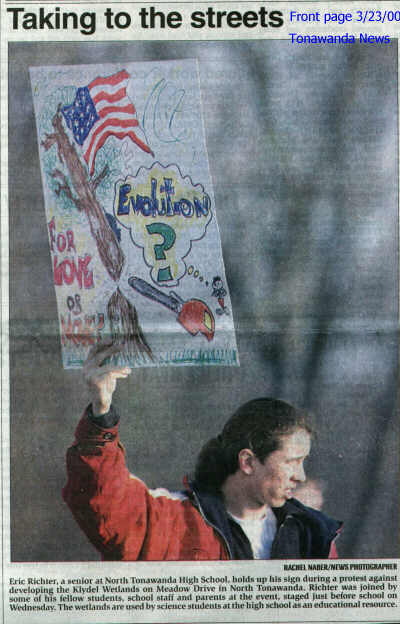
dateline... Thursday, March 23, 2000 -
Letter to the editor published in the Tonawanda News
CHILDREN NEED THE WETLANDS MORE THAN A DEVELOPMENT
by Art Klein
Congratulations. I was pleased to see the Tonawanda News publish a front-page article about the rally and the protest by students and community folk of North Tonawanda regarding the Klydel Wetland.�
As a result of the article, I attended the rally and also congratulated the students. Their protest shows the point of preservation efforts: their right to a future in a world we have not harmed.� These young and involved students reveal that the Klydel area and the wetlands within are a community asset, not just a government process.
I doubt the problems Mr. Probst has encountered at the site are the result of confusing government regulation or a victimized property owner.� Mr. Probst acquired the property long after wetlands became an easily identifiable aspect of land.� I can't imagine in today's world a responsible real estate transaction among intelligent people with the sums involved that ignored the wetlands in the property.
We can assume that more wiggle room was hoped for than what is available. Regardless of the amount of wetlands within it, the Klydel site is an excellent candidate for preservation as a natural area.� I hope Mr. Probst will realize that Klydel is a community as well as a government issue and would consider creative alternatives to development.
I would hope that local government will help him find ways for this to happen.
Our children need these sanctuaries more than we need more buildings and paved areas.
Wetlands developer
isn't above the law
�
Published on the
Editorial Page of the�Buffalo News on Saturday, January 29,
2000
�
�
Herman Probst, a North
Tonawanda developer, is digging up land and removing trees from an 18-acre
parcel he owns in the�Klydel Wetlands, which is federally protected
land.� Probst defied a federal order prohibiting the work, based on laws
designed to protect our precious wetlands.� According to The News, Probst
has said, "I'm so sick and tired of people telling me what I can't do, that I'm
going to do what I want."
�
This is not a case of an
average citizen being bullied by the U. S. government.� This is a case of
an average citizen who will not abide by the laws designed to protect all
Americans and our environment.
�
Probst seems to have no
regard for his neighbors.� Instead he whines about his need to do as he
pleases.� Imagine what society would be like if all people decided to
disregard the law.� Perhaps we should be sick and tired of people who break
laws because they are sick and tired of being told what to do.
�
Timothy P.
Sloan
West Seneca,
NY
�
Go to our other page to view the editorial that was published in the Tonawanda News on January 28, 2000 about preserving the Klydel Wetland by the NTHS Outdoor Awareness Club.
View information published in the Tonawanda News concerning the proposed People Inc. senior housing complex that was awarded a $3 million+ HUD grant for a Klydel Wetland site (but has since been withdrawn by People Inc).
dateline January 24, 2000 .... Here's a really
interesting soundoff that appeared in today's Tonawanda News.�
It's nice to see the thoughts of a responsible,
caring landowner.
�
"This is in regards to the wetland
controversy.� I, too, own part of the Klydel Wetlands in North
Tonawanda.� I bought this property fully aware that "harvesting of trees on
federally protected lands" is illegal.� Where do you get off tearing down
signs prohibiting destruction of federally-protected wetlands?� I, too, am
sick and tired of people telling me what I can and cannot do.� Therefore,
from now on, I'll ignore traffic signals, DWI laws and any other regulation
mandated by city, county, state, and federal legislation that I don't personally agree with.� I'm not sure if you're breaking the law, but until a decision is made, why don't you wait before you go and destroy 150-year-old trees?� Thank you."
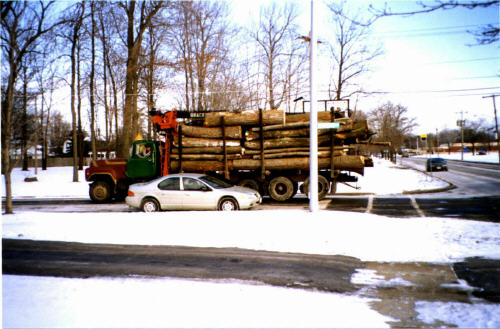
dateline January 22, 2000 - The birds are chirping again in the wetland for the moment. The great horned and screech owls are probably looking for new homes. From the perimeter of the property one can't see all the damage to determine what was obligerated during the timbering frenzy.
Go to our other page to view the great article that was published in the Buffalo News on January 21, 2000 about the logging operation that began this week in the Klydel Wetland.
dateline January 21, 2000 - If you watched the 5:30 am, 6:00 am, 5:00 pm, and 6:00 pm Channel 2 News you have a good idea of what is going on in Klydel and what our group is trying to do about it. NYSDEC Region 9 Director, Gerry Mikol, completely supported the developer's actions with his own little pronouncement on property rights. Investigative reporter, Mike Igoe, did a wonderful job showing what happens when wetlands are overdeveloped and those whose homes surround the wetland (or are actually in the wetland) are flooded.
dateline January 20, 2000 - Klydel made the front page of the Tonawanda News today. Klydel also made the 11:00 pm Channel 2 News with some footage involving our group and great reporting by Mike Igoe.
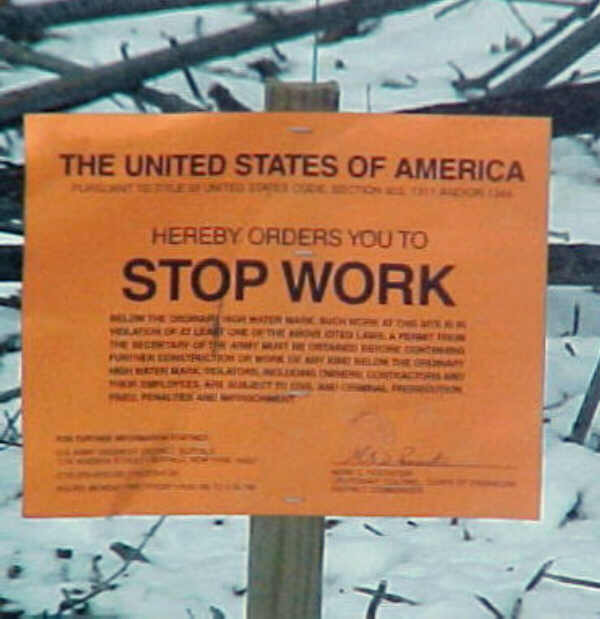
THE US ARMY CORPS OF ENGINEERS POSTED�THIS STOP WORK ORDER IN THE KLYDEL WETLAND�ON
1/19/2000.
�
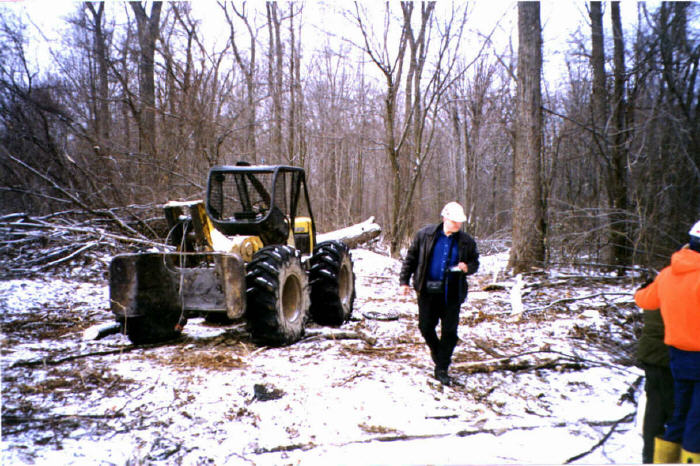
Assault on the KLYDEL WETLAND !!!� Timbering that began on 1/18/2000 continued on 1/20/2000 after the original "STOP WORK" sign mysteriously disappeared before 5pm on 1/19/2000 (the same day it was posted). It was replaced with additional signs.
�
Citizens for a�Green North Tonawanda extends�thanks to all the organizations who have offered to join in activist actions.� We will let you know when an event will be scheduled. As a result of the sad events that began on Tuesday, January 18, 2000, we have only increased our resolve that this wetland be spared such monumental environmental destruction!
The disaster that occurred in the Klydel Wetland the week of January 18, 2000 and a great follow up article on Feb. 1, 2000 from the Buffalo News.
We applaud the swift action taken by the US Army Corps to halt the timbering at this point.� Plain and simple- the Klydel Wetland is a federal and state wetland and there are laws in place to protect wetlands. Many organizations, representing a large part of the community, support the preservation of the Klydel Wetland.
�
Klydel trees cut down on January 18, 2000.
Go to our other page to view the article that was published in the Tonawanda News on January 10, 2000 concerning the grant that DuPont awarded for the Klydel Wetland.
Forward to our latest news.
Archives of 2004 news.
Archives of 2003 news.
Archives of 2002 news.
Archives of 2001 news.
Archives of 1999 news.
Archives of 1998 news.
Archives of 1997 news.
Back to our MAIN PAGE.
� 2000
|