
Group
Urges Wetland Protection
�
By Cheryl A. Krajna, Tonawanda
News
�
April 6, 2000 - Front Page
�
"It really is an oasis of habitat surrounded by a desert of
suburbia."-
Chuck
Rosenburg / Audubon Society Member
�
Mother Nature was
well represented Wednesday evening during discussion of the Klydel
Wetland.� People ranging in age from student to senior citizen attended the
April meeting of the Buffalo Audubon Society at the North Tonawanda Public
Library; across the street to the wetland in question.
�
It is on that 70-acre
site that Herman Probst, who owns 18 of those acres, is asking to build a
55-unit senior citizens residence.� The development is planned on nearly
seven acres north of North Tonawanda Senior High School.
�
"I pose a question to
the audience tonight.� Is Klydel really a high-value wetland
ecosystem?� Or is it a mosquito-infested swamp?�, said Chuck
Rosenburg, an ecologist working with the Citizens for a Green North Tonawanda
and member of the Buffalo Audubon Society.
�
He proceeded to
answer his own question through a series of often picturesque slides of wildlife
and trees found in the wetland, including mourning doves, white-tailed deer,
Magnolia warblers, frogs, snakes, opossum and even a type of crayfish that might
be a rarity in this area.� some of the species, particularly the birds, are
forest interior species and need those places deep inside a forest area where
nothing of man is visible.� An area such as that exists within Klydel,
Rosenburg said.
�
"Klydel is such an
important area, " he said.� "It has both ecological and social
value."
�
The North Tonawanda
Nature Trail within the Klydel Wetland begins at the dead end of Woodward Avenue
and allows visitors glimpses of those creatures, flora and fauna.
�
Rosenburg showed an
aerial photo of the area, which is surrounded by 200 or so households.� "It
really is an oasis of habitat surrounded by a desert of suburbia," he
said.
�
Ecologists and others
have identified 22 species of trees, 13 species of shrubs and more than 100
species of birds in the wetland, he said.�
�
"We're doing what we
can to preserve as much of (Klydel) as possible," he said.� By doing so, it
will help maintain green space, provide a habitat for birds and offer
educational and recreational opportunities.
�
The Buffalo Audubon
Society is looking to expand its educational programs, and the Klydel Wetland
may be just the place to host some of those new offerings, said Tony Wagner,
president.
�
Sharon Tiburzi and
two volunteers from Owl Facts showed three varieties of owls - that visitors can
hear during "owl prowls" through the wetland.� "These birds are in your
wetland," Tiburzi said.� "We wish you well with your wetland project.�
It's important to have them."
�
Liz Kaszubski, board
member for Audubon Society and a member of the Citizens group, pointed out that
people have until Saturday to make their feelings known to the U.S. Army Corps
of Engineers, which is accepting public comments until Saturday.� Based on
the response, the corps will decide whether to hold a public hearing on Probst's
application for the senior housing project.
�
�
Development Has
No Place in Klydel wetlands
�
Published on
the Editorial Page of the Tonawanda News on Friday, January 28,
2000
�
�
Over the recent years,
North Tonawanda High School students have benefited from the convenience and
ecological diversity of the Klydel wetlands to further their knowledge of these
beautiful, yet rapidly fading areas of natural beauty.� Due to its close
proximity to the school, in fact directly across the street, it has enabled
science teachers to expand upon their curriculum allowing for a more hands-on
approach in the areas of earth science and biology.� This "natural
laboratory" contains a wealth of information in the vast number of species found
therein.� This land serves as a habitat for 18 species of trees, 12 species
of shrubs, and 98 species of birds.
�
Many activities also take
place there, such as the Owl Call nights, when groups gather to experience the
warning call of a screech owl.� The high school's Outdoor Awareness Club
has also blazed trails and set up markers at key points of natural and
historical value, such as the trees that are over 180 years old.� The club
plans to arrange tours so that members can take school groups, and others that
may be interested, through the public owned property in order to better educate
the community about this irreplaceable source of ecological value.
�
This piece of land that
has proved so useful and educational to our small community faces more and more
danger of being destroyed every day.� Despite federal and state
regulations, developers have still continued to debase the protected land over
the past 15 years with little respect for the diminishing habitat of the
remaining species.� For the most part, protective laws have helped, but
sometimes help comes a little too late.
�
Only three years ago, in
1997, contractors violated the laws and poured concrete, planning to develop the
area without going through the proper procedures.� By the time the proper
authorities were made aware of the situation, the damage was already done.�
Regretfully, this rather disastrous course of events is occurring again.� A
private property owner whose land (nearly) borders the land owned by the school
board, just last week began cutting trees down on his property.� The
legality of this action is currently being investigated.
�
My most outstanding
question is why?� According to the law, there can be no development on his
land, so why deface the land of its trees?� The result of this action is
primarily negative to all parties involved, except that is, for those who do not
give much thought to preserving the integrity of the wetlands for the future
generations of North Tonawanda.
�
Kelly Koban
Secretary, Outdoor
Awareness Club
North Tonawanda High
School
�
�
�
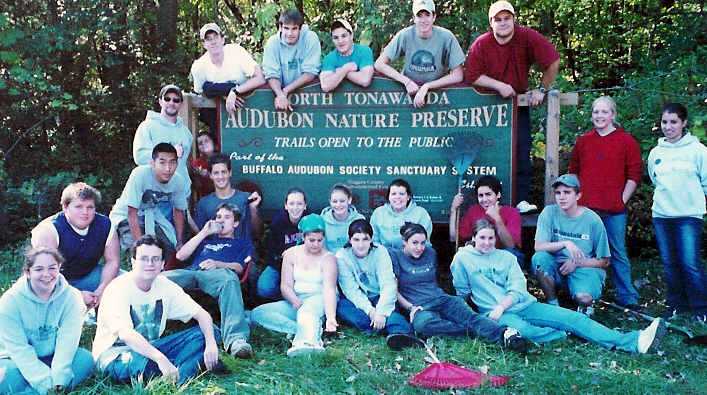
Citizens for a Green North Tonawanda would like to thank the members of the North Tonawanda High School Outdoor Awareness Club for their interest and assistance in preserving the Klydel Wetland. You are the trail blazers of a better future for this community.
Hit here to return to our MAIN PAGE.
� 2006
 Get your own Free Home Page