Citizens for a Green North Tonawanda
Logging in the Klydel Wetland Was Stopped

This is the great article that appeared in the January 21, 2000 Buffalo News On Line and also in all editions of the newspaper. This appeared on the front page of the local section:
| Developer makes a stand Order to stop work in wetlands ignored |
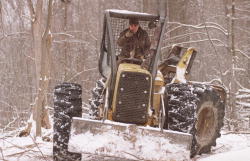
News Niagara Bureau 1/21/00 A North Tonawanda developer has dug up the land and removed trees from a federally protected wetlands area he owns, in apparent defiance of a federal order prohibiting the work. In addition to facing possible criminal action, the developer has also drawn the ire of local conservationists. Herman Probst, who owns an 18-acre parcel of the Klydel Wetlands, said he brought in bulldozers this week and told contractors to begin cutting down 150-year-old cottonwoods and red maples. Although some "selective cutting" of trees on wetlands property is allowed, the contractor working for Probst used a bulldozer with a blade that tore up the ground, which is illegal, according to Paul Leuchner, chief of the Corps of Engineers' Regulatory Branch in Buffalo. As soon as the U.S. Army Corps of Engineers learned of the work, a sign was posted on the property forbidding Probst from doing any more work. The sign said: "The United States of America hereby orders you to stop work." "I'm so sick and tired of people telling me what I can't do, that I'm going to do what I want," Probst said. He said he was just "harvesting" the trees and refused to say if he was planning to develop the site. Officials of a half-dozen conservation groups condemned the developer's "bulldozer mentality." "That land is a wetlands jewel in an urban area," said Tony Wagner, president of the 3,000-member Buffalo Audubon Society. "Wetlands are fragile, and if you remove the woods, you destroy the whole character of the area." The 70-acre Klydel Wetlands, just north of the North Tonawanda Senior High School on Meadow Drive, is protected by federal law and comes under the jurisdiction of the Corps. Leuchner said the sign prohibiting any further work on the site was erected Wednesday and was gone Thursday morning. Liz Kaszubski, who lives in the area and is fighting to preserve the wetlands, said the sign was torn down soon after being put up. People working for Bracey Logging were still hauling away trees Thursday. They refused to speak to reporters. Steve Slivan, a director of Citizens for a Green North Tonawanda, said he watched them haul away two truckloads of trees Wednesday and Thursday. "That's close to 100 trees indigenous to this wetland and vital for its survival," said Slivan. Leuchner said he has told Probst to provide the Corps with detailed plans on any development project. "I expect a deluge of letters from people opposed to any development," Leuchner said. Probst must apply to the federal government and to the state Department of Conservation before he can begin any development on the site. The Klydel Wetlands have been the target of at least five development projects in the past four years, including a 1996 proposal by Benderson Development Co. of Buffalo to build a Tops supermarket on the site. "People in the area went crazy," said James K. McGinnis, who was in a partnership with Probst at the time. McGinnis is the son of James M. McGinnis, then the mayor of North Tonawanda. "They blamed my father for the whole thing." McGinnis said he sold his share back to Probst after Benderson backed out of the deal. The latest known proposal is for a 39-unit senior citizen housing project in the wetland area. "The value of this wetland as a community asset and in containing localized flooding far outweighs the benefits of an apartment complex," said Richard Lippes, a Buffalo attorney who is chairman of the Sierra Club-Niagara Group. About a quarter of the original wetlands has already been destroyed by
development, he said.
|
By BILL MICHELMORE
Buffalo News Niagara Bureau
February 1, 2000
A developer who last week defied a U.S. order to stop digging up trees on federally protected land in North Tonawanda has put the work on hold.
Meanwhile, the Western New York Land Conservancy wants to buy the remaining privately owned parcels on the Klydel Wetlands and permanently protect all 70 acres.
Herman Probst, who owns an 18-acre parcel on the wetlands, apparently defied an order last week by the U.S. Army Corps of Engineers to stop digging up land and cutting down 180-year-old cottonwoods and red maples. The corps posted a sign on his property that said, "The United States of America hereby orders you to stop work."
But the next day, the sign was gone, and Probst continued to allow a contractor to use heavy machinery to remove the trees.
When the Corps of Engineers put the sign back up and demanded a written explanation from Probst about his intentions for the site, the developer backed off, according to Paul Leuchner, chief of the corps' regulatory branch in Buffalo.
Probst said he was just "harvesting" the trees and refused to say if he was planning to develop the site.
"The Army Corps has no jurisdiction over me cutting trees on my own property," he said.
The corps has jurisdiction over the Klydel Wetlands, located just north of North Tonawanda Senior High School on Meadow Drive, and regulates what people can do on them, said Joe Kassler, a biologist in the enforcement section. But there is no federal agency or act that totally protects wetlands, he said.
The Western New York Land Conservancy wants to purchase all the privately owned parcels on the Klydel Wetlands to prevent any further development.
The conservancy has so far received preliminary agreements from half of the 10 property owners, said John R. Whitney, co-chairman of the conservancy's conservation committee. The first purchase contract is expected to be signed in the next two weeks, he said. The organization hopes to have half of the Klydel Wetlands under permanent protection in the next two years, Whitney said.
Some of the owners said they will sell their properties at their assessed value, while others are prepared to sell for less and write off the balance on their tax returns as a charitable donation, Whitney said.
One 17-acre parcel, for example, is appraised at $107,000, but the owners would sell it for $33,000, with a $74,000 tax write- off.
Probst bought his 18-acre parcel in 1996, knowing it to be part of the protected wetlands, he said. The property has an assessed value of $33,000, according to city records. Probst said if the land were developed, it would be worth $800,000, but he would be willing to sell it for half of that. He said no one from the conservancy has approached him about the possibility of selling the land.
About 100 trees, many of them 180 years old and indigenous to the wetlands, were cut down and removed by Probst's workers, said Steve Slivan, a director of Citizens for a Green North Tonawanda. Slivan, who lives nearby, said he saw the contractors haul away two truckloads of trees before being stopped.
"It's a travesty," said Tony Wagner, president of the Buffalo Audubon Society. "That kind of older-growth woods are so uncommon. They used to cover all of Western New York, and now there are just a few pockets left."
The Corps of Engineers regulates wetlands under the federal Clean Water Act and can restrict certain projects if they significantly affect the protected area.
"We have to determine the cumulative impact on a wetlands area, and Klydel has taken quite a few hits," said Kassler of the enforcement section.
Probst has the support of commercial real estate agent James K. McGinnis, the son of former North Tonawanda Mayor James M. McGinnis.
"Herman is a well-respected developer and businessman in the area and has done a lot to help the communities of North Tonawanda and Wheatfield," said McGinnis, who used to be in partnership with Probst.
Almost 60 percent of the original wetlands in Western New York have been destroyed, according to Land Conservancy records.
Titles to the purchased properties in the Klydel Wetlands will be transferred to the Buffalo Audubon Society, with the Land Conservancy controlling the easement rights, allowing such things as nature trails, Whitney said. The only buildings that would be allowed would be warming huts or limited hiking facilities, he said.
The North Tonawanda School Board already has nature trails on land it owns in the wetlands.
"The damage to the wetlands has been relatively minor so far," Leuchner said. "But we want to know what he (Probst) plans to do with the property."
To our latest news page.
To our 2003 news page.
To our 2002 news page.
To our 2001 news page.
To our 2000 news page.
To our 1999 news page.
To our 1998 news page.
To our 1997 news page.
Back to our MAIN PAGE.
We welcome comments or suggestions sent to the e-mail address listed below.
� 2004 [email protected]