Details
Well-placed sources in the Pakistani establishment have told Asia Times
Online that - the Pakistani government's denials apart - there is a serious
split between those who decide (generals) and those who implement (field
commanders) Pakistani policy. Intelligence sources say that the US operators
had been so sure of the quality of their information that they are now
convinced that the escape of the key al-Qaeda operators was the result of
"collusion" within the Pakistani operations team.
Pakistan struggles to keep
its end up
Syed Saleem Shahzad
KARACHI - In a potential setback
for the United States and its global "war on terror", one of its "most
important partners", Pakistan, is struggling to keep up its end of the
bargain as a valued ally of Washington.
Last week, US ambassador to
Pakistan Nancy Powell said that the US "was committed to building a strong,
long-term and comprehensive bilateral relationship with Pakistan". Speaking
in Karachi on Pakistan-US relations, she added that since September 11,
Pakistan had become "one of the most important partners of the US in
fighting this most challenging of wars [against terrorism]". "We are working
closely and cooperatively with the government of Pakistan to neutralize the
remnants of al-Qaeda and the Taliban that remain in the region."
As a reward for this cooperation,
during President General Pervez Musharraf's visit to the US in June for
talks at Camp David, President George W Bush announced plans for a US$3
billion aid package over five years for Pakistan, half of that $3 billion,
still to be approved by Congress, is intended for defense spending.
But recent events, despite
attempts to paint a rosy picture, have the potential to undermine
Islamabad's relationship with the US as it is emerging that Musharraf is
losing crucial support among his colleagues for the "war on terror".
Well-placed sources in the
Pakistani establishment have told Asia Times Online that - the Pakistani
government's denials apart - there is a serious split between those who
decide (generals) and those who implement (field commanders) Pakistani
policy.
An operation in the Southern
Waziristan agency, which caught pro-US elements and US authorities based in
Pakistan by surprise, is a case in point. This agency in the Federally
Administered Tribal Areas in the west of Pakistan on the border with
Afghanistan is the most sensitive in Pakistan; it is not under the direct
administration of the central government, but indirectly governed by a
political agent, and it is a hotbed of resistance.
The US and Pakistan jointly
launched an operation in Southern Waziristan in search of al-Qaeda
fugitives, many of whom are known to take advantage of the lawlessness and
inaccessibility of the region to seek refuge. Officially, the operation was
said to have netted several important suspects, but this is not the case.
The joint operation actually
began in September, but was aborted almost immediately as tribals attacked
Bannu airport with missiles. Later, in October, with new plans and with
heavy reinforcements, a new operation was launched in South Waziristan.
The operation was initiated on
pressure from US authorities, who apparently had been tipped off that some
major al-Qaeda operators were holed up in the region, including top men such
as Jamal Asim and Abdul Hadi Iraqi. This information was based on
intercepted telecommunication conversations.
However, the only people rounded
up were a few minor Central Asian operators, Afghans and Pakistanis.
Intelligence sources say that the
US operators had been so sure of the quality of their information that they
are now convinced that the escape of the key al-Qaeda operators was the
result of "collusion" within the Pakistani operations team.
This suspicion is confirmed by
another incident. A US Federal Bureau of Investigation (FBI) team based in
Islamabad informed its Pakistani counterparts about a communication they had
intercepted, as a result of which three Arab Afghans had been apprehended in
Islamabad (just near the BBC's bureau). During interrogation, the men said
that top al-Qaeda operators had been in the South Waziristan area, but they
had been tipped off before the joint Pakistan-US raid.
The three detainees also spilled
the beans on a plan of their local Pakistani counterparts to assassinate
President General Pervez Musharraf. As a result, two young armed men were
caught near the Islamabad airport shortly before Musharraf was due to pass
through. One of those arrested was named Tariq, and they both came from a
Kashmiri family now settled in England.
These five arrests were made
solely as a result of the FBI's efforts, and their work is being made all
the more difficult now as it does not have the full weight of Musharraf's
security apparatus on its side as the general's ranks are clearly becoming
increasingly divided.
The chief of the powerful
Jamaat-i-Islami, Qazi Hussain Ahmed, said in a recent press conference that
the combined opposition will launch a powerful street campaign after the
month of Ramadan towards the end of this month. He stressed that "army
representatives" have been informed about the campaign, and some apparently
will join in.
Asia Times Online 19/11/2003
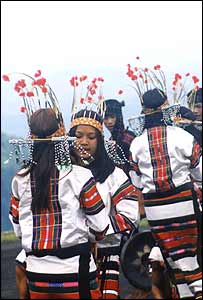
Chief Minister Zoramthanga is hoping to return to power 17 years after he
traded his battle fatigues for the civilian dress of a politician. The
former guerrilla commander is helping Delhi negotiate with half a dozen
separatist groups in the north-east.
Mizoram's model elections
Subir Bhaumik
Mizos are determined there will
be no slide back to war India's tiny state of Mizoram votes on Thursday to
elect a new leader.
Mizoram is the only state in
India's troubled north-east where a political settlement with Delhi has
held.
Chief Minister Zoramthanga is
hoping to return to power 17 years after he traded his battle fatigues for
the civilian dress of a politician.
The former guerrilla commander is
helping Delhi negotiate with half a dozen separatist groups in the
north-east.
Bringing peace
In June 1986, Zoramthanga walked
out of a large rebel base in the dense jungles on India's north-eastern
borders with Bangladesh and marched towards Mizoram.
Peaceful scenes after years of
war He was joined by hundreds of guerrillas who had followed him for 20
years during a bloody separatist campaign against Indian forces.
As church bells rang and Mizos
prayed for peace, Zoramthanga began his new life as an Indian politician.
Now he wants to return to office
for a second successive term.
"Regardless of whether I win or
not, I will help Prime Minister Vajpayee to bring peace to north-east
India," Zoramthanga said in a BBC interview.
"I have opened parleys with
several guerrilla groups in our region and we will take the peace process
forward."
Analysts say his Mizo National
Front (MNF) is still the front-runner though it may not be easy for it to
secure a clear majority in the 40-member state assembly.
Mizo editor David Thangliana says
smaller regional parties like the Mizoram People's Conference and its ally,
the Zoram Nationalist Party, may become a decisive factor if they win four
to five seats.
Don't write us off, we are a
force to reckon with in Mizoram
Congress leader Lalthanhawla
The Congress is still not seen as
a party on a comeback trail but its local chief, Lalthanhawla, says party
chief Sonia Gandhi's whirlwind tour of Mizoram will make a difference.
"Don't write us off, we are a
force to reckon with in Mizoram," Lalthanhawla said.
The former chief minister stepped
down from power in 1986 to make way for an interim administration that
included the MNF - one of the pre-conditions its leaders set for signing the
peace accord.
"He sacrificed his chair for
peace and the Mizos have not forgotten it," says a senior Congress leader,
Pranab Mukherjee.
Quiet campaigns
In Mizoram's tiny constituencies,
a few hundred votes usually make the difference between defeat and victory
and poll-time violence is rare.
Mizoram is the easiest election
to conduct anywhere in India
Election Commissioner JM Lyngdoh
The Young Mizo Association, with
nearly 40,000 members in the state, takes the initiative to organise public
debates in each constituency where candidates argue their case.
There are no noisy microphones,
no posters and no big processions. There is also no mud-slinging. Candidates
try to win support by advocating what they wish to do.
Door-to-door campaigning is what
most candidates resort to once the big public debate in the constituency is
over.
"That makes Mizoram elections
less of a party affair. Victory or defeat has a lot to do with candidates,"
says Mizo political analyst Lalmawia.
But that also makes elections in
Mizoram - once one of the most troubled states in India - a peaceful affair.
"Mizoram is the easiest election
to conduct anywhere in India," says India's chief election commissioner
James Michael Lyngdoh, who comes from the neighbouring state of Meghalaya.
New challenges
Mizos value the tranquillity they
enjoy in a troubled region and are determined to maintain it, but the heroes
of the peace process have new challenges to contend with.
Rebel-turned-politician
Zoramthanga seeks second term Though helping Delhi to start dialogues with
other separatists, Zoramthanga has failed to end the Reang armed rebellion
in his own state.
The Reangs want an autonomous
council for themselves in western Mizoram along the lines of the three
councils that exist in the state's southern fringes for the Chakmas, Lai and
Mara tribes.
More than 30,000 Reang refugees
have fled to the neighbouring state of Tripura.
Minority tribes like the Reangs
and the Chakmas often complain of persecution by Mizos.
Chins from Burma, once seen as
ethnic cousins of the Mizos, have also recently been driven out of the state
in their thousands.
So beneath the apparent calm,
there are ripples in Mizoram.
But Chief Minister
Zoramthanga says peace will hold in Mizoram regardless of who wins the
elections.
Top|Home
