|
| |
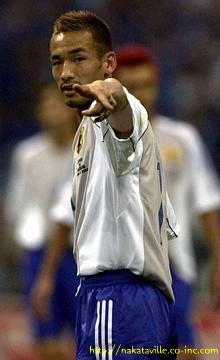
NAKATA
HIDETOSHI Highlights EMERGENCE OF JAPANESE SOCCER
The
same international trend can be found in soccer, which is just as popular in
Japan as baseball, at least at the grassroots level. Historically, and with the
exception of a third-place finish at the 1968 Mexico Olympics, the Japanese
soccer team had struggled in the international arena. The solution to this
problem was to make the transition from amateur to professional play. The
professional J.League, established in 1993, was welcomed with fanatic enthusiasm
by Japanese soccer fans, whose sport had always been overshadowed by baseball at
home. Every stadium was packed to capacity, players' salaries skyrocketed, and a
new professionalism infused the sport. Naturally, the level of play also
improved, eventually producing players who are capable of competing
internationally. One such player is Nakata Hidetoshi.
Japan
qualified for in the World Cup for the first time in 1998, when the tournament
was held in France. Although Japan lost all three of its first-round matches,
Nakata had an exceptional tournament, displaying great technique and an
exceptional ability to read the game. His thrusting midfield performances were
admired by commentators around the world. In July, after the tournament had
ended, Nakata was tapped to join Perugia, a team in Italy's Serie A, perhaps the
most technically demanding league in the world. Admittedly, Perugia was a
relatively unknown commodity, a team that had just come up from the Serie B
league, but just to have a Japanese player on the same pitch as so many
world-class stars was an historical event for Japanese soccer.
As
with Nomo in baseball, Nakata was not the first Japanese soccer player to play
abroad. From 1977 through 1986, Okudera Yasuhiko played for Cologne and Werder
Bremen in the German Bundesliga. Okudera, however, had the full backing of
Furukawa Electric (where he was employed) and the Japan Football Association,
and was required to take a test before being permitted to join the German team.
This was a very different situation from that of Nakata, who was scouted and
offered a very lucrative contract.
Nakata
proved that the scouts had made the right decision from his very first match,
played on 13 September 1998 against the mighty Juventus of Turin. Trailing by
three goals seven minutes into the second half, Nakata suddenly brought his side
back into the game when he buried a Rapajc Milan cross from what seemed an
impossible angle. Seven minutes later, he scored again, volleying home after a
mistake by the Juventus keeper. If anyone had any doubts about the abilities of
the young Japanese, they were dispelled with this performance. The Italian media
and the fans roared with approval, giving Nakata a new nickname:
"Emperor."
In
his first year in Italy, Nakata scored 10 goals, an excellent return for a
midfield player, not least in Italy where goals come at a premium. But it is for
his passing skills, vision, and assists that Nakata is most valued. In January
of this year the player was traded to A.S. Roma, one of the world's top club
sides, for a fee of an estimated ¥1.72 billion ($16.3 million) and an annual
salary of ¥230 million ($2.18 million). At Roma, Nakata has been asked to play
a slightly deeper role than he did with his former clubs and does with Japan,
but he is a regular starting member, rubbing shoulders with such international
stars as Italy's Francesco Totti and Cafu of Brazil.
Nakata's
exploits have made sensational news at home, inspiring other players to try
their luck abroad. In 1999, midfielder Nanami Hiroshi joined A.C. Venezia, also
in the Serie A league, and striker Jo Shoji transferred to Valladolid in the
Spain League. While it's true that Nakata's success has sparked a reassessment
of Japanese playing prowess among those who manage teams in other countries,
another factor in this recent spate of exported talent is the fact that, unlike
baseball, soccer has always been an international sport, one in which players
move quite freely between countries.
*Adapted
from lookjapan.com
next:
first page 1 2
3 4 5 6 7 8 9 10
|