|
| |
Footballculture.com
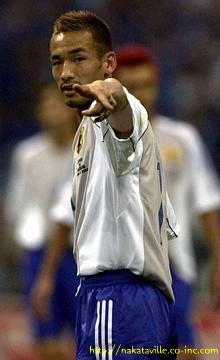
Hidetoshi Nakata -
Independent Hero
“Nakata carries Japanese soccer on his shoulders. He is the god of
soccer,” enthuses Yousuke Kawata, a Tokyo bartender. But Nakata’s hero
status in Japan is as much a testimony to his fierce independent streak as it is
to his football.
These days it’s hard to spend an hour in Japan without encountering the
likeness of Hidetoshi Nakata. From the football field to the subway station, the
25-year-old player for AC Parma is everywhere.
But don’t blame the World Cup; Nakata has been inspiring this nation since he
joined J-League’s Bellmare Hiratsuka out of high school seven years ago.
Indeed, Nakata is widely considered the greatest footballer in the history of
Japan. And while his path to stardom has taken him far from his homeland,
Nakata’s continuing success and independent streak only seems to solidify his
hero status in Japan.
“There’s no question that Nakata was head and shoulders above any other
Japanese player in the J-League. But when he went to Perugia in ’98, he proved
that Japanese players can mingle and play alongside the best, in one of the best
leagues in Europe,” explains Yo Takatsuki, a sportswriter for the Asahi
Shimbun News Service.
For a country that only formed its professional league in 1993, Nakata’s
induction into the international football fraternity was cause for major
celebration. For many fans, it was if Japan itself had been raised to a higher
level.
And, as it was for the baseballers who went to the United States before him,
Nakata was never alone. Thirty thousand fans traveled to Perugia his first
season and his every move was tracked by a gaggle of Japanese reporters.
Rather than buckle under the pressure, Nakata took matters into his own hands.
Following some unsettling articles, the midfielder ceased direct communication
with the Japanese media and founded nakata.net.
The Parma player uses the website, which now averages 700,000 page views a day,
to send emails to fans and fuel his burgeoning empire encompassing everything
from television specials to a Tokyo café created especially for the World Cup.
“The biggest lesson I’ve learned by living abroad for the last four years is
the importance of communication,” Nakata told Tokyo’s Metropolis magazine.
Despite a history of chilly relations with the media and Japan coach Philippe
Troussier, Nakata remains to many the embodiment of a nation’s potential.
“[His success] has given younger Japanese players, if nothing else, confidence
to give it a go,” says Sanborn Brown, a football editor.
And if that means bursting bank accounts, lucrative sponsorship deals and more
faces on and off the field, it’s likely that few will complain. As in
baseball, business, music and more, any Japanese who succeeds overseas only
serves to fire the hopes of the millions who one day hope to do the same. And
what is a hero if not a symbol of hope?
Tama Miyake, June 2002
next:
first page 1 2
3 4 5 6 7 8 9 10
|