

The Wolf is truly one of the most perfect creatures. If only we humans could live as they do then there would be no suffering, pain, murder, crime, etc. They live within a perfect society where social order is established early and unless the alpha male or female dies, this social order remains stable. Even the "low man on the totem pole," the omega wolf, has a place and is important is sustaining the perfect social order.
I truly hate the way the wolf is depicted many times in the movies. They are depicted as being vicious, man-eating creatures and this is surely not the case. THERE HAS NEVER BEEN A DOCUMENTED CASE OF A WOLF ATTACKING A HUMAN OR KILLING A HUMAN BABY!!! Wolves are leery of humans and would not approach them. There has been much research into the life of the wolf and it has taken professional behaviorist many years of research to help us to understand more about the wolf, from which our domestic dogs are descended from. One such researcher stated that it took him a long time to gain the trust of the wolves before they would even allow him near their pack. We could learn a lot from their social order--a lot about companionship, trust, loyalty, and working as a team.
It upsets me when I hear about people breeding "wolf hybrids". Although, there are some individuals who will dispute this, many feel that these animals are very unstable and unpredictable. Personally, I feel the wolf is a wild animal and that is where he should remain--in the wild. I believe that eventually they will become extinct because there is so much bad said about them and it is just human nature to destroy. The farmers in certain areas are given permission to shoot a wolf if it attacks their livestock, but the wolf will not do this unless its natural food source is compromised. It would much rather feed off of moose, deer, and the like rather than chickens, sheep, and cattle. So what is the solution to this? I think it is placing the wolf into the areas where their natural food supply is abundant. I also believe if the wolf fades from the earth, then we as humans will be deprived of a clearly beautiful and perfect animal. The wolf just touches my heart and soul deep down and it is my "totem." I believe in that wholeheartedly! One of these days maybe I will be able to actually see a wolf in its natural habitat and then I will know and feel the true beauty of this wonderful, yet misunderstood creature.
A Few Facts About Wolves
- As of 2006, there are an estimated 250,000 captive wolves and wolf-dog hybrids in the United States alone. Most are kept as domestic pets in households.
- The number of wild wolves in the U.S. is estimated at fewer than 3,000. About 2,000 of those animals live in Minnesota.
- Although sometimes confused with the coyote, wolves are distinctly different. The wolf has a larger muzzle, larger jaws, and a smaller skull than the coyote. Wolves also have more massive teeth.
- No other animal--except humans--has the widespread distribution of the wolf. Tropical rain-forests and deserts are the only place you won't find a wolf because these nomadic hunters can adapt to almost any environment.
- It is not unusual for wolves to maintain territories of more than 500 square miles, which is a lot of "real estate" to roam, mark, and defend.
- Wolves are extremely sociable animals. They typically live in packs of 5 to 10 related animals and function as a highly cooperative family unit.
- Wolves exhibit individual personalities and can be shy, confident, playful, teasing--and a variety of other traits that humans claim as well.
- The hierarchy of the wolf pack includes the alpha pair (alpha and his/her mate), the beta wolf; the second ranking male, subordinates; wolves of both sexes, and at the bottom of the hierarchy is the omega wolf.
- The alpha wolf is the one who leads the pack in the hunt and makes important decisions concerning the welfare of the group.
- Only the alpha pair have the privilege of mating and they usually remain together for life.
- The alpha male in a pack takes control over the group while the alpha female is in heat. As soon as her heat ends, the alpha female reclaims her dominant role from the alpha male.
- The female will begin preparing a den a few weeks before the birth of her pups. Her mate often assists her in this "nesting".
- All the members of the pack have responsibilities in the rearing of the young. The pups are born blind and deaf and are unable to regulate their own body temperatures until they are approximately 3 weeks old. During this time, the mother rarely leaves the den and relies on the rest of the pack to bring her food.
- When the need for the den has passed, the pack will choose a meeting site away from the original den. Like the den, this meeting place is near water, but it also has a clear area that can be used as an observation post.
- The omega wolf is the "scapegoat" of the pack and can bear the brunt of the pack's frustrations and harassment. Although; this may seem cruel to some, the omega wolf is essential to the emotional well-being of the pack.
- Wolves have no natural predators... except man.
- Wolves are naturally fearful of man.
- In North America there have been no documented attacks by wolves which resulted in the death of a human. HEALTHY WOLVES DO NOT ATTACK HUMANS. The few cases ever recorded of human attacks were the result of wolves being surprised and threatened, or when the attacking wolf was rabid.
- Wolves can hear sounds up to five miles away.
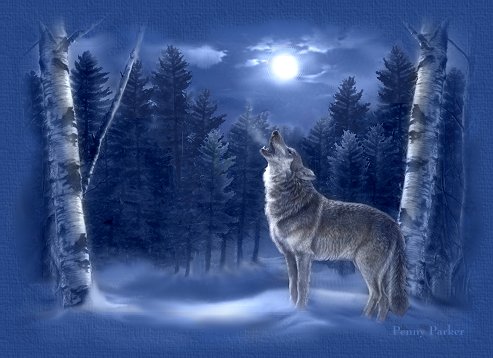
- Wolves howl to communicate with each other.
- Wolves can recognize each other by their howling and use this as a method to locate each other, and as a means of strengthening
group unity and reinforcing the pack's territorial boundaries.
- Wolves will often answer a human howl with howls from the entire pack.
- Lowering the pitch of a vocalization is a universal sign of aggressiveness in mammals. When a wolf lowers its howl (when it nears a stranger, for instance), it can sound quite daunting.
- Wolves grow three times faster than dogs, and their brains are twice the size of dogs. They are highly intelligent creatures.
- At top speed, a wolf can run up to 30 miles per hour.
- Wolves run in a rotary gait--right front, left front, right hind, left hind.
- Wolves have a high endurance and strict pack structure which gives them superior hunting ability.
- Wolves are often personified as ruthless and vicious killers. However, unlike humans, it neither kills out of greed or anger or for sport. The wolf kills to survive.
- If mankind doesn't start taking responsibility for what they have done to the wolf population, and doesn't start doing something to protect what is left of it, these beautiful animals will be lost...
- The Arctic wolf is the only subspecies of wolf that is not yet threatened. Their remote location has left them practically unharmed or harassed by man.
 
Please Tell A Friend About My Site :)
TOP OF PAGE
This web site is designed and maintained by, Webmistress63

Contents of this site, unless otherwise indicated,
Copyright © 2000-2007 N2TCHNK9S. All Rights Reserved.
|

 Home Page
 Coming Soon!