I tried to cheer her up, "Well, by the time your package would arrive here, the parsley leaves, and green onion and potato tails would pierce through the cardboard box." She didn’t think my observations were funny.
We were starved for decades in Romania under Nicolae Ceausescu. Not because of anorexia, oh, no, just because he senselessly sold all our food to the West until ’89, when we shot him.
I asked my mother if they celebrate the ten-year revolution anniversary. "What’s that?!" She didn’t relate. "Do you have festivities on TV about the revolution?" "Oh, it’s pandemonium here. They go on strike, one after the other. You can’t leave home because the trains stop running often. They want bigger salaries, on and on…."
They are so busy with survival that I assume no one thinks of writing eulogies to the ’89 revolution. "Well, I will celebrate it on my part," I told my mother.
I realized that I have an obligation to remember, remember exactly and clearly and specifically. Nothing should be allowed to dilute the memory of something so significant.
Here is my interpretation:
The ’89 revolution was crucial to me. Its impact on me has been reverberating within me since. Then I saw for the first time how people could make a change if they fight desperately, blindly, without caring if they might die, and they do fight and do get their freedom in the end. Since then, whenever I’ve been treated unjustly and it seemed more convenient/realistic to be spineless and compromise, I’ve felt an urgency to raise hell if I must, but fight for my dignity.
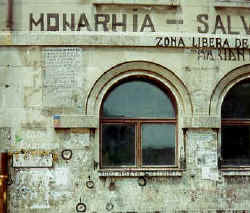
I don’t do it rationally, that’s the miraculous aspect about it. Instinctively, I just can’t stand anymore being trampled upon. I don’t fear anything, which is strange. I can fight relentlessly, especially against abusive authority figures. I know I am compelled to behave like this because of the example set by the people who believed in revolution, who had enough of our quietly obeying the oppressors’ orders, of gulping down stupid lies and rules. Those who died for my freedom. Who died for my child’s freedom. It is hard not to shed tears for them, though I never saw them in real life, but just on TV. I ran to join them where they fought, but I arrived too late…
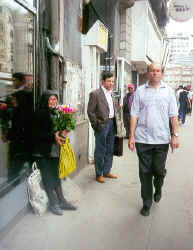
I was living in the countryside at that time, in Craiova. We’d just moved there because my late husband received his first job and he was for three years on probation at the local symphonic orchestra. I was pregnant, housewifing. I was down. There was no future for us in Romania. Everything was bleak to me. I was so disgusted with what I saw around that I couldn’t bear to face it anymore. I isolated myself in an island of English language by borrowing books and audiocassettes from the British Library. I remember that I was reading E.M. Foster’s A Passage to India. I was nauseated from using soy oil. I was cooking lunch for my husband who was at the orchestra rehearsal.
He came home, put his viola down and told me nervously that tanks were placed in front of the Filarmonica Craiova building, his work place. We never saw tanks on the streets before! He said I should switch on the TV. I did. I couldn’t understand what was going on. On the screen there was a prominent Romanian actor, Ion Caramitru, and a group of people that I didn’t know who they were, urging us to come to help the Romanian revolution. It was so crazy. So unexpected. I was not a religious person at that time, but somehow I got on my knees and hurriedly crossed myself. I never knew which way to go first, left or right shoulder, but it didn’t matter. I guess it was a way of showing my incredible happiness that miraculously I got an answer to my prayers. My fear gave way to hope. It was the recognition that tomorrow would be different than any other tomorrow I ever knew or knew about, not metaphorically, but actually…
In Bucharest, people were fighting to overthrow the communist regime. They occupied the Romanian National Television building. They were frightened that their compatriots wouldn't help them and that the State Secret Police commando groups would kill them. They were exhausted. Their unshaven faces on the TV screens called to us over and over again to go there, be with them and face the better-armed aggressors together.
We watched TV on and on. I couldn’t believe that this was happening. It was so unlike anything we saw before in the unreal life we lived as prisoners under Ceausescu. We went out on the streets of Craiova. People were joyous. I never saw such expressions. It might seem I exaggerate, but the night got bright from their beaming faces. I will never, never forget the feeling of love and pride I felt that night. It was so beyond my experience. We were so against each other before. It had been such a general mutual distrust.
It was bedlam, everyone was walking, gesticulating, talking loudly to each other, there was music coming from somewhere, no cars moved on the wide streets. The tanks were there, but no one cared… No one bothered! We were no longer intimidated by them!
In those hours I wasn't cursing my fate, I was proud that I was born there and not 1000 kilometers further West. I was even proud to be a human being. It seemed that the everyday cynicism left us: we loved each other! The whole of Europe seemed willing to love us and to help us.
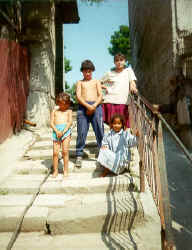
All the years of eating pig hooves and fearing to talk to your neighbor who may have been an informer, all the winters when we were going to sleep dressed in our frozen rooms as if we went to ski, because we had no heat, seemed to be past. Dreaming of life in a free world, where your letters from abroad reached you, seemed to become real.
It was true! It was true! We went back home and again turned on the TV. It was dramatic. The people were still telling us to come to help, because they were afraid they would get killed and we’d lose the revolution. We stayed up all night. I wanted to go to Bucharest immediately, but my husband calmed me down, saying I was crazy and forgetting that I was pregnant.
It went like this until morning, when I told him, "We have to go there. I can’t cower like that." He said the helicopters were above our apartment block, couldn’t I hear their buzz? They might shoot us. Finally, I angrily left, but I still hoped he’d catch up with me at the railway station. He didn’t.
The train was full of peasants, teenagers, workers and soldiers… They were all heading towards Bucharest. We went very, very slow. At times, the train wouldn’t move for almost an hour. They said all kinds of things about the butchery that was going on in Timisoara, in Sibiu… You didn’t know what to believe, especially since the men were drinking to keep themselves warm. The train was cold, we could see our breath.
We arrived in Bucharest around ten at night. We got off. Bullets whizzed by us on the platforms and all around the train station. It was eerie. I’d never heard that sound in real life, it was like in a World War II movie. I got to the metro station. It was said terrorists were hiding there, coming out through hidden doors from the walls and butchered people with their machine guns. Nothing like that happened. The metro stop was empty. I got off near my friends’ place and when I got out at the surface the bullet whizzing went on. But no one got killed. People were running around. My friends were surprised to see me, especially without my husband. They thought me imprudent to venture out like that, with my big belly in the middle of a revolution. I didn’t care. I told them, "Well, musicians are delicate creatures, they are not meant to be soldiers! It would be stupid for him to risk his life on the streets…"
Then my friends got used to the idea. We watched TV on and on. We were so happy. My friends were so drunk… Next morning I went with my friend to the National Theater where she worked. Volunteers with banderoles torn out of the Romanian flags repeatedly blocked the streets. They searched you to see if you had guns. The University Square, where the first fight took place, was empty. Later in the day I wanted to head to the TV station, but it was impossible to get through the crowd of people and cars. So we watched TV. It was spectacular. People from all over the country were on TV, telling agitatedly their life story of outrageous humiliations. The communist atrocities came out told by escaped political prisoners and exiles who rushed back home with the first airplane. Then Ceausescu’s son was on TV with his pants wet. And then, finally, we saw Ceausescu dead!
We saw his trial. We wanted him impaled, skinned, tortured, dead ten times and that wouldn’t have been enough for us… Nothing could compensate our own suffering… Humiliating suffering... How I hated to switch on the TV on which you could see only the same illiterate face of our benefactor president who kept on reelecting himself again and again, leading us to "the golden era of communism" as he forced us to repeat after him. Now, a flow of people appeared on the screen, telling of their miseries in a chopped language, for they had never talked normally before.
Meanwhile foreign TV stations plugged in and we saw people all over the world sending us humanitarian help. I will never forget that either… The world was opening the gates, the walls were falling.
There was a French TV anchor who said something I could never sort out. He was laughing frivolously as he told his audience about the photo of Ceausescu’s corpse that was on the pavement, "Can you imagine that?! A whole nation, millions of people leaning their heads to the left to see if the dead man was really Ceausescu." I couldn’t handle that someone found our worry and need for certitude laughable…
We celebrated his death by emptying the freezer and eating aplenty… It was pig-killing time in Romania and my friend got half a pig from his parents in the country side. We devoured the supply for three-winter months, because he said boastfully, "From now on, we won’t miss anything!"
Well, it didn’t work out quite like that. We were still starved for some good months thereafter, but we celebrated for a week… And it was good for my baby.
There were many kids born called Victor and Victoria that year. My late husband wanted my boy to be named Alexandru, after his own grandfather. And so he is.
I thought I’d forgotten all these facts by now... I went back to Bucharest in May 1999. The University Square was indifferent. Gray. Boring. After ’89 we often had tumultuous political rallies there. Then people calmed down.
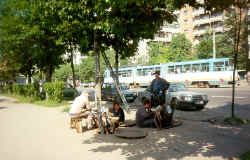
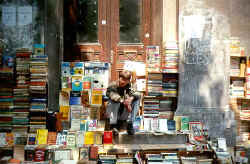
In May ’99 it seemed it was like total apathy reigned in the University Square. People bought second hand books from tired merchants. The walls had political graffiti on them. The wooden cross commemorating the young fallen was there, in the middle of the traffic. The flowers were fresh and the candles flickered their little flame. But the heroism, the ecstasy left the place.
I am lucky and grateful that I have the memory of it still in me.
I hope I don’t sound like a war veteran grandpa, bragging about heroic adventures in exchange for a glass of vodka….