I am far away from my aging parents. I feel guilty for not making their old age lighter with my presence. When I came to visit them home in Zalau, a small Romanian town in Transylvania region where they live with my sister Elena, I thought of checking on her, so I went with her to her work. “If it comes out that she knows what she's doing,” I was debating with myself, “then I can leave and roam the world at ease, because my parents are in good hands. If not, then I’ll have to do something.”
My younger sister was the delicate flower of our family. She was so sensitive and quiet and sheltered and mommy’s daughter that I couldn’t possibly see her as a doctor who faces everyday the pain and misery of being human. I knew she had a golden heart, but still, I was really doubtful that medicine was her calling. I thought my slightly hypochondriac/ always health concerned mother forced her into becoming a doctor just to have a doctor at hand...
In her first year we got to hear about how wonderful was Cellular Biology, Molecular Biology, Physiology, Biophysics, Biochemistry. She was proud to be a student of Dr. Benga’s class, who was himself a disciple of Dr. Palade, a legendary figure at the Romanian Medicine School in Cluj. And we went through Anatomy pretty safely. The Muscular System was peanuts, then we chewed diligently on the Bones, but we thought we’d get stuck when it came to Dissection. Well, we didn’t…
I couldn’t stop laughing with relief when she told us, after her first dissection, that she liked it. I mean, what was to like about slashing a former human being? My delicate sister watching a blue cadaver and not vomiting, not throwing a fit, not coming home in a hurry with suitcases and all from the University of Cluj, not crying her eyes out and hugging mother desperately that she was no doctor and preferred to be a clerk at the post office?! It was bewildering. She was strong enough to have overcome her squeamishness.
She did well all along the six years of Medical School. She got a position at the municipal hospital in Zalau for one year on probation. Now, this book-worm, spoiled mother’s skirt-tagger that is my sister I knew has become a family doctor and started her practice in Comuna Virsolt, a large village near our hometown Zalau. She has 2250 patients on her list.
So far so good.
Every morning she goes together with workers and farmers and some schoolteachers by a raggedy bus, rampa-rampa-dampa, for 45 minutes on a pot holed road. She gets off the bus in front of a grim cold medical center, cuts through the 30-40 people that worriedly have diligently been awaiting for her arrival. And she starts consulting crying babies and moaning old women. Old people, young people, little kids, and dying widows.
The main illnesses are bronchitis and asthma, because in this area the climate is foggy and dump, nearby there is the man-made lake/reservoir Virsolt, that provides the two nearby towns, Zalau and Simleu with drinkable water. If the dam breaks the villages will be covered up to the third floor.
Another disease, this one is apparently hereditary, is varicose veins, on the legs, or "gambier" ulcers, as she calls it.
Her office is an unwelcoming, frigid room. She has a medicine cupboard in a corner, displaying a few boxes. In another corner she has a weighting scale with a metal meter. A bed with a white cloth on it for the patients. A desk with several drawers full of her medical books and papers. On the desk you see several booklets and leaflets with foreign medicines ads. And that’s about it. The floor is covered with a brownish linoleum.
Her environment is not very much different than the one I would imagine rural medicine to be. A dreary setting, yes, but not really so very desperate.
The patients come in, tell her in an agitated manner about their concerns, show her their huge scars, their throats, their calloused gouty hands, or their babies’ red irritated bottoms… My sister sees them all, pats them gently, writes prescriptions, sends them to the hospital if necessary and gives them encouraging words as they leave her office.
She also goes to visit some patients at their homes.
A poor woman who can’t sleep because of her continuous pains in the hip. A baby who has pneumonia, a young woman who broke her foot.
Usually she goes on working like that until late afternoon but today—because once a week, she does this—she has to go on a field trip, three kilometers away by a horse-drawn buggie over the hills, to Recea. Recea is a small Romanian village. Her patients there are mostly old people. There aren’t but a few kids, young people left for the town.
The buggy waits for us in front of the dispensary. The carriage driver doesn’t say a word. He is soft and slightly happy. Red nose and cheeks like his are something you see all over the place in Romania. Alcoholism is rampant. Keeps some of them from facing a sordid reality. It’s thought manly, too. Huh!
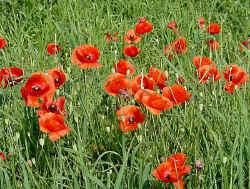
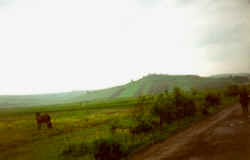
We squeeze into each other, like when we were kids and slept in the same bed, as we share the harsh woolen cover. It rains, so we put some plastic sacs on us and we trot. There is no car on that country road. Only the sound of the horse shoes trop-trop-trop! We pass by blue houses, freshly painted, by fields with neat cultivated patches, by beautiful fields of poppies, by lonely horses munching the grass. We trot in silence. The coachman broods, my sister waits me to say something, I look at the hills and sky and clouds and I find my country immensely beautiful and intimidating.
I just look at the beautiful horse that diligently pulls the yellow buggy and defecates like all decent horses do. Huh! I wanted to photography it, stunned as I was at how uninhibited horses are, and how my daffodil sister got used to it. Well, we trot. We pass by peasants carrying rakes and hoes on their shoulders. Protected by rubber boots and straw hats they walk busily. They greet my sister deferentially. Other carts pass us by as well.
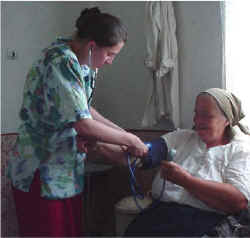
We arrive in Recea. It’s pouring. Drenched, we run into the shabby dispensary. A group of old women, with black scarves knotted underneath their chins, wait eagerly. It comes out it’s a pity party. This is their routine: before going to church they want their blood pressure taken to show themselves or their family or the world, that they take good care of their own health. “If I had any other kind of harmless machinery with me, they’d ask for that. If I had an ecograph, they’d flock on it,” my sister tells me smiling. “So I take their blood pressure every time they catch me here.”
But she has more serious cases too. One old woman, she can’t hear, she’s 84 she says, peels off her cotton stocking revealing a huge inflated, red, infested wound. My sister and her assistant are worried. “But did you use the antibiotics and the unguent I gave you last week?” asks my sister in disbelief. The woman came previously because she had been bitten by a dog.
“Well, Mademoiselle the Doctor, to tell you the truth, I didn’t,” she says like a guilty child.
“Why on earth didn’t you?!” the assistant nurse scolds her with disgust.
“Well, I went to my neighbor, nana Letitia, and she said I should put urine on it.”
I am almost fainting…
The nurse fumes with anger. “So you trust your neighbor's pissy advice more than the university educated modern doctor! What a world!”
My sister shakes her head despondently… They clean her wound again, put an unguent, bandage it and beg her to take the medication and not put piss on it because that infects it even more.
“Otherwise you might have your leg cut!” the nurse scares her.
“Well, to tell you the truth, Mademoiselle the Doctor, I am afraid of the unguent, because Vasile a Stanciului had his nose eaten like that! He went to have a wart cut in town and then his nose got eaten a bit and then the whole face and he died of cancer. I don’t want that to happen to me. Thought I’d be happy if God the Almighty took me from this sorrowful life!”
They reassure her and finally she takes her walking stick and plastic sac and leaves.
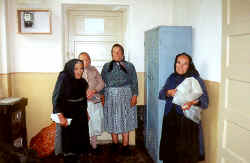
I look at all these meek sparrow-like old women, sun tanned, glittering eyes, bony hands and remember the days I was tinny and had nannies like them. I’d like to hear more of their stories, but the assistant rushes them, trying to protect my sister’s energy.
An agitated granny comes to ask my sister to come to see her grandchild who has a high fever and coughs. The rain stopped. On our way to the sick child, my sister drops me off at the priest’s house, because we have been invited to have lunch with them. The priest is not at home, but his wife is, she’s also the school principal, treats us as if we were royalty.
It is a wonderful occasion, or ordeal, because Romanians take their ideas of hospitality very seriously: you have to succumb before leaving the table. First the aperitifs: salami, sheep cheese, bacon, and boiled eggs platter; then the thick chicken soup with home made pasta is served; followed by the pork schnitzels and mashed potatoes and the stuffed cabbage and the beef stew and the sausages and the egg plant salad and the tomato salad. Then the freshly picked cherries and the home planted strawberries and the various cakes. Then the coffee and then the doggy bag. I didn’t mention the plum brandy and beer and wine… All these have to be savored, appreciated, and praised without any thought about cholesterol and slimness.
Obviously the local leaders appreciate my sister. They keep on telling her she should move to their village. She doesn’t know what to do. She wants to open her private consultation room at my parents’ house, but it is costly, the red tape insurmountable, and the patients dirt poor.
We sit in the bus stop, waiting to get back home. I feel good about my sister. My mother always bitches about her, how helpless she is. How can she be helpless when she handles loads of patients?
She has a surprisingly rich life. She is respected, listened to. She does something important. She has immediate recognition of her work. The patients are there, thankful, healthier…. Though she complains that they usually show up only when it rains or on religious holidays, when they don’t go to work the field… On the other hand the payment is an offense: $300 a month, a joke. The little tips patients bring make her feel both appreciated and guilty. She comes home with eggs, cakes and fruits, whatever the patients timidly gave her and she put away hurriedly inside her desk.
In the evening, after that rattled ride in the rain, my hip starts to ache. “Well,” I thought, “Now here is something she can prove herself to me by. No placebos on me, please! Do I do what she tells me or do I figuratively pour piss on my wounds too?” and I watch her at work. She gives me an injection, makes me a massage with a stinky liquid, then gives me some pills, and in two days I’m healed. I felt so grateful and proud about my little sister, Mademoiselle the Doctor.