I'm a platypus of a journalist and student at Eotvos Lorand University (ELTE) in Budapest on a scholarship granted by the Romanian state. Because of this my son, Alex seven-year-old, is also studying here, in Budapest. As a result he has started to forget Romanian, so I took him back to his grand-parents in Zalau (Zilah), a small town in northwest Transylvania. It would be a pity to lose our family's bilingual capacities (we are an amalgam of Transylvanian ethnicities).
To kill two birds with one stone, I also took
Melissa, a
Chinese-American, with us thinking would give me a different perspective
on my country.
We ended up having a trip full of lessons.
First we went by train up to Cluj (Kolosvar/ Klausenburg) to witness the
opening of the Hungarian Consulate. Then we went to the country side to
hear what peasants had to say about the transition period.
Finally, we went back to Cluj where new events were taking place.
A Budapest - Cluj return ticket with the international
Claudiopolis train costs about $70. As a student, it's advisable to
imitate the more experienced travelers on this line: buy a return ticket
up to the Hungarian frontier, then another return ticket to cross the
border, then a third one, in lei, up to Cluj. Thus it will cost you
about $35.
You can get it even cheaper if you know how to haggle with the
inspectors as our co-traveler did. She traveled for only $7 one way. I
can't haggle properly, so I got off and on the train and bought all
those tickets.
Still, I had to confront the inspectors who wanted some bribe with the excuse of us having no "reservation tickets." "We are poor." I explained to them. "What is this greed?! As soon as you see a Western passport you want to rip us off. And why do you spit sunflower seeds in our coach? We are humans and you should respect the law." After a while they gave up.
Melissa had fun watching me up in arms. I asked her to pretend she was dumb in order to make the guards go away. She did so.
The scenery was dramatic: hills, forests, cultivated fields, canyons and tunnels in which you hold on to your bag tightly in case of thieves.
No thieves. People are warm-hearted, talkative, helpful
and apologetic. They apologize for the lack of comfort, for the food
they lavish on you, for the potholes, for the weather... It doesn't even
cross their minds that we are grateful that we have a place to eat and
sleep for free.
Cluj’s industrial outskirts showed up first, more than 50 factories
that produce porcelain, beer, clothing, shoes, pharmaceuticals,
chemicals.
Finally the lovely church cupolas came into the view delighting Melissa. The city is dominated by Cetatuia Hill and crossed by Somesul Mic river.
Cluj has a population of more than 350,000, about 78% Romanians and 20% Hungarians. The city was founded by Romans in the 2nd century and populated by Hungarians in the 11th century and then Saxons in the 15th century. During the past 20 years, though, its Saxon population has migrated en masse to Germany. Romanians added “Napoca” to its name in the ‘70s as a recognition of their Roman ancestry.
We hurried to the opening of the Hungarian Consulate waving our press tags, elbowing through the hundreds of people gathered in front of it applauding warmly and cheering at its reopening after being peremptorily closed by dictator Nicolae Ceausescu nine years earlier. “The ovations in Cluj, said Hungarian Foreign Minister Laszlo Kovacs,” show the peoples’ interest in making peace between the two states and coming to terms with each other. Today we close the era of distrust, provocation and interethnic conflict.”
Yet the event was clouded by vandalism and nationalist fervor. The ring leader was Gheorghe Funar, mayor of Cluj and president of the extreme-nationalist Party of Romanian National Unity (PUNR), and notorious for his anti-Hungarian agenda. Earlier he had declared the Hungarian consul persona non grata and announced in the local media that he forbade the flying of the Hungarian flag over the consulate.
Romanian foreign Minister Adrian Severin responded, “With all due
sympathy for Mr. Funar’s state of health, and approving of the local
authority’s wish for self-government, he deals with issues which are
not under his jurisdiction. His bizarre decision, I am convinced, will
only make Cluj’s voters show their wisdom.”
Romanians opposed to the Hungarian ethnic minority stole the Hungarian
flag from the building the very next day.
Funaru's influence was visible elsewhere in the pretty city of neoclassical, baroque and secession-style buildings that have at the ground floor restaurants and elegant shops with folklore, books, fashionable dresses and whatnot.
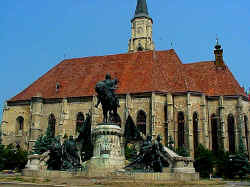
We went for a walk to Unirii Square the main square so Melissa could take shots of Matei Corvin's (King Matthias) bronze statue by Janos Fadrusz standing in the middle of the square. The inscription on the statue which used to read “Hungariae Matthias Rex”, thanks to Funar’s inventiveness now reads just “Matthias Rex” and is surrounded by six Romanian flags on ugly metal poles.
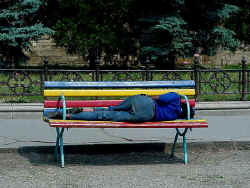
Recently he had the benches painted in stripes of red, yellow and blue - the colors of Romanian flag. "That was very smart of him. He is mad, you know?!" commented a Romanian passer by seeing our amusement. "Now Hungarian peasant women can place their fat bottoms and fart on our flag."
An archeological dig has been opened in front of the statue, presumably to provide a pretext for removing it altogether. We had a look at the display of Roman ruins. The excavations destroyed the previously stylish park. "Cool!" said Melissa, "It's like discovering a dinosaur in your backyard."
The watchman--there were no diggings going on because everybody was across the square to see the opening of the Hungarian Consulate--said that a Hungarian told him that in the past at the left corner of the ruins there was the stable, next to it the inn and further on the whore house. When he heard Melissa speaking in her glamorous English, he asked her if she sold dollars. "We don't. But why are the diggings covered by weeds?" "We are only eight workers and it goes slowly." "Why haven't you extend the diggings under the church? Maybe you find the throne hall! Why don't you demolish the statue?!" "Well, this is how it was planned, but the political friction hasn't allowed us to."
We had many other interesting conversations in Cluj. One intellectual
told us Romania's future is horrible: the Freemasons and the Jewish
mafia is controlling the world. The thought that we, ordinary people,
are like helpless leaves floating on a river, made her blood boil.
Another person, a young business woman, told us how corruption had
corroded everything: she had to pay 150,000 lei to the authorities in
order to open a stand and spent another half a million on bribes to
actually open it. Then all kinds of inspectors come and fine heavily
private business. No one knows in whose pockets this money actually goes
into.
It was gloomy. I came home listening to Liza's advice, my Ukrainian friend, who said at home even the walls heal. It's peaceful. Your family loves you. You forget about cramming, exams, stress...
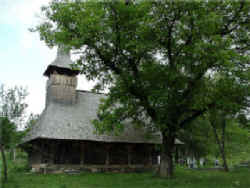
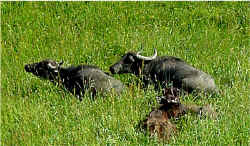
We headed towards Zalau, my hometown, over the Meses Mountains on a bumpy road in the old Dacia my brother drove us in courteously passing through villages with wooden churches and herds of black buffalo pensively crossing the street in front of the car maddening the driver with their lazy dangling of tails.
Zalau is a small country town with two cinemas and a large industrial fringe grafted on during communist years. From a hamlet with a few houses and five intellectuals it has been built up to 70,000 people housed in apartments in a kind of neo-barrack style.
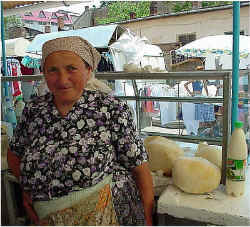
My father works in the market for a living. My parents are both retired agronomists. Now they buy bananas in bulk and sell them to Zalau’s citizens. They also sell plastic bags, sunflower seeds, jar lids, cigarettes, coffee... It's hard. People don't have money to buy. Vegetables lie limply on tables. A kilogram of cabbage costs 500 lei...
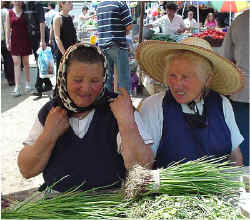
My father counts the money at the end of the day. There are piles of bank notes because of the high inflation rate and Alex, his grandson helps him. He gets 1,000 lei (less than 25 U.S. cents) a day. Maybe we go to the seaside, he says. I doubt it, but it is sweet of him.
Once upon a time, in the collective farm era, my father managed scores
of villages. He supervised the planting of vineyards, orchards on the
hills of Badon, Guruslau or Hereclean. After the revolution the peasants
uprooted the fruit trees, and burnt the vines. Though they were noble
varieties of vines, my mother recalled sadly. They planted potatoes
instead.
I asked my father why they acted like this. Why haven't they continued
to work the vine? "Because they don't know how, "said my
father. "In the time of the collective farms the peasant didn't
work the land anymore, he just listened to the leadership. It was
humiliating for them, I think. This fueled their anger. Burning the
vines was like erasing a past of humiliation."
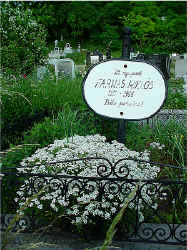
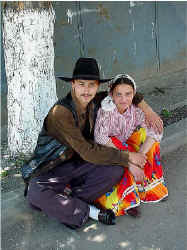
We strolled on the narrow streets up to the cemetery so Melissa could get a panoramic shot. We passed by a two-floor brick building under construction. Women in lively dresses were talking loudly. Melissa worked her camera. This was pleasant for them. A whole family of smiling Roma came to pose. They were very proud of their house and car and prosperous family. "Gypsies are very good at business," said a Romanian woman from the market. "They are hard working and have such good sales skills that we almost envy them."
We went to see one of the orthodox churches. The altar was carved by prisoners in the Gherla jail and the icons were brought from Israel.
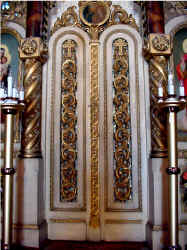
On the walls, there were words of thanks written in pencil by the faithful: "Oh, Dear Lord, help me take the entrance exam at the university, keep us healthy and help me make peace with Cristina." "Dear Lord help me buy good blue jeans and protect us from earthquakes and calamities. Protect us from Satan's hallucinations and temptations." "Jesus, thank you for giving me a son and help, Dear Lord, our volleyball team beat CSS Arad." I could spend a day collecting those little naive prayers.
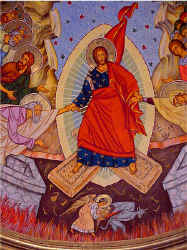
At the other end of the town they built what would be the most beautiful orthodox church in Romania, one of the young clergymen boasted, through the financial effort of the believers. The bell would be of silver. We saw the net scaffoldings around its spiral staircase and rounded spires as we went to the country side. In the back the blocks were covered with black soot coming from the industrial site.
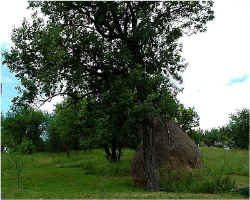
I thought of going to a village I knew and see if I could buy a hut at the end of the village where I could write my mighty works in peace and quiet. At the dawn we hitchhiked up to Guruslau. On its hills there is a monument commemorating Mihai the Brave Voivode's victory in a medieval battle. I remembered how in primary school we gathered on a windy, icy day on the top of the hill wearing our uniforms with short skirts, white blouses, white stockings and red pioneer scarves to welcome our comrade Ceausescu, "the most beloved son of the Romanian people," as the slogan was. He came by helicopter, didn't say a word, pulled the silk cloth off the tall monument and off he went in his chopper. Not even a word for the thousands of workers and pupils gathered that windy day.
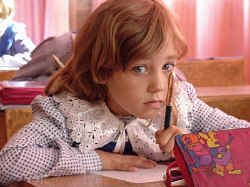
Nowadays it's different. I went to the school where I attended as a
child to pick up Alex’s little friends for his seventh birthday party.
The pupils were playing in the schoolyard. Some still wore uniforms but
most had colorful clothing and shoes. A Gypsy girl played alone, drawing
on the pavement. She wore many layered flowery skirts and lucky red
ribbons in her hair. I pointed her prettiness to my son but he said
outraged, "Mom', she is a Gypsy!" So we got again into,
"Yeah! You are partly Gypsy yourself!"
Our guests were two Hungarian girls, a Hungarian boy and a Romanian boy. The shy little Hungarians couldn’t speak Romanian well and the Romanian couldn’t speak Hungarian. They were scooping the cake and quietly drinking their juice. We sang a Romanian version of “Happy Birthday to You”, then we wanted to sing one in Hungarian. But the Hungarian girls didn’t know their own people songs. Finally we sang in English, which all of them knew, from television, I suppose.
But the shyness wouldn’t lift. “Do something Alex!” I begged my son. You know what he did? He started to talk in both languages. First he would address the child in his or her own language, then translate accurately and patiently in the other language. I bet he won’t vote for Mr. Funar.
We wanted to make our trip an adventure and go by noisy tractors or picturesque hay carts, because there were some coming along the road, but it didn't work that way. They went only near by, they said. Finally a Dacia took us up to Cosei, a village of Hungarians and Romanians. The driver, a Hungarian sanitary inspector, said that people in the region had no problems living together. "We are way backwards in political education. Look at Switzerland: Germans, Italians, French living peacefully. Here, all kinds of ruthless politicians provoke friction because they have no solutions for the everyday tedious problems of a poor and hopeless people. They enjoy their privileges while riding on our back."
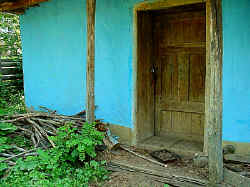
We got to Cosei, with its traditional houses painted in blue or light green, with wooden poles and a porch. I knew there nana Floare of Cornea. Her house looked deserted. The neighbors said she died a year ago. "Aren't you the agronomist's daughter?" "Yes..." "Oh, do come in. We just buried my old man, rest him in peace. The yard was full of mourners yesterday. My five children came from town. Please come in."
They noticed Melissa's almond eyes and questions poured out: is she a foreigner, from where? America?! They smiled sadly. "How is life there? Here is a misfortune, there is no money. The land is full of weeds, we can't work it because the tractor costs money, the seeds cost money, the transportation too, so we just keep it for pasture or simply sell it..."
Glasses of wine and palinca were emptied fast. They fed us stuffed
cabbage and chicken soup, very good sweet bread, and again wine and
palinca.
In the neighborhood there was a house for sale, but they asked $ 4,800
for it, four times what I thought it might be, so we went to catch the
bus dragging the bag full of bottles and sweet bread they gave us as
gifts.
Cured of rustic dreams we marched back to Cluj where new events took
place.
I bought newspapers to read while traveling. Just glancing them over was like opening a Pandora's box: "The Hungarian Flag Was Stolen From The Consulate." "Mayor Funar Sues A Printing House Because He Appeared With Hollow Eyes In A Paper." "One Million Faked Dollars, Russian, Arabian, And Italian Mafiosi Have No Problems In Operating In Romania," "15 Men Died In An Air Crash Near Brasov," "Protest Against Poverty And 'Selling Our Country To Foreigners' " “Thieves, Forgers, Crooks” ”Spies and Secret Agents In Romanian Press” “Americans Ask 2 Million Dollars For Copyright Fees” “The ‘89’s Revolutionaries Protest. Three Hunger Strikers Were Taken To The Emergency Hospital” “Gypsy Power Is Overruling Law”.
It was raining over Cluj. We went again downtown, to Unirii Square see
if the flag really disappeared from Consulate. Yes, it did.
We went inside the huge Gothic style St. Michael’s Church built in
1442, when the Catholic Hungarian nobility ruled unchallenged over the
city. We looked at its frescos. I liked the portrait of a mother beating
her child with a broom, Melissa liked a hunting scene and some floral
motifs.
Other necessities urged us away from spirituality.
The doorkeeper at the public toilet was singing: “Jesus, you who
sacrificed for us...” in a soothing voice while trying to catch an
annoying fly.
Opposite the St. Michael’s church stands the Art Museum housed in an
18th-century baroque mansion of Banffy, a Hungarian noble. We went in to
see its collection of paintings by notable Romanian artists like
Grigorescu, Aman and Luchian.
We were told that we should visit the exhibits clockwise. Melissa walked in the opposite direction. After about five minutes when I was talking to the flowers of Stefan Luchian, an impressionist painter who though confined in bed kept on painting, mostly flowers, until death. The flowers said: "It doesn't matter where you live, he lived in the slums in a little house. He painted us so delicate and joyous for you. Wherever you'll go, you can transfigure the world around you into your only real world. You'll survive ugliness and arrogance...."
Suddenly one of the custodians was blocking my view and screaming: "Is that young Japanese lady with you? Because we can't understand each other." "Why are you screaming?" "I'm screaming? You should hear me screaming!" "I didn't know this was included in the price of admission. Anyway, the young lady can only speak English and Chinese." "I explained to her that she should go to the right because the rooms are in chronological order but she doesn't want to at any price!" "Leave her alone then. I can tell her what you said but she is an American and is not used with 'to the left', 'to the right'. They live in a democracy there."
Melissa explained later that it was exhilarating to see them annoyed when she affirmed her right of going to the left. She missed that kind of experience in her country where you had by law the right to behave as idiotically as you choose to.
The custodian went away puzzled, but she forgot about us when her
colleague rushed in and pointed excitedly out of the window: “They put
back the Hungarian flag!”
I put on my journalist hat and ran across the square and pressed the
buzzer at the Consulate to interview the consul, Karoly Bitay. He told
me that after the inauguration he looked out of the third-floor window
and saw a man grabbing at the Hungarian flag. “I asked the man climbed
on the ladder what he was doing there. He answered he was just carrying
out an order. When asked whose order, he refused to answer and went away
with the flag under his arm and drove away in a red Dacia car.” The
flag was returned to the Consulate by the police 15 minutes before I
stepped into the building. It felt good to be a journalist and get hot
news.
The incident was covered heavily in the local media. Some papers’ commentaries said it was not Funar but Hungarians themselves who tried to project abroad a bad image of Romanians.
After this achievement we went to see churches. There were weddings
everywhere. The brides liked to be photographed in front of Funar's
monuments placed across the main churches.
These many monuments meant to highlight Romanians settlement in
Transylvania long before Hungarians even dreamt of.
We went around the Romanian National Theater and Opera with its six
lions topped by triumphant Thalias or whatever dandy deity they wanted
to embody. We hid from rain in the immense Orthodox cathedral. This
looked old but it is actually built in 1920s. The neo-Byzantine stone
facade hides a concrete structure.
We went towards the center along the inspiring nineteenth-century Iuliu Maniu street by taxi. We passed by a bunch of rocks glued together with a man up there ready to tumble on his head. We were told this was the statue of Avram Iancu, the leader of the 1848 revolt against the Hungarians. Its cost was over a million dollars apparently paid by business men as well as by the central government. “City Hall has no money to fix the potholes,” said the taxi driver,” but it doesn’t think twice about financing pricey and ugly statues like this."
I thought it fair that on our way back
Melissa should
deal with the ticket inspectors. I gave her the tickets and I plunged
into reading A Choice of Heroes: The Changing Face of American
Manhood.
No one bothered us up to Biharkeresztes, when the Hungarian guard asked
us if we had gotten on then. Melissa asked me what he said, I said in
English that I assumed he wanted to know if we were going to Budapest
and we both nodded: "Igen, igen." He looked at us and asked
again and we again said, "Igen, igen." So he left.
Overall I liked traveling with Melissa. I turned bluish-green after having to translate for her seven times the same following questions: "Do you like Romania?" "What's it like in your country?" "Are the taxes high in USA?" "I can't believe there are poor Americans like you." Are you really willing to sleep on the floor?!" "Send us the photos you took." "Can you invite us to America?"
Next time we will bring with us a leaflet answering these questions. We will ask the new acquaintances: "Have you ever met an American before? No? Here is this leaflet. Read it while we go walking around town for ten minutes. If you have any other questions we will be delighted to answer them."
Previously published in:
The Budapest Week, August 14-20, 1997
Dilema Autumn 1997
Transitions, Vol. 4. No. 7, December 1997