
Great Pyramid of Giza 1 2 3 4
 The nearly
square shafts measure about 20 centimeters wide by 20 centimeters high. Each
chamber has a pair of shafts. One shaft is directed precisely north and the
other precisely south. In each chamber, the shafts are aligned along a
north-south line.
The nearly
square shafts measure about 20 centimeters wide by 20 centimeters high. Each
chamber has a pair of shafts. One shaft is directed precisely north and the
other precisely south. In each chamber, the shafts are aligned along a
north-south line.
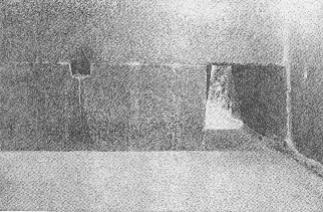
The photo shows the King's Chamber north shaft to the left of the chamber's entrance passage. In each chamber, the shafts enter the wall horizontally for a short distance and then angle up, each shaft at its own precise elevation:
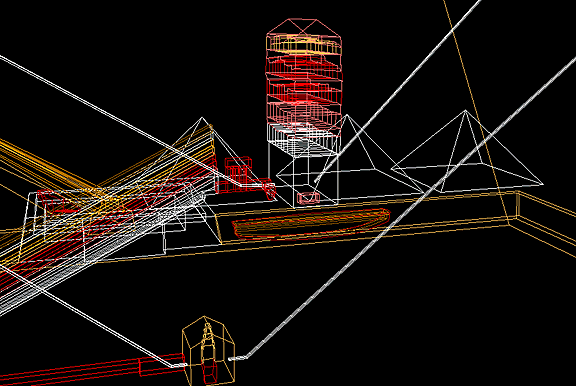
Queen's Chamber South: 39d30'
King's Chamber South: 45d00'
Queen's Chamber North: 39d00'
King's Chamber North: 32d28'
The King's Chamber shafts extend to the outside world, their exit points measuring equally high (about 80 meters) above the basal plane. The Queen's Chamber shafts terminate inside the pyramid.
 One current
theory suggests that the shafts were constructed as "conduits" through
which the soul of the dead Cheops could depart to the stars after his burial in
the pyramid.
One current
theory suggests that the shafts were constructed as "conduits" through
which the soul of the dead Cheops could depart to the stars after his burial in
the pyramid.
The shafts are angled through the masonry with great effort. Each shaft stone is actually several disparate pieces of masonry, which must be assembled in order to integrate the angled shaft into the pyramid's horizontal masonry courses. It seems unlikely that the builders would have gone to so much extra effort to construct such complex features merely for ritual purposes. Could they have had another reason?
In 1837, explorer Howard Vyse discovered a wrought Iron Plate, believed to be contemporaneous with the Great Pyramid's construction, imbedded in the masonry a few meters from exit of the King's Chamber south air shaft. The heavily corroded plate measures 26 x 8.6 centimeters and is believed to be a portion of the original plate that measured about 26 centimeters square. Chemical analysis of the plate in 1989 revealed traces of an original gold coating on one side.
The plate is controversial in its own right. According to historians, man had not yet discovered how to make wrought iron in the Pyramid Age. Some critics, therefore, have expressed doubt about the plate's authenticity, suggesting that it might be a hoax. What could have been the purpose of this mysterious Iron Plate?
Similar in orientation and elevation to the air shafts are the Great Pyramid's internal passages, including the Ascending Passage and Grand Gallery and the Entrance Passage and Descending Passage. Could there be a connection between the shafts and passages?
In 1993, engineer Rudolf Gantenbrink sent a TV-camera-equipped robot some 35 meters up the Queen's Chamber south air shaft where it discovered "Gantenbrink's Door", a block of stone with two imbedded copper fittings, one of which has broken off and lies on the floor of the shaft. There has been much speculation about what lies behind Gantenbrink's Door.
| Back Sign our Guestbook Submit your experience |