
Great Pyramid of Giza 1 2 3 4
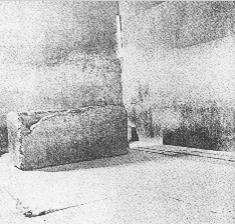 Whatever
treasure the Great Pyramid was designed to protect--whether it was the mummy of
Cheops or something else--the King's Chamber and Granite Coffer were that
treasure's most likely resting place.
Whatever
treasure the Great Pyramid was designed to protect--whether it was the mummy of
Cheops or something else--the King's Chamber and Granite Coffer were that
treasure's most likely resting place.
The granite-walled King's Chamber (a rectangular parallelepiped) was
constructed with great precision and has been carefully measured, yielding the
following estimates for its original dimensions:
Length = 10480 mm
Width = 5240 mm
Height = 5860 mm
Naturally, we might expect a margin of error of a few millimeters in each of
these measurements.
Obviously, the King's Chamber floor was designed as a double square, the length measuring exactly twice the width. Clearly, this 2-to-1 proportion was intentional and indicates that the architect intended the King's Chamber proportions to be meaningful in some way. We view this as a clue from the architect that we should investigate further.
 While the King's
Chamber floor is a double square, the King's Chamber volume is not quite a
double cube, the ceiling measuring 620 mm higher than necessary to create a
double cube. Why?
While the King's
Chamber floor is a double square, the King's Chamber volume is not quite a
double cube, the ceiling measuring 620 mm higher than necessary to create a
double cube. Why?
It was none other than the great 17th century mathematician and scientist Isaac Newton who established to general assent that the King's Chamber floor was designed to be 10 x 20 Royal Cubits (RC). Based on the King's Chamber floor dimensions stated above, 1 RC would measure very nearly 524 millimeters.
If the King's Chamber really was designed in Royal Cubits, we might expect to find the height to be an integral number of RC as well. Measuring in RC, we find that the King's Chamber height is 11.183 RC. This seems a bit odd. Rather than designing the height to be 10.0, 11.0, or 12.0, or some other integral number of RC, as he did the floor dimensions, the architect chose 11.183 RC, a number with no apparent significance. Why?
"Many investigators have tried to explain the dimensions of this coffer, but none has reached a positive conclusion. However, the majority of the investigators agree on two basic assumptions; the coffer embodies some numerical conundrum and the contents of the coffer corresponds to some standard of volume." -- Livio Catullo Stecchini (1971) - from Notes on the Relation of Ancient Measures to the Great Pyramid
The Granite Coffer is a marvel of engineering in its own right. It was cut to exacting specifications out of a single block of solid granite and precisely hollowed out by methods unknown.
The lidless Granite Coffer has been painstakingly measured, yielding the following estimates for the original length (L), width (W), and height (H):
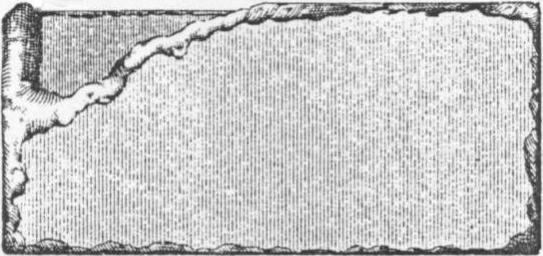 Inside:
L = 1977 mm
W = 677 mm
H = 872 mm
Outside:
L = 2278 mm
W = 977 mm
H = 1048 mm
The Coffer's four vertical walls are all very nearly 150 mm thick.
The Coffer's surfaces have been chipped and degraded over the centuries, so we might expect a margin of error of at least a few millimeters in each of these measurements, particularly the inside and outside heights.
Knowing the inside and outside dimensions, we can quite readily calculate the Coffer's Outside Volume (VO) and Inside Volume (VI):
VO = 2278 mm x 977 mm x 1048 mm = 2.3324 cubic meters
VI = 1977 mm x 677 mm x 872 mm = 1.1671 cubic meters
Calculating the ratio of the inside and outside Coffer volumes, we find that:
VO/VI = 2.3324/1.1671 = 1.9985
Thus, the measured inside and outside Coffer volumes are in a 2-to-1 proportion to better than 1 part in 1000. Given the small uncertainty in our Coffer measurements, it is reasonable to conclude that the architect designed the inside and outside Coffer volumes in a proportion of exactly 2 to 1. Supporting this view is the fact that the Coffer rests on the King's Chamber floor, which the architect clearly designed in the same 2-to-1 proportion, as we just established.
If we measure in RC, we find that the outside Coffer height appears to be exactly 2 RC, but the height measurement is somewhat uncertain, so we might attribute this fact to coincidence or wishful thinking. None of the other five Coffer dimensions are equal to an integral number of RC (or a meaningful fraction thereof), so we might question whether the architect actually did design the Coffer dimensions in RC.
In terms of the RC, the Coffer would seem to fail as a standard of volume as well. Based on our earlier values for the inside length, width, and height, the Coffer's inside volume measures 8.11 cubic RC, and its outside volume measures 16.22 cubic RC, two numbers with no apparent significance.
It is almost certain that the Coffer was originally sealed with a matching granite lid. Perhaps the correct concept applies only to the lidded Coffer. Maybe there is some way we can infer the height of the lid from the information provided to us by the lidless Coffer. Knowing that the lid might be destroyed, could the architect have "encoded" its height and other information into the Coffer's lidless proportions and dimensions?
Could the Coffer and the King's Chamber in which it resides be linked according to some geometrical or mathematical principle? If we understood the riddle of the King's Chamber height, might that lead us to a solution to the Coffer's design or vice versa? Could the designs of the King's Chamber and Coffer somehow be connected to the pyramid's exterior design?
What could be the solution to this most ancient of puzzles--the Coffer Puzzle, and what other secrets might it unlock?
The architect evidently went to extraordinary lengths to prevent violation of the King's Chamber and its priceless Granite Coffer. Vertical slots in the sides of the granite-walled antechamber to the King's Chamber indicate that the King's Chamber originally was blocked by three (now gone) massive granite Antechamber Portcullis Blocks that were 55 centimeters thick and, depending on their height, probably weighed 7000 kilograms each. The design indicates that the blocks were propped high enough to allow access to the King's Chamber until it was ready to be sealed. To seal the King's Chamber, the builders merely had to knock out the props supporting each block and let gravity lower the blocks into place.
Thus, the architect confronted potential violators of the King's Chamber with a wall of solid granite. We can imagine the ancient intruders chiseling by hand through each solid granite block, one by one, not knowing how many more granite blocks were to follow. It must have been a long and exhausting task, but each granite block ultimately surrendered, finally opening the looters' way to the King's Chamber and its Granite Coffer.
| Back Sign our Guestbook Submit your experience |