
Great Pyramid of Giza 1 2 3 4
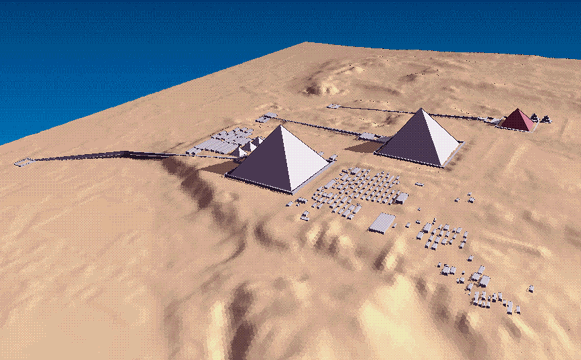 The Great
Pyramid is the largest and finest of three large pyramids on the Giza
plateau near modern-day Cairo, Egypt. The Great Pyramid itself is the only
surviving member of the Seven Wonders of the Ancient World. Egyptologists
say the Great Pyramid was built as a tomb for the great Cheops, who ruled
in the Fourth Dynasty about 2600 B.C.
The Great
Pyramid is the largest and finest of three large pyramids on the Giza
plateau near modern-day Cairo, Egypt. The Great Pyramid itself is the only
surviving member of the Seven Wonders of the Ancient World. Egyptologists
say the Great Pyramid was built as a tomb for the great Cheops, who ruled
in the Fourth Dynasty about 2600 B.C.
 According to
Egyptologists, the Great Pyramid was followed by Chephren's pyramid (the one in
the middle), which is slightly smaller than the Great Pyramid. The third large
Giza pyramid, built for Mycerinus and much smaller than the other two, completed
the complex.
According to
Egyptologists, the Great Pyramid was followed by Chephren's pyramid (the one in
the middle), which is slightly smaller than the Great Pyramid. The third large
Giza pyramid, built for Mycerinus and much smaller than the other two, completed
the complex.
The Great Pyramid was constructed with an original outer layer of white Tura limestone casing stones that gave it a smooth and almost seamless outer surface. In the 14th century, the local inhabitants stripped the casing stones from the pyramid to rebuild after an earthquake.
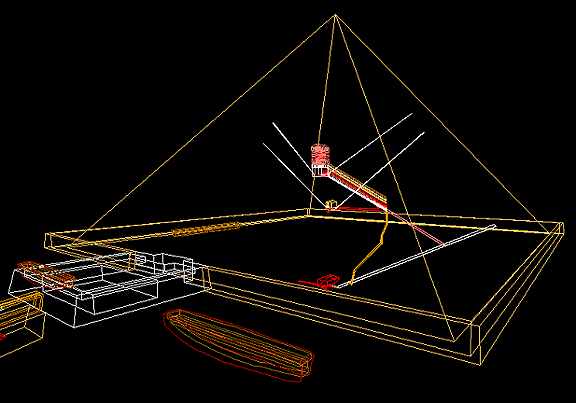 Not only is it
the largest true pyramid ever built, the Great Pyramid's compelling geometric
form conceals a complex system of internal passages, chambers, air shafts, and
other features found in no other pyramid. Most notable among these features are
the King's Chamber and its Granite Coffer and the Queen's
Chamber and its Niche.
Not only is it
the largest true pyramid ever built, the Great Pyramid's compelling geometric
form conceals a complex system of internal passages, chambers, air shafts, and
other features found in no other pyramid. Most notable among these features are
the King's Chamber and its Granite Coffer and the Queen's
Chamber and its Niche.
The Great Pyramid is estimated to contain some 2.3 million blocks of stone. Granite blocks were used in some of the internal features, such as the King's Chamber, while limestone blocks were used for most of the body of the pyramid. A typical limestone block weighs about 3 tons. The heaviest granite blocks weigh more than 70 tons. Except for its relatively small internal features, the Great Pyramid is solid masonry.
The accuracy of the Great Pyramid's construction is most remarkable. The base is an almost perfect square. The difference between the longest and shortest sides is only 20 centimeters, and the four 90-degree corner angles are accurate to better than 3.5 arc minutes. Furthermore, the base is almost perfectly aligned to the compass points, with the largest alignment error measuring only 5.5 arc minutes.
The Great Pyramid rests on a stone platform 55 centimeters tall. This platform is level to some 2.5 centimeters across a diagonal base length of some 325 meters.
Interestingly, the Great Pyramid rests at latitude 29d 58' 51" N, which is only 01' 09" (2125 meters) south of exactly 30 degrees north latitude. Did the builders intend to build the Great Pyramid at 30 degrees north latitude, or is this curious fact merely a coincidence?
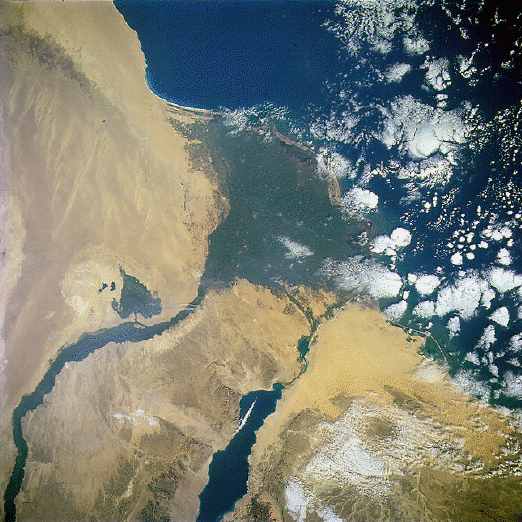
The satellite photo clearly shows the Nile River, which winds north to the Nile Delta and then into Mediterranean Sea at the upper right. The Giza plateau is visible as a very small oval white region west of the Nile River just where it widens into the delta. The dark heart-shaped region south of Giza is the Faiyum. The large dark area east of the Nile is the Gulf of Suez.
The definitive 1925 Cole Survey estimated the Great Pyramid's original dimensions as follows:
 Corner Angles
and (Errors):
Corner Angles
and (Errors):
NW: 89d 59' 58" (-00' 02")
SW: 90d 00' 33" (+00' 33")
NE: 90d 03' 02" (+03' 02")
SE: 89d 56' 27" (-03' 33")
Side Alignments:
N: 02' 28" S of W
S: 01' 57" S of W
E: 05' 30" W of N
W: 02' 30" W of N
Side Lengths:
N: 230.26 meters
S: 230.45 meters
E: 230.39 meters
W: 230.36 meters
We can add the Cole Survey's four estimated side lengths to find the Great Pyramid's original base perimeter length:
Perimeter (P) = 921.46 meters
The Cole Survey also estimated the original vertical apex height to have been:
Height (H) = 146.73 meters
If we divide the perimeter by twice the height, we find the result to be almost exactly equal to the important mathematical value known today as pi. It was English mathematician John Taylor who first discovered pi in the Great Pyramid in 1859 using slightly different values for the perimeter and height. Taylor, Piazzi Smyth (Astronomer Royal of Scotland), and others believed this occurrence of pi in the Great Pyramid to have great religious and prophetic significance, and their theories on the subject are bizarre, to say the least.
Further inspection shows that the perimeter length is very nearly equal to the length of 1/2 arc minute of latitude, which is 923.79 meters at the Great Pyramid's latitude of 30 degrees N.
The Great Pyramid's half-arc-minute perimeter length, its P/2H = pi proportion, its precise alignment to the compass points, and its 30-degree latitude have led many to suggest that the ancient Egyptians constructed the Great Pyramid as a geodetic monument. This view is not accepted by historians and scientists, who attribute these facts to other causes or to coincidence and contend that man did not possess such detailed geodetic knowledge in the Pyramid Age.
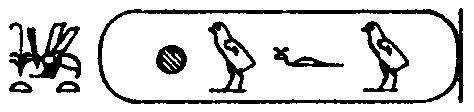 The first recorded
entry into the Great Pyramid was in A.D. 820 by the Caliph Al Mamoun, who
was inspired by (then) ancient legends that the Great Pyramid contained great
wealth and knowledge.
The first recorded
entry into the Great Pyramid was in A.D. 820 by the Caliph Al Mamoun, who
was inspired by (then) ancient legends that the Great Pyramid contained great
wealth and knowledge.
Unable to find the builders' hidden entrance, the Caliph's men made their best guess as to where to begin and spent weeks tunneling into the pyramid's north face. The men had tunneled about 35 meters when they heard the sound of a large stone falling. They tunneled a few meters in that direction (east) and soon broke through the wall of what we call the Descending Passage today.
They followed the long Descending Passage down some 80 meters to find the empty and unfinished Subterranean Chamber, sometimes called the Pit.
At the top end of the Descending Passage, they discovered the architect's original Entrance Passage, which had been hidden from the outside world. The architect had thwarted the Caliph's discovery of the Entrance Passage by constructing it some 8 meters east of the centerline of the pyramid's north face.
The aforementioned falling stone was a great Prismatic Stone, which had been dislodged by the violence of the Caliph's tunneling efforts. The architect had carefully shaped and crafted the Prismatic Stone as a section of false ceiling for the Descending Passage. The inadvertent dislodging of the Prismatic Stone revealed the bottom end of a massive Granite Plug blocking what appeared to be an ascending passageway.
Undaunted, the Caliph's men tunneled up and around the 6-meter Granite Plug until they reached what we now call the Ascending Passage. At this point they encountered yet another obstacle. The builders had filled the Ascending Passage with limestone blocks, completely obstructing it.
The Caliph's men chiseled out the first stone block, only to find that each time a block was removed, the stack of blocks, the full length of which was hidden from their view, slid down the inclined Ascending Passage to fill the vacancy. The blocks likely were stacked the full length of the Ascending Passage (about 40 meters). After exhausting effort, the Caliph's men eventually cleared the stack of limestone blocks from the Ascending Passage, and the upward leading passage became navigable.
After reaching the top of the narrow Ascending Passage, the Caliph's men continued another 48 meters through the 8.5-meter-high Grand Gallery.
At the top of the Grand Gallery, a short walk through a small "antechamber" led the Caliph's men to the so-called King's Chamber and its Granite Coffer.
At the base of the Grand Gallery, the Caliph's men followed a horizontal passage that led them to a large chamber known today as the Queen's Chamber, which contains the Niche.
To his great disappointment, the Caliph found that the pyramid already had been entered and looted at some unknown earlier date by persons unknown and by methods unknown. All that remained was an empty, lidless Granite Coffer in the King's Chamber and an empty Niche in the Queen's Chamber.
How had the looters entered? What treasures did the Great Pyramid originally contain, and what became of those treasures?
| Back Sign our Guestbook Submit your experience |