
Great Pyramid of Giza 1 2 3 4

 The
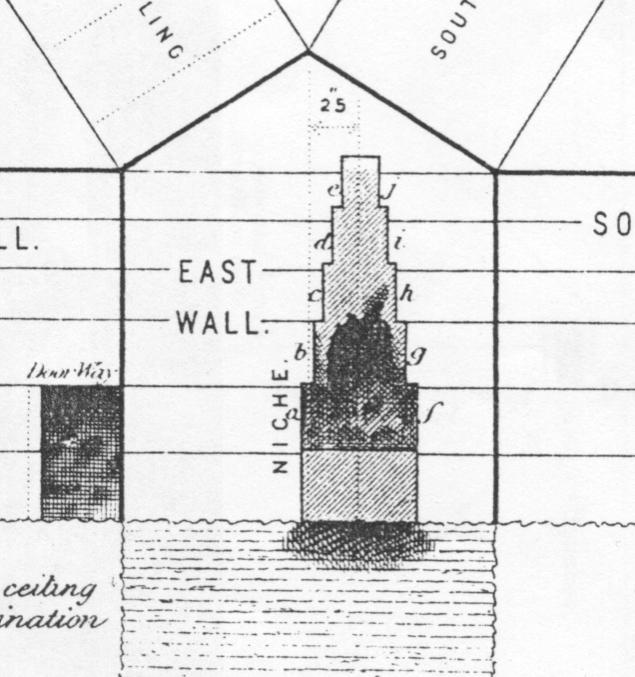
seven-sided, limestone-walled Queen's Chamber lies lower in pyramid than the
King's Chamber and, therefore, was constructed some years earlier. The chamber's
most prominent feature is the recessed Niche in the east wall. The other notable
Queen's Chamber feature is the pair of "air shafts" entering the north
and south walls. The floor of the Queen's Chamber is rough and uneven,
indicating that floor tiles or slabs originally were installed.
The
seven-sided, limestone-walled Queen's Chamber lies lower in pyramid than the
King's Chamber and, therefore, was constructed some years earlier. The chamber's
most prominent feature is the recessed Niche in the east wall. The other notable
Queen's Chamber feature is the pair of "air shafts" entering the north
and south walls. The floor of the Queen's Chamber is rough and uneven,
indicating that floor tiles or slabs originally were installed.
The architect appears to have designed the Queen's Chamber in Royal Cubits (RC). The floor measures 10 x 11 RC, where 1 RC = 524 mm. The height from the top of the wall to the top of the gable measures 3 RC. The designed wall and gable heights are uncertain due to the uneven floor, but the wall height probably was 9 RC, and the gable height 12 RC.
It is interesting to note that the Queen's Chamber and King's Chamber widths, both of which are oriented north and south, are equal to 10 RC. Did the architect intend any significance in this design? The architect clearly designed a 2-to-1 proportion in the King's Chamber floor. What did he have in mind when he designed a 11-to-10 proportion into the Queen's Chamber floor?
The Niche's purpose always has been one of the Great Pyramid's mysteries. Treasure seekers ancient and modern have tunneled into the wall behind the Niche and into the floor in front, hoping to find a hidden chamber, but to no avail. It has been suggested that the Niche once held an overlifesize human statue, or than it served as a symbolic "doorway to the afterlife", but no really convincing explanation for the Niche has been proposed.
 It is
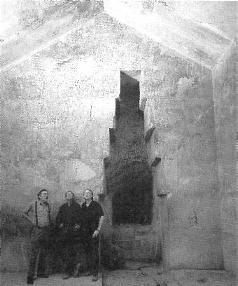
reasonable to suppose that, like the Queen's Chamber in which it resides, the
(now) dilapidated Niche was designed in RC. The Niche appears to measure 3 RC
wide at the base, and its depth into the wall appears to be 2 RC. The height of
the Niche is somewhat uncertain due to the uneven floor, but it probably was 9
RC.
It is
reasonable to suppose that, like the Queen's Chamber in which it resides, the
(now) dilapidated Niche was designed in RC. The Niche appears to measure 3 RC
wide at the base, and its depth into the wall appears to be 2 RC. The height of
the Niche is somewhat uncertain due to the uneven floor, but it probably was 9
RC.
The vertically symmetrical Niche consists of 5 sections, each section about 26 centimeters narrower than the section beneath it. The Niche thus narrows from a base width of 3 RC = 1572 mm to a top section that measures very nearly 500 mm in width. We might wonder why the architect designed the width of the Niche's top section to be 500 mm, a number with no apparent significance in terms of the RC. Could this 500-mm width have been designed for some as-yet unknown purpose?
A curious fact about the Niche is its off-center location on the Queen's Chamber east wall. For some reason, the Niche was constructed some 636 mm south of the east wall's centerline. Why? This so-called Eccentricity of the Niche, which has no apparent significance in terms of the 524-mm Royal Cubit, has remained a mystery.
A quick calculation reveals the proportion between the width of the Niche (WN) and the Niche's top width (WT) to be:
WN/WT = 1572/500 = 3.1440
Unless we wish to contest the published values for the Niche's top and bottom widths, we are compelled to recognize their proportion to be equal to p = 3.1416 to better than 1 part in 1300. Did the architect intend to design the p proportion into his Niche, or is this relationship merely an interesting coincidence?
If the architect really did design p into the proportion between the top and bottom widths of the Niche, as we have suggested, perhaps he designed p into the Eccentricity as well.
A little contemplation reveals the following very simple relationship between the top width of the Niche (WT) and the Eccentricity of the Niche (EN):
WT/EN = p/4
Thus, we can compute the Eccentricity like this:
EN = (4/p) x WT = (4/p) x 500 mm = 636.6 mm
This is less than 1 mm from the measured value and within the margin of error we might expect, considering the small uncertainties in our working values for p, WN, WT, and EN.
Because WT = WN/p, as we previously established, the following relationship also holds:
WN/EN = (p/2)2
Are these occurrences of p in the Niche merely coincidences, or did the architect design p into the Niche with a purpose? If he did, what else might this design tell us about the Niche, its purpose, and its original contents, if any?
Three objects, apparently left behind by the builders, reportedly were found in the horizontal segment of the Queen's Chamber north air shaft when the shaft was discovered and opened in 1872 by explorer Waynman Dixon. Two of the objects in the shaft were a small brass grapnel hook and a small piece of cedar-like wood.
 The third object
discovered in the air shaft was a spherical Granite Ball measuring 540
grams in mass and about 7.4 centimeters in diameter--about the size of a
baseball.
The third object
discovered in the air shaft was a spherical Granite Ball measuring 540
grams in mass and about 7.4 centimeters in diameter--about the size of a
baseball.
What could have been the purpose of this strange artifact? Is it somehow connected to the grapnel hook, to the air shaft, to the Iron Plate, to the Queen's Chamber, to the Niche, or maybe to the Granite Coffer or some other part of the pyramid?
Evidence suggests that the builders concealed the 38-meter-long horizontal passage to the Queen's Chamber with the (now gone) Grand Gallery Bridging Slab, which served also as a false floor at the bottom of the Grand Gallery. It is likely that the builders blocked the entire length of the horizontal passage to the Queen's Chamber with limestone blocks, as they did the comparably long Ascending Passage to the King's Chamber. Clearly, the architect intended to protect the Queen's Chamber from intruders, just as he did the King's Chamber. Did the Queen's Chamber once hold a second treasure?
| Back Sign our Guestbook Submit your experience |