|
|
|
|
|
|
By Laura Lorenzetti
Co-Editor in Chief
|
|
|
|
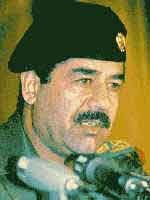  As the United States teeters on
the edge of war, students are left wondering, how did this happen and what are the issues that are pushing us towards war? As the United States teeters on
the edge of war, students are left wondering, how did this happen and what are the issues that are pushing us towards war?
The conflict began in 1990 when Iraq invaded Kuwait, a small country to its south. Saddam Hussein perpetrated this aggression to gain a
seaport to export Iraqi oil. The United Nations then imposed economic sanctions to "bring the invasion and occupation of
Kuwait by Iraq to an end." These sanctions were the first of many to be placed on Iraq by
the U.N., and prohibited all imports into Iraq except for medical aid and banned all exports from Iraq.
In the beginning of 1991, the U.S. stepped in with military action and launched a 43
day air-and-ground war on Iraq with the intent to rid Kuwait of all Iraqi forces. The Gulf
War, as this action became known, was short lived. By March Kuwait was freed and Iraq was devastated. A U.N. mission to Iraq reported "most means of modern life
support...destroyed or rendered tenuous."
Shortly after the Gulf War, the U.N. put into effect Resolution 687 which created a list
of obligations that Hussein could meet in order for the sanctions to be lifted. This
resolution included destroying all of Iraq's chemical, biological and long-range weapons to
ensure the safety of its neighbors, and an acceptance of liability for all war-related damages.
Before the invasion of Kuwait and the resulting sanctions, Iraq was "among the
most...generous [countries] in the Arab world." Iraqis enjoyed the highest per capita food
availability in the region; there were over 250 hospitals with 93 percent of all citizens having
access to health services. Nearly all urban residents and 72 percent of rural residents had access to clean water supplies.
By not destroying its aggressive weapons, Hussein placed Iraq under the sanctions
and deprived it of the foreign currency it needed to provide adequately for its citizens due
to its noncompliance with U.N. regulations. Almost 70 percent of Iraq's food supply was
imported. Bombing had devastated the civilian infrastructure causing a major public health
crisis. The loss of electricity caused the collapse of water and sanitation systems, which
resulted in a lack of clean drinking water and widespread illness. In short, Iraq was
destroyed, and reconstruction was looking grim. At any time, however, Hussein could have given up his weapons of mass destruction and set his people back on the road to
prosperity.
Jan. 1997, the U.N. developed an "oil for food" program that gave Iraq the
opportunity to obtain limited amounts of humanitarian supplies. This program helped, but
due to the tight restrictions made by the U.N. (restrictions caused by Hussein's lack of
cooperation with previous sanctions) Iraq's infrastructure still was not able to recover. The program failed to resolve Iraq's problems.
The original coordinator for the "oil for food" program, Denis Halliday, resigned in
1998 in protest of the program saying, "4000 to 5000 children are dying unnecessarily every month due to the impact of sanctions because of the breakdown of water and
sanitation, inadequate diet and the bad internal health situation." His successor, Hans von
Sponeck, resigned in 2000 calling the situation in Iraq "a true human tragedy."
Throughout this entire period, U.N. inspectors had remained in Iraq conducting
weapons inspections. However, the inspectors were hampered by the efforts of Iraqi officials to conceal information and deny access to important areas. The weapons
inspectors also faced charges of spying for the U.S. However, this situation began to change in Dec. 1998, when the U.S. launched a 70-hour bombing campaign known as
Operation Desert Fox, which marked the end of U.N. weapons inspections. The inspectors were withdrawn just before the bombing began and were refused re-entry into Iraq.
In May 2002, the U.N. Security Council adopted Resolution 1409 which aims to
loosen the sanctions already placed on Iraq, giving them the ability to obtain civilian goods
while still restricting their ability to acquire or produce weapons of mass destruction.
However, the Iraqi government continued to violate U.N. resolutions and to fire upon U.S.
and British forces patrolling the "no fly zone" established after the Gulf War.
The most recent resolution passed by the United Nations has heated up the
international scene putting the spotlight back on Iraq. Nov. 2002, the U.N. passed
Resolution 1441 which found Iraq in violation of the previous contracts which called upon Hussein to comply with weapons checks by U.N. inspectors. Now, Resolution 1441
gives Iraq one last chance to work with the U.N. to destroy all chemical, biological and
long-range weapons, and admit U.N. inspectors into Iraq with full access to assure that the
country complies with the resolution. The U.N. has given fair warning to Iraq stating "that
the Council has repeatedly warned Iraq that it will face serious consequences as a result of its continued violations of its obligations."
On the basis of 1441 the current round of inspections has been taking place. Chief
inspector Hans Blix has most recently noted that Iraq has been uncooperative and less than
forthcoming. President Bush has called upon the U.N. Security Council to form a coalition to force Iraq's compliance in destroying its chemical and biological weapons and
long-range missiles.
France, Germany, Russia and China have led the opposition to the U.S. and its
supporters Great Britain and Spain, insisting on more time for weapons inspections. On
Mon., Feb. 24 the U.S. and its coalition presented a follow-up resolution to 1441, which
states that Iraq "has failed to take the final opportunity afforded to it." This does not
expressly mean war, but the threat is imminent. Russia and other opponents to the U.S. do
not feel the resolution has enough support to pass, and France and Russia still hold their
vetoing powers. However, the matter is far from resolved. As the Speculator goes to press, war remains on the horizon. |
|