|
|
|
|
|
Photo courtesy of Time magazine
|
|
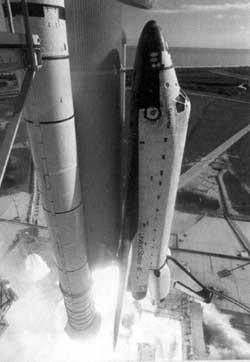
The Columbia space shuttle lifts off for the last time Jan. 16.
|
|
|
|
By Sarah Callicutt
Staff Writer
|
|
On the morning of Feb. 1, between 9:00 and 9:15 a.m., the space shuttle Columbia broke apart in the sky above Texas. Seven
astronauts, six Americans and one Israeli lost their lives in the fiery disaster.
Communication between Columbia's crew
and Ground Control was first lost at 9:00 a.m., after abnormal temperature readings were indicated in the left wing and landing gear. In addition to communication, NASA
lost data and tracking links with the shuttle. Minutes later, residents across eastern Texas heard a sound similar to a loud explosion and
saw the shuttle disintegrate into balls of fire as it streaked across the sky. The break-up left a field of debris scattered across eastern Texas to Louisiana.
In the weeks since the disaster, NASA officials have worked closely with several government agencies and the public to
discover the cause of this mysterious national tragedy. Besides NASA's own internal investigation, an independent Columbia Accident Investigation board has been assembled
to conduct an inquiry into the cause of the catastrophe. The board is composed of members of the U.S. Air Force and Navy, the Federal Aviation Administration, the
Department of Transportation, and other experts in fields related to space travel and manned flight.
The main objective of this committee is to "determine the facts, as well as the actual or
probable causes of the Shuttle mishap in terms of dominant and contributing root causes...Obtain and analyze whatever facts, evidence, and opinions it considers
relevant...Develop recommendations for preventative and other appropriate actions... and
provide a final written report...which upon its completion will be immediately released to the public" (www.nasa.gov).
Currently, several scenarios which may be responsible for the calamity are under
investigation. The most recent theory surrounding the shuttle failure asserts that damage to
the left wheel-well allowed superheated gas, or plasma, to breech the hull, causing the
fragile Columbia to break apart upon re-entry. Although the outer surface of the shuttle is
sheathed in protective thermal blankets and ceramic tiles, the interior of the wheel well is made of aluminum, which melts at about 1,220 degrees Fahrenheit.
The shuttle traveled at a speed of about 12,500 mph, 207,135 ft above the earth when
the disintegration began to occur. At this point during re-entry, the high speed of the shuttle
creates friction against the gasses, which compose the atmosphere surrounding earth. This friction heats the exterior of the shuttle to temperatures exceeding 3000 degrees
Fahrenheit. Temperatures outside the shuttle peaked as Columbia crumbled over Texas.
Due to the timing of the breakup, a possible breach of the heat-absorbing tiles is also
under investigation. "Losing a single tile can do you in...Once you have lost the first tile, the
adjacent ones become much more vulnerable," warned Elisabeth Pate-Cornell, an engineer and risk-management specialist who has formerly led NASA studies on tile failures.
Officials are also considering other factors: damage occurring during liftoff, space
debris collisions, and the effects of age on the orbiter-all may have contributed to the
disaster. The theories surrounding failure of the heat shield or an explosion in the left wheel
well are supported by evidence of damage which may have occurred to the outside of the
shuttle during liftoff. Videotapes of the launch show two large pieces of insulating foam
falling from the external fuel tank and striking the left wing side of the orbiter. Foam fell
from the tank and struck shuttles on previous launches, but the small pieces never caused
significant damage. However, the fragment that fell and collided with Columbia Jan.16 was
the largest to date. The piece was calculated to measure 20 in. by 10 in. by 6 in. and weigh two and a half pounds.
NASA officials analyzed tapes of the liftoff and determined that any damage caused by
the debris should not have caused any problems during the mission, re-entry, or landing. However, in an email from NASA Safety Engineer Robert H. Daugherty to NASA
officials, Daugherty said that if tiles had been damaged during lift off, they could possibly
fail during the extreme heat of re-entry, causing the tire of the left landing wheel to explode.
"It seems to me that with that much carnage in the wheel well, something could get screwed
up enough to prevent deployment and then you are in a world of hurt...it would almost
certainly blow the door [of the wheel well] off the hinges or at least send it out into the slip
stream-catastrophic," cautioned Daugherty. However, he also mentioned that he was,
"admittedly erring way on the side of absolute worst-case scenarios, and I don't really believe things are as bad as I'm getting ready to make them out."
A collision with space debris is also another possible cause involved with the disaster.
During Columbia's first full day in orbit, an object was tracked moving slowly away from
the shuttle. This object could have been a piece of space junk, or a very small meteoroid which struck and then moved away from the shuttle. However, it could also have been a
routine waste dump or ice buildup although neither of these things was reported by Columbia at the time.
Age may also be a contributing factor, considering that Columbia had made 28
previous space flights, and was the oldest in a fleet of four shuttles. Although each is subjected to minute safety inspections prior to every launch and undergoes maintenance
and updates every three years, wear and tear could have accumulated.
For now, the true cause of the tragedy will remain shrouded in mystery. Until a
conclusive report is issued in the following weeks by the independent review committee, America, Israel, and the world grieve over the inexplicable loss of seven individuals.
The Columbia's mission, STS-107, scheduled to take place over 16 days in space
orbit, was dedicated to physical, life, and space science research. The crew consisted of Commander Rick D. Husband, Pilot William C. McCool, Payload Specialist Michael P.
Anderson, Mission Specialists Kalpana Chawla (the first female Indian astronaut), David M. Brown, Laurel B. Clark, and Payload Specialist Ilan Ramon. Ramon was the first
Israeli astronaut, and due to current world affairs, many people's first thoughts turned to
terrorism as a possible cause of the disaster. NASA and government officials determined
that there was no terrorist involvement, especially with heightened security surrounding the mission due to Ramon's presence.
Remains from all seven astronauts were identified among debris scattered across Texas
and Louisiana. For the time being, the entire shuttle fleet has been grounded. The government hopes to restore the space program to normal operation as soon as possible
so that space exploration can be continued in honor of the astronauts who lost their lives.
The accident also served as a wake up call to many Americans who had come to take
the risks space travel for granted and revived chilling memories of the ill-fated Challenger for those who lived through it.
President Bush also supports NASA in the continuation of the shuttle program and the
operation and construction of the International Space Station. As soon as he was informed
of the catastrophe, the President returned from Camp David to the White House, where he promptly addressed the nation. He also spoke at a memorial service at the Johnson Space
Center in Houston, TX for the fallen astronauts held on Feb. 4.
As the nation continues to mourn the loss of seven men and women who slipped the
bonds of earth, many find comfort in the words of the President:
"Farther than we can see there is comfort and hope. In the words of the prophet
Isaiah, 'Lift your eyes and look to the heavens. Who created all these? He who brings out
the starry hosts one by one and calls them each by name. Because of His great power and mighty strength, not one of them is missing.' The same Creator who names the stars also
knows the names of the seven souls we mourn today. The crew of the shuttle Columbia did not return safely to Earth; yet we can pray that all are safely home. May God bless the
grieving families, and may God continue to bless America." |
|