|
|
|
|
El
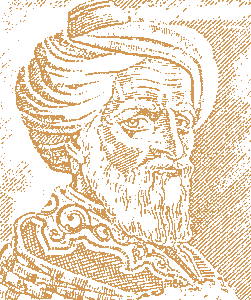
Zahrawi (Albucasis) - father of surgery
Almost
a thousand years ago at a time when Spain (Andulesia)
was part of the Islamic empire, there lived near the
capital city of Cordoba one of the great, but now
largely forgotten, pioneers of surgery. He was known
as El Zahrawi, though in European languages his name
is written in over a dozen different ways: Abulcases,
Albucasis, Bulcasis, Bulcasim, Bulcari, Alzahawi,
Ezzahrawi, Zahravius, Alcarani, Alsarani, Aicaravi,
Alcaravius, Alsahrawi etcEl Zahrawi is believed to have been
born in the city of El-Zahra, six miles northwest of
Cordoba, sometime between 936 and 940. It was here
that he lived, studied, taught and practised
medicine and surgery until shortly before his death
in about 1013, two years after the sacking of El-Zahra
Because El-Zahra was pillaged and
destroyed, little is known about its illustrious son
El Zahrawi. He was first mentioned by the Andalusian
scholar Abu Muhammad bin Hazm (993-1064), who listed
him among the great physician- surgeons of Moorish
Spain. The first known biography of El Zahrawi,
however, appeared in al-Humaydi's Jadhwat al-Muqtabis
(On Andalusian Savants), completed six decades after
El Zahrawi's death
It is clear from El Zahrawi's life
history and from his writings that he devoted his
entire life and genius to the advancement of
medicine as a whole and surgery in particular. El
Zahrawi wrote a medical encyclopaedia spanning 30
volumes which included sections on surgery,
medicine, orthopaedics, ophthalmology, pharmacology,
nutrition etc. This book was known as At-Tasrif and
contained data that El Zahrawi had accumulated
during a career that spanned almost 50 years of
training, teaching and practice. He apparently
travelled very little but had wide experience in
treating accident victims and war casualties
In At-Tasrif, El Zahrawi expressed
his concern about the welfare of his students whom
he called "my children". He
emphasised the importance of a good doctor patient
relationship and took great care to ensure the
safety of his
patients and win their trust irrespective of their
social status. El Zahrawi's clinical methods showed
extreme foresight - he promoted the close
observation of individual cases in order to
establish the most accurate diagnosis and the best
possible treatment. He insisted on compliance with
ethical norms and warned against dubious practices
adopted by some physicians for purposes of material
gain. He also cautioned against quacks who claimed
surgical skills they did not possess
At-Tasrif contains many original
observations of historical interest. In it, El
Zahrawi elaborates on the causes and symptoms of
disease and theorises on the upbringing of
children and youth and on the care of the aged and
convalescent. In the section on pharmacology and
therapeutics, he covers areas such as cardiac drugs,
emetics, laxatives, cosmetology, dietetics, materia
medica, weights and measures and drug
substitution
At-Tasrif was translated into Latin
by Gerard of Cremona in the 12th century and
alongside Avicenna's
Canon, played a major role as a medical text in the
universities of Europe from the 12th to the 17th
century AD. Two of El Zahrawi's treatises deserve
special mention. Firstly his 28th treatise, known in
Latin as Liber servitoris de preeparatione
medicinarum simplicium, describes chemical
preparations, tablet making, filtering of extracts
and related pharmaceutical techniques. This treatise
was printed in Venice in 1471 by Nicolaus Jensen |
Perhaps
the most importance treatise is the one on surgery. This
monumental work was the first in Arabic to treat surgery
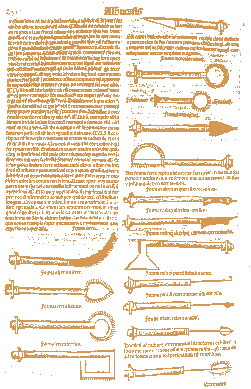
independently and in detail. It included many pictures of
surgical instruments, most invented by El Zahrawi himself,
and explanations of their use. El Zahrawi was the first
medical author to provide illustrations of instruments
used in surgery. There are approximately 200 such drawings
ranging from a tongue depressor and a tooth extractor to a
catheter and an elaborate obstetric device
The variety of operations covered is
amazing. In this treatise El Zahrawi discussed
cauterisation, bloodletting,
midwifery and obstetrics and the treatment of wounds. He
described the exposure and division of the temporal artery
to relieve certain types of headaches, diversion of urine
into the rectum, reduction mammoplasty for excessively
large breasts and the extraction of cataracts. He wrote
extensively about injuries to bones and joints, even
mentioning fractures of the nasal bones and of the
vertebrae. In fact 'Kocher's method' for reducing a
dislocated shoulder was described in At-Tasrif long before
Kocher was born! El Zahrawi outlined the use of caustics
in surgery, fully described tonsillectomy, tracheotomy and
craniotomy- operations he had performed on a dead foetus.
He explained how to use a hook to extract a polyp tiom the
nose, how to use a bulb syringe he had invented for giving
enemas to children and how to use a metallic bladder
syringe and speculum to extract bladder stones
El Zahrawi was the first to describethe
so-called "Walcher position" in obstetrics; the
first to depict dental arches, tongue depressors and lead
catheters and the first to describe clearly the hereditary
circumstances surrounding haemophilia. He also described
ligaturing of blood vessels long before Ambroise Pare
Once At-Tasrif was translated into Latin
in the 12th century, El Zahrawi had a tremendous influence
on
surgery in the West. The French surgeon Guy de Chauliac in
his 'Great Surgery', completed in about 1363, quoted At-Tasrif
over 200 times. El Zahrawi was described by Pietro
Argallata (died 1423) as "without doubt the chief
of all surgeons". Jaques Delechamps (1513-1588),
another French surgeon, made extensive use of At-Tasrif in
his elaborate commentary, confirming the great prestige of
El Zahrawi throughout the Middle Ages and up to the
Renaissance
Selected References
1. Hamareh S K in The Genius of Arab Civilisation
edited by J R Hayes; 2nd edition, 1983; Eurabia
(Publishing) Ltd; pp 198-200
2. El Afifi. S. Kasr El Aini; Journal of Surgery 1960;
I
3. Albucasis; On Surgery and Instruments; English
translation and commentary
by Spink M S and Lewis G L; 1973
|
