Analysis
What is music censorship?
Who are the opponents? What
are the different arguments? How
did the censorship movement become so prevalent today?
What can possibly be done concerning the censorship movement?
This section of the web page answers all of these questions.
1)
The Controversy
Here are lyrics by Fiend, a gansta rapper, and Marilyn Manson, a shock rocker, respectively.
“N**ga
you really f***ed up.
We on a muthaf***in’ mission….
Retaliation is a must
Dumpin rounds on my muthaf***in adversaries.
N**ga, n**ga ridin dirty for revenge”
And
“I
am totalitarian, I’ve got abortions in my eyes
I hate the hater, I’d rape the raper….
F*** it
Hey victim, should I black your eyes again?
Hey victim, you were the one who put the stick in my hand….
Let’s just kill everyone and let your God sort them out.”[1]
Should young kids
be able to hear lyrics such as the above? What
type of influence do the lyrics have on children?
Should there be laws against explicit lyrics?
If so, how is regulation possible without violating the Constitution?
It is conflicting answers to these questions that thrust censorship into
the limelight as the most prominent controversy of the music industry today.
2) The Two Sides
There are two major sides in the controversy
of lyrical censorship. On one side
of the debate we have those in support of censorship.
Certain groups in support of censorship or legal action include the American
Family Association, the Concerned Women for
America, the Gay and Lesbian Alliance Against
Defamation, Artists for a Hate Free America, Parents’ Music Resource
Center on Music Lyrics, some members of the federal
government, many teachers, and mothers, just to name a few.
Conversely, the main opposition to censorship are the artists, represented by
the Recording Industry Association of America.
Believing in the same cause are numerous fans such as the ROC
Organization, the Constitution,
the National Campaign for Freedom of Expression, the People
for the American Way, the Massachusetts Music Industry
Coalition, and many more.
The main role of the government is to represent the people and carry out popular
laws. The RIAA's maintains an “uncompromising stand against censorship and for the First Amendment rights of
all artists to create freely.”[2]
Numerous bills have been proposed by the US Senate to
instate censorship, or improve the current content labeling systems.
At present, the music industry self-instated a voluntary
labeling system. The
labeling system has come under
much scrutiny because of many reasons that will be talked about later in this
page.
3) Arguments and Rational of Both Sides
Both sides
have numerous and extremely strong arguments.
With such strong points, it is easy to see how a solution has yet to
come.
|
The
arguments against censorship: |
Arguments
for censorship: |
|
a)
“Congress shall make no law respecting an establishment of religion, or
prohibiting the free exercise thereof; or abridging the freedom of speech,
or of the press; or the right of the people peaceably to assemble, and to
petition the Government for a redress of grievances." b)
“Speech that is neither obscene as to youths nor subject to some other
legitimate prescription cannot be suppressed solely to protect the young
from ideas or images that a legislative body thinks unsuitable for
them.” Erznoznik
v. City of Jacksonville[4]
c) If
the United States government labels music, then what is stopping the
placement of similar labels on other forms of artwork, such as paintings,
books, newspapers, and perhaps even political debates?
The point is that there is a line that must be drawn as to where
restrictions can be implemented. d) Voltaire’s defense of free speech: “I disapprove of what you say, but I will defend to the death your right to say it.”[5] e) The
Constitution doesn’t start at age 18. f)
Blaming the recording industry is an easy scapegoat.
Rather than looking for a solution, it is easier to point a finger. g)
The music doesn’t create the problems, yet is a reflection of them.
We must understand that the actual problem is much larger, and
deals with violence, drugs, and underage sex being far too prevalent in
our society, not just the music. h)
Lyrics are often misinterpreted or are said to prove a point.
The latter is what Eminem claims to be his reason for explicit
lyrics in a personal
interview. i)
All music is not intended for everyone.
It should be the parents’ responsibility to oversee this. If the government begins to censor music, what they are
really doing is taking away reasonability from the parents. This creates relationships that are more out of touch. j)
The RIAA has put out
voluntary, uniform labels on music containing explicit lyrics. k)
Elvis was thought to be on the edge, and now he is on a postage stamp.
Jimi
Hendrix was thought to be radical, and now he is in the music hall of
fame. l)
Every generation rebels against their parents.
It is only natural. Music
is the story of the generation. m)
Censorship often targets
certain groups, in this case African Americans. n)
The topic of censorship is upon us now mainly because of recent teen
violence. Public policy
should not be made in times of distress and chaos. o) If
you don’t like it, don’t listen. |
a) The
youth of our country should not be exposed to the content of some lyrics. b) Children are easily impressionable at that age and do not make mature
decisions. c) A statement made by
Debbie Pelley, a teacher at Westside Middle School in Jonesboro,
Arkansas tells how she believes the school shootings were influenced by
music. She says that Mitch,
the twelve-year-old murderer, was self-admittedly influenced by gangsta
rap. An investigation was
launched and it was found that he loved music that talked constantly about
murder and violence. d) Numerous reports show how easily obtainable music of all types is. e) The only information provided to parents is a little, inadequate “Explicit
Content” label on a front corner of a CD. f) Some
artists can’t handle the responsibility of having the freedom of speech. g)
Record
companies deliberately target young adolescents in order to sell more
copies. h) Artists, such as Marilyn Manson,
will oftentimes use shock in their lyrics to sell a maximal amount. i) The artists that top
the charts are the ones who use these types of lyrics.
Common themes involve sex, drugs, and violence.
Eminem
is one of the most popular rappers. He
constantly bashes gays, talks about torturing and killing his wife, and
how his mother abuses drugs. j)
Explicit lyrics labels
are used to promote a CD, or some are kept off when they should be on it.
It is all marketing strategy. k) There are stats that prove teen
violence, suicide, drug use, and sexual activity have all been on the
rise. Doesn’t it make sense
that the catalyst promoting such ideals is to blame? l) Shock Rocker Marilyn
Manson tears pages out of the Bible and throws a puppy into the crowd
and won’t sing until it is dead.
|
4) Flaws and Contradictions in Both Arguments
The major flaw in the argument in favor of censorship is that the first amendment is ever present. Whatever one says, he or she still possesses the right to free speech. Freedom is the central theme that the US was founded on, and subsequently, I cannot foresee total censorship ever happening. Another flaw in both sides is that they remain divided. Those opposing censorship are mainly artists who want to preserve their right of free speech. But there exists a few musicians that formed Artists for a Hate Free America. AHFA disapprove of their fellow musicians. Similarly, those advocating censorship are also divided. Mostly it is parents and teachers who support censorship. But there are always numerous parents and private citizens who are very against censorship, such as members of The Roc, a web based organization. The major point hurting the anti-censorship movement is that younger and younger audiences are listening to explicit music. Undoubtedly, some children will be affected.
5) Similarities between the Two Arguments
The main similarity between the arguments is that they both have America’s best
interest at heart. But it is this best interest that is disputed. Both
sides have formed various organizations to back up their arguments.
Both sides use the power and size of these organizations to try to
influence elected officials. Both
sides think they know what America needs.
Also, both sides contain members that believe so strongly about their position, they are not
able to constructively listen to the oppositions points.
6) Past Ways Others have Attacked the Problem
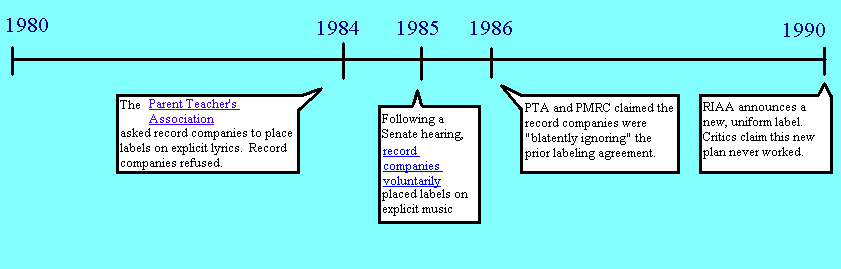
The people in favor of censorship have fought hard for it and failed to bring it
about. Here is a timeline of what they have tried
to do:
Those opposed to censorship have:
-Created anti-censorship mailing lists, web
pages, and magazines.
-Organizations have tried to inform the public about an oppressive government.
7) Why Neither Side has Won Yet
Because freedom of speech is an amendment to the US
Constitution,
total censorship will never exist in America.
Therefore, music will never be fully censored.
Also, aside from parental censorship, the only Constitutionally-compliant
method to regulate explicit lyrics
is basically voluntary action by the record companies.
Sufficient voluntary labels are not likely, for they would prove disastrous
to record sales. The RIAA does everything with marketing strategies in mind, but actually
has a sound argument. As more and more
parents sample the lyrics that their children hear, the concerned parents keep
bringing this issue to our attention. The
idea of music censorship has been in America since it’s creation.
Because of concerned parents and the first amendment, it is here to stay.
For thoughts on what the future holds, visit my Implications
Page.
8) A Solution
The record companies are not obligated to label their products. Because a sufficient labeling system will never be self-instated, I am in favor of finding another approach for a solution. I believe all companies who sell records with explicit lyrics should post the lyrics on their web site. Additionally, the government should run public service announcements to inform parents on what their kids may be listening to. This issue shouldn’t be about what artists can say, but rather who may listen to it. Something must be done so children cannot hear this music. But censorship is not the key. Parental involvement in children’s lives is. The government can’t put labels on the music, but they can inform the parents. It is these informed parents who can "parentally censor" the music of their child. To see the details of my plan, please visit my Theory Page.
[Home] [Analysis] [Essay] [Theory] [Implications] [Links] [Censorship Watch] [Classmate's Sites] [Music Lyrics] [About Me]
[1] United States. Congress. Senate. Committee on Commerce, Science, and Transportation. Labels and lyrics: do parental advisory labels inform consumers and parents? : hearing before the Committee on Commerce, Science, and Transportation, United States Senate, One Hundred Fifth Congress, second session, June 16, 1998. Washington: U.S. G.P.O.: For sale by the U.S. G.P.O., Supt. of Docs., Congressional Sales Office, 2000.
[2] Recording Industry Association of America. (2000). Freedom of Speech. Retrieved December 2, 2000 from the World Wide Web: http://www.riaa.org/.
[3] The US Constitution. (2000). The Bill of Rights. Retrieved December 2, 2000 from the World Wide Web: http://bhorlor.4mg.com/billofrights.html.
[4] United States. Congress. Senate. Committee on Commerce, Science, and Transportation. Labels and lyrics: do parental advisory labels inform consumers and parents? : hearing before the Committee on Commerce, Science, and Transportation, United States Senate, One Hundred Fifth Congress, second session, June 16, 1998. Washington: U.S. G.P.O.: For sale by the U.S. G.P.O., Supt. of Docs., Congressional Sales Office, 2000.
[5] Recording Industry Association of America. (2000). Freedom of Speech. Retrieved December 2, 2000 from the World Wide Web: http://www.riaa.org/.