Latest Updates
Topics:

Smallpox
Plague
Influenza
HIV
Typhus
Emerging Infections
Biological Warfare

Links

Bibliography

This page is updated frequently, check back for new content.
12/23:  Added swine flu section
11/09:  Added Emerging Infections and Expanded Influenza Section
9/17:  Expanded biological warfare section
Breaking News - Updated June 26, 2001
Anthrax in Texas, but...Ranching Goes On Despite Anthrax Threat

Crimean Congo Hemorrhagic Fever in Kosovo


Smallpox a big terrorism worry

Yellow Fever in Peru
Click to Order
Intro
My Homepage
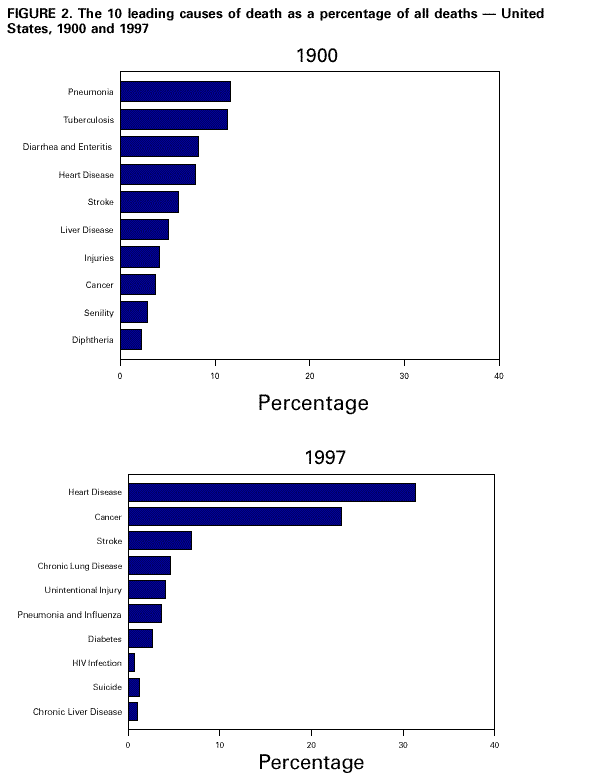
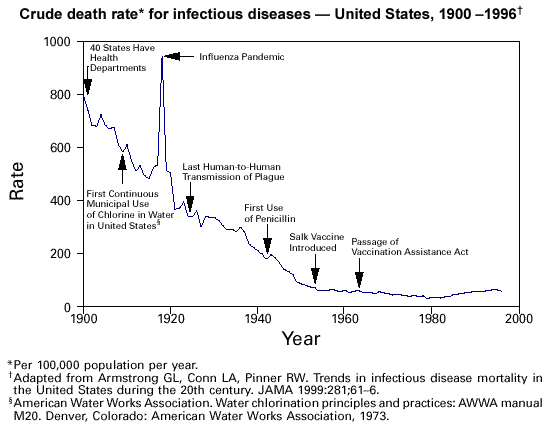
        Throughout history, epidemic diseases have posed the greatest threat to human life.  In 1900, the top three causes of death in the US were infectious diseases, accounting for over 30% of all deathsToday, medical and public health advances have reduced this threat in much of the developed world.  We live our lives today more concerned with the threats of cancer, heart disease, and the debility of aging.  The unifying feature of these conditions is that you must live long enough to develop them.  Prostate cancer, for example, develops primarily in men in their 60's and 70's.  In a population where tuberculosis, smallpox, dysentery, and the plague reduce the life expectancy to 40 or 50 years old you are not likely to see much prostate cancer.  The same holds true for heart disease, Alzheimer's disease, colon cancer, and numerous other "diseases of aging" that seem so rampant today.  The threat of infectious diseases, however, is not gone.
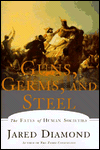
Guns, Germs and Steel: The Fates of Human Societies
Click to Order
Email me
Click to Enlarge
Left:  Declining mortality from infectious diseases since 1900.

Right:  Data on leading causes of mortality in 1900 compared with 1997.  Note that pneumonia, TB, and diarrhea are the three leading causes of mortality in 1900.

Source -
MMWR July 30, 1999 / 48(29);621-629.  Click graphs for larger image
Click to Enlarge
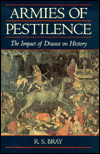
Armies of Pestilence - The Impact of Disease on History
         The third world today resembles the world of our past.  Infectious diseases exact a horrific toll on developing nations in Africa, Asia, and South America.  Here, epidemics of plague, dysentery, cholera, and typhus still are commonplace.  Parisitic diseases are endemic.  Newcomers to the scene such as HIV threaten to reduce the life expectancy in Africa to the 30's or 40's within the decade.  Public health is all but nonexistant and regional warfare creates perfect conditions for the spreat of disease.  As human activity continues to penetrate farther into the jungle we have seen the emergence of new and spectaculary virulent pathogens like ebola. 
          We should not forget the threat of epidemic diseases in our own world either.  Each winter, influenza kills 15 to 20 thousand persons in only a few months.  Staphylococcal infections, once easily eradicated with penicillin, are becoming resistant to even our most advanced antibiotics.  HIV is now a treatable illness to us, but only at an enormous cost to individuals and society.  (Serious side effects complicate most HIV drugs, and the annual cost of effective therapy can run 20 to 30 thousand dollars per year.)  Rogue states and terrorist organizations can easily develop
biological warfare agents for a fraction of the cost of nuclear technology, and the major cities of the West are all but defenseless and woefully unprepared for such an attack.  Finally, modern airtravel places any epidemic in the world a short flight away from New York, Tokyo, London, or Los Angeles.
          The following pages seek to offer a brief and subsequently incomplete history of some particular epidemic diseases.  The goal is to provide the user with an easily accesible source of information on epidemic diseases.  The target audience is physicians, historians, and anyone with an interest in the field if infectious disease.  Much of the information herein is of second or third order, and the history of some diseases is still hotly debated.  References will be given where known, and links to other sources of information will be provided as well.  Where possible, original sources will be used.
Hosted by www.Geocities.ws

1