Smallpox Links
Smallpox Eradication Campaign
WHO recommendations on smallpox research and destruction of virus (requires Adobe Acrobat reader)
Smallpox History
Amherst and the Native Americans
The Edward Jenner Museum Homepage
Timeline of the disease
Site with Good Smallpox photos
....a pestilence of such extent and mortality was nowhere imagined. Neither were the physicians at first of any service, ignorant as they were of the proper way to treat it, but they died themselves the most thickly....
Thucydides - History of the Pelopponesian War
For centuries, smallpox plagued mankind throughout the world. In many
places it behaved as an endemic disease, returning regularly to carry off a
portion of the population, leaving behind a large number of survivors permanently
immune to the disease. In other areas, such as the New World, the disease
was nothing short of devastating. In the Americas smallpox virtually wiped
out Native American populations. The Inca and Maya empires disappeared
from the face of the earth. North American tribes were only slightly better off,
losing up to 90 percent of their peoples in a series of epidemics that swept the
continent clean. This was the major historical impact of smallpox, though the
disease continued to ravage the world until its eradication in 1977.
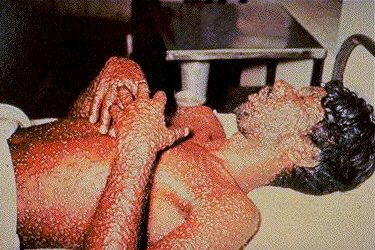
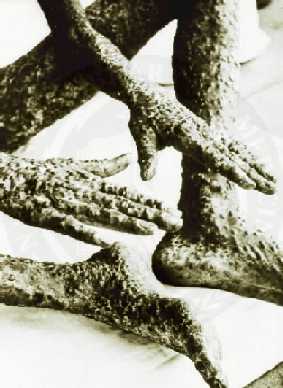
Image of a smallpox victim. Notable are teh extensive pustular lesions over the face, arms, and trunk. Survivors of this severe of an attack would be left severely scarred and possibly blind. A lack of pock-marks on ones face was a sign of beauty in Renaissance England. Severely scarred people had difficulty finding mates and several suicides are recorded from people ashamed of their disfigurement.(1)

Smallpox victim (Source CDC Public Health Image Library)
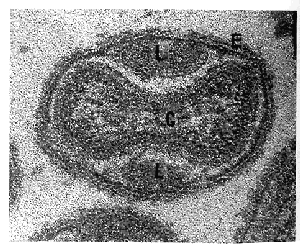
Smallpox is caused by the Variola major virus. A less virulent form is
caused by the closely related Variola minor. Both are moderately contagious
poxviruses, spread by large aerosolized droplets. The germ is very stable in the
environment and can survive long periods of time on clothing and linens.
Infection is acquired by inhaling virus into the lungs. Following an incubation
period of around 1 week, the first symptoms manifest themselves. High
fever, nausea, vomiting, and headache occur initially. This is followed in a
couple of days by red spots forming over the face and torso. This later
spreads to the rest of the body. Over the following days the spots turn to
blisters and pustules. These eventually form scabs that can last for several
weeks. These scabs then fall off, leaving the victim extensively scarred. The
mortality ranges from 20 to 30 percent in this form of the disease. In some
people the early blisters become hemorrhagic, the so called red or black
smallpox. This form is almost uniformly fatal. Variola minor causes a much
milder illness with a mortality of around 1 percent. Apart from the disfiguring
scars, smallpox victims are often left deaf and/or blind from the effects of the
virus.