
Smallpox - Page 2
Ancient History
Smallpox Links
Smallpox Eradication Campaign
WHO recommendations on smallpox research and destruction of virus (requires Adobe Acrobat reader)
Smallpox History
Amherst and the Native Americans
The Edward Jenner Museum Homepage
Timeline of the disease
Site with Good Smallpox photos
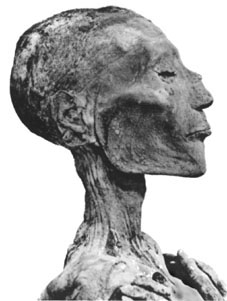
Smallpox is thought to have originated when the earliest civilizations developed, around10 000 BC. The first mention in recorded history can be found as far back as the 14th century BC. The disease was such an influence in Asia that cults of goddess worship sprung up around figures thought to provide protection from the disease. In India the worship of Shitala Mata and in China the worship of a similar goddess was carried out in an attempt to ameliorate the effects of Smallpox. In Egypt, traces of smallpox can be found on the mummified remains of Rameses V. Other Egyptian mummies bear the marks of a bout with smallpox.
In his History of the Peolpponesian War, Thucydides records the Plague of Athens. It is generally agreed that his very detailed descriptions point to Smallpox as the specific disease. He tells of a disease where:
People in perfect health began to have burning feelings in the head; their eyes became red and inflamed; inside their mouths there was bleeding from the throat and tongue, and the breath became unnatural and unpleasant. The next symptoms were sneezing and hoarseness of voice, and before long the pain settled in the chest and was accompanied by coughing. Next the stomach was affected with stomachaches and vomitings of every kind of bile that has been given a name by the medical profession, all this being accompanied by great pain and difficulty. In most cases there were attacks of ineffectual retching, producing violent spasms.... Externally the body was not very hot to the touch, nor was there any pallor: the skin was rather reddish and livid, breaking out into small pustules and ulcers.
Death came on the 7th ot 8th day of symptoms per his description. He also noted the immuniity to reinfection granted to the survivors of this plague. The description given by Thucydides is remarkable given his non-medical background. Curiously absent is any mention of a similar illness in the Hippocratic Corpus. Smallpox devastated the Athenian population, perhaps enough to have played a role in the eventual triumph of Sparta and decline of Athens.
Other ancient civilizations were plagued by recurrent smallpox epidemics. Carried about by invading armies, religious pilgrims, and traders, smallpox was a common occurence throughout the Old World. Around 1000 AD the first attempts at immunization are recorded. In China, practioners performed Variolation on uninfected persons in an attempt to protect them from smallpox. This was accomplished by blowing powdered scabs from a person with a mild case of smallpox up the nose of the patient. This generally resulted in a mild case of smallpox with less scarring that left the patient immune to subsequent infections. Innoculation was another form of this practice, where contents of a smallpox pustule would be injected under the patients skin by means of a sharp stick or lance. Things did not always go as planned, however. Sometimes the patient would contract a fatal case of smallpox or end up so scarred that end result was far from perfect. In the worst cases, variolated patients would form the starting point for a new epidemic that would carry of thousands of victims. Nevertheless, this practice was the most effective means of protection from smallpox for almost a thousand years.

Smallpox in Europe
Smallpox made its first appearance in Europe in the 6th century, AD. Though its effects on the population were severe, with large numbers of children killed by the disease, the effect on the population was not nearly as profound as that of the Black Death. The disease became more or less endemic in Europe, leaving large populations of survivors immune to the disease. The reproductive rate was sufficiently hight that they could easily replace the lost children by having more. (Sounds crass, but it was a different world back then. Even today, high infant mortality is a fact of life accepted with resignation in much of the world.) Occasionally, the disease would disappear for a time, allowing large populations of susceptible people to accumulate, resulting in a large epidemin upon its return. In general though it was a persistent scourge, never causing a sustained decline in European populations but leaving many scarred, blind victims in its wake. The effects of the disease on the royal families of Europe are well recorded in history. In his excellent and extensive review of smallpox, Princes and Peasants: Smallpox in History,(1) D.R. Hopkins catalogs the many rulers and nobles killed or scarred by this disease. Among the notables are Queen Elizabeth I, who survived, and Lois XV of France, who was killed by the disease. Wolfgang Amadeus Mozart had the disease as a child, and to the worlds benefitt survived. I encourage anyone with interest in the history of this disease to read Hopkins' book. (It is out of print, but any good medical library should have it).
Left: Lady Montagu - A smallpox survivor and proponent of variolation (innoculation) in England in the early 1700s. Had her young children innoculated (they survived). By mid-1700s inoculation was widespread in Europe.
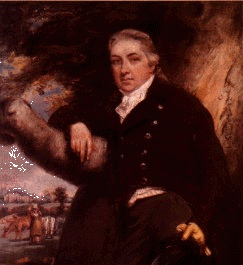
Right: English physician Edward Jenner, "father" of vaccination
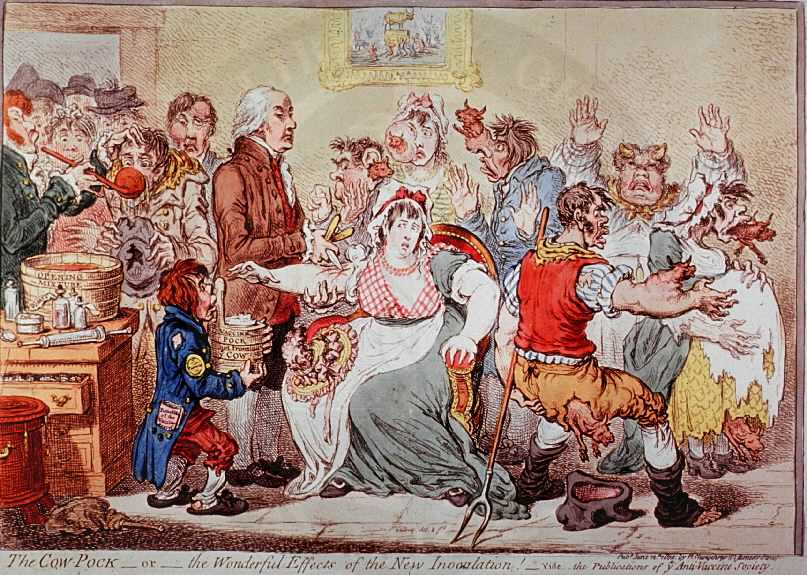
In 1796, English physician Edward Jenner made one of the greatest leaps forward in the history of medicine. He "vaccinated" a young boy with material from a cowpox pustule, and later directly challenged the child with smallpox. The child was immune. This was repeated on 23 other children. Shortly thereafter, vaccination is in wide practice throughout the world.It is debated by some that the idea behind cowpox infection granting immunity to smallpox was known long before Jenner. While this may have been the case, Jenner was the first to publish his findings in the medical literature of the day (though not without opponents within the medical profession and in the press.) Jenner's vaccine eventually made possible the global eradication of smallpox, though the acceptance of his practice was slow. Even today there are those that either through ignorance or malevolence attack the efficacy of vaccines and even the existence of smallpox as a terrible epidemic disease.

email me: [email protected]